let $g(x)=int_{0}^{x}f(t)dt$, where $f$ is the function whose graph is shown below. at what value of $x$…
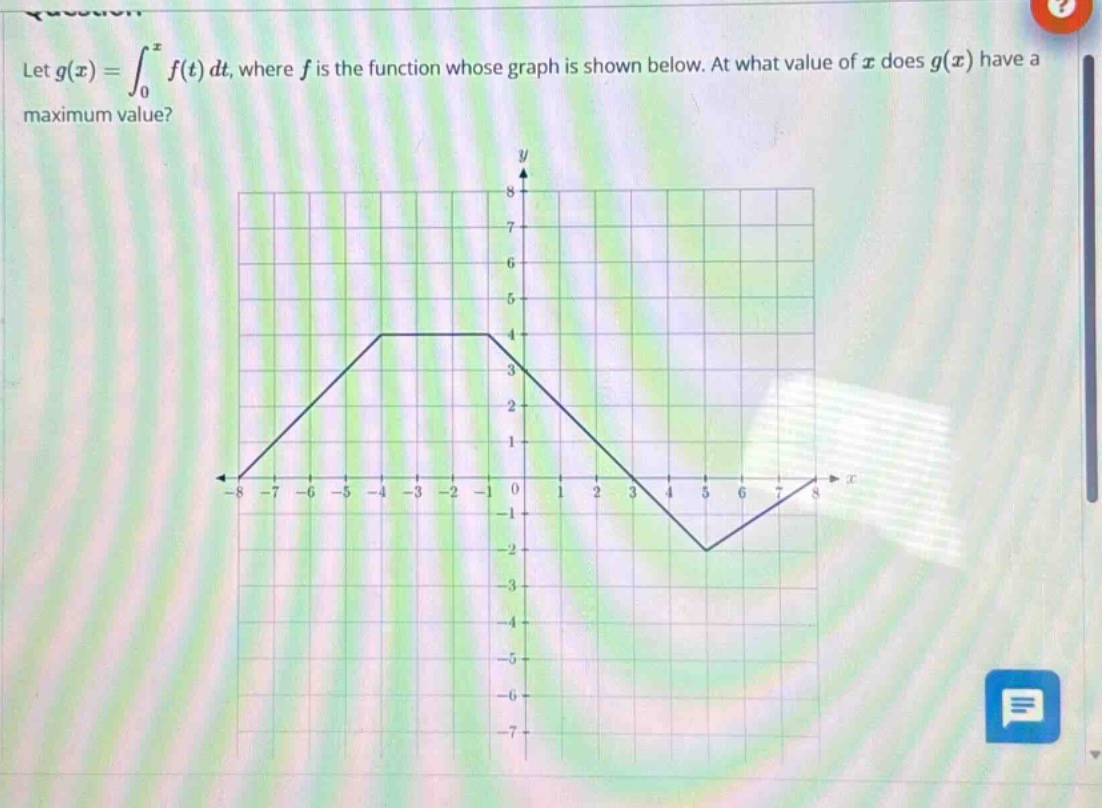
let $g(x)=int_{0}^{x}f(t)dt$, where $f$ is the function whose graph is shown below. at what value of $x$ does $g(x)$ have a maximum value?
Answer
Explanation:
Step1: Define $g(x)$ and its derivative using the Fundamental Theorem of Calculus.
The function $g(x)$ is defined as $g(x) = \int_{0}^{x} f(t) dt$. According to the Fundamental Theorem of Calculus, the derivative of $g(x)$ is $g'(x) = f(x)$.
Step2: Find critical points by setting $g'(x) = 0$.
Critical points of $g(x)$ occur where $g'(x) = f(x) = 0$. From the provided graph of $f(t)$, $f(x) = 0$ at $x = -8$, $x = 3$, and $x = 7$.
Step3: Analyze the sign of $f(x)$ to determine where $g(x)$ is increasing or decreasing.
- If $f(x) > 0$, $g(x)$ is increasing. From the graph, $f(x) > 0$ on $(-8, 3)$ and $(7, 8]$ (assuming the graph ends at $x=8$).
- If $f(x) < 0$, $g(x)$ is decreasing. From the graph, $f(x) < 0$ on $(3, 7)$. This indicates that $g(x)$ has a local maximum at $x=3$ and a local minimum at $x=7$.
Step4: Calculate $g(x)$ at critical points and endpoints of the graphed interval $[-8, 8]$.
$g(x)$ is the net signed area under the curve of $f(t)$ from $t=0$ to $t=x$.
- $g(0) = \int_{0}^{0} f(t) dt = 0$.
- $g(3) = \int_{0}^{3} f(t) dt$: Area from $t=0$ to $t=1$ (rectangle): $A_1 = (1-0) \times 3 = 3$. Area from $t=1$ to $t=3$ (triangle): $A_2 = \frac{1}{2} \times (3-1) \times 3 = \frac{1}{2} \times 2 \times 3 = 3$. $g(3) = A_1 + A_2 = 3 + 3 = 6$.
- $g(7) = \int_{0}^{7} f(t) dt = g(3) + \int_{3}^{7} f(t) dt$: Area from $t=3$ to $t=5$ (triangle below x-axis): $A_3 = \frac{1}{2} \times (5-3) \times (-2) = -2$. Area from $t=5$ to $t=7$ (triangle below x-axis): $A_4 = \frac{1}{2} \times (7-5) \times (-2) = -2$. $\int_{3}^{7} f(t) dt = A_3 + A_4 = -2 + (-2) = -4$. $g(7) = 6 + (-4) = 2$.
- $g(8) = \int_{0}^{8} f(t) dt = g(7) + \int_{7}^{8} f(t) dt$: Area from $t=7$ to $t=8$ (triangle): $A_5 = \frac{1}{2} \times (8-7) \times 1 = 0.5$. $g(8) = 2 + 0.5 = 2.5$.
- $g(-8) = \int_{0}^{-8} f(t) dt = - \int_{-8}^{0} f(t) dt$: Area from $t=-8$ to $t=-4$ (triangle): $A_6 = \frac{1}{2} \times (-4 - (-8)) \times 4 = \frac{1}{2} \times 4 \times 4 = 8$. Area from $t=-4$ to $t=-1$ (rectangle): $A_7 = (-1 - (-4)) \times 4 = 3 \times 4 = 12$. Area from $t=-1$ to $t=0$ (trapezoid): $A_8 = \frac{1}{2} \times (4+3) \times (0 - (-1)) = \frac{1}{2} \times 7 \times 1 = 3.5$. $\int_{-8}^{0} f(t) dt = A_6 + A_7 + A_8 = 8 + 12 + 3.5 = 23.5$. $g(-8) = -23.5$.
Step5: Compare the values of $g(x)$ to find the maximum value.
The calculated values of $g(x)$ are: $g(-8) = -23.5$ $g(0) = 0$ $g(3) = 6$ $g(7) = 2$ $g(8) = 2.5$ The maximum value among these is $6$.
Step6: Identify the value of $x$ at which $g(x)$ has its maximum value.
The maximum value of $g(x)$ is $6$, which occurs at $x=3$.
Answer:
The value of $x$ at which $g(x)$ has a maximum value is $3$.