let ( g(x)=int_{0}^{x} f(t) d t ), where ( f ) is the function whose graph is shown below. at what value of…
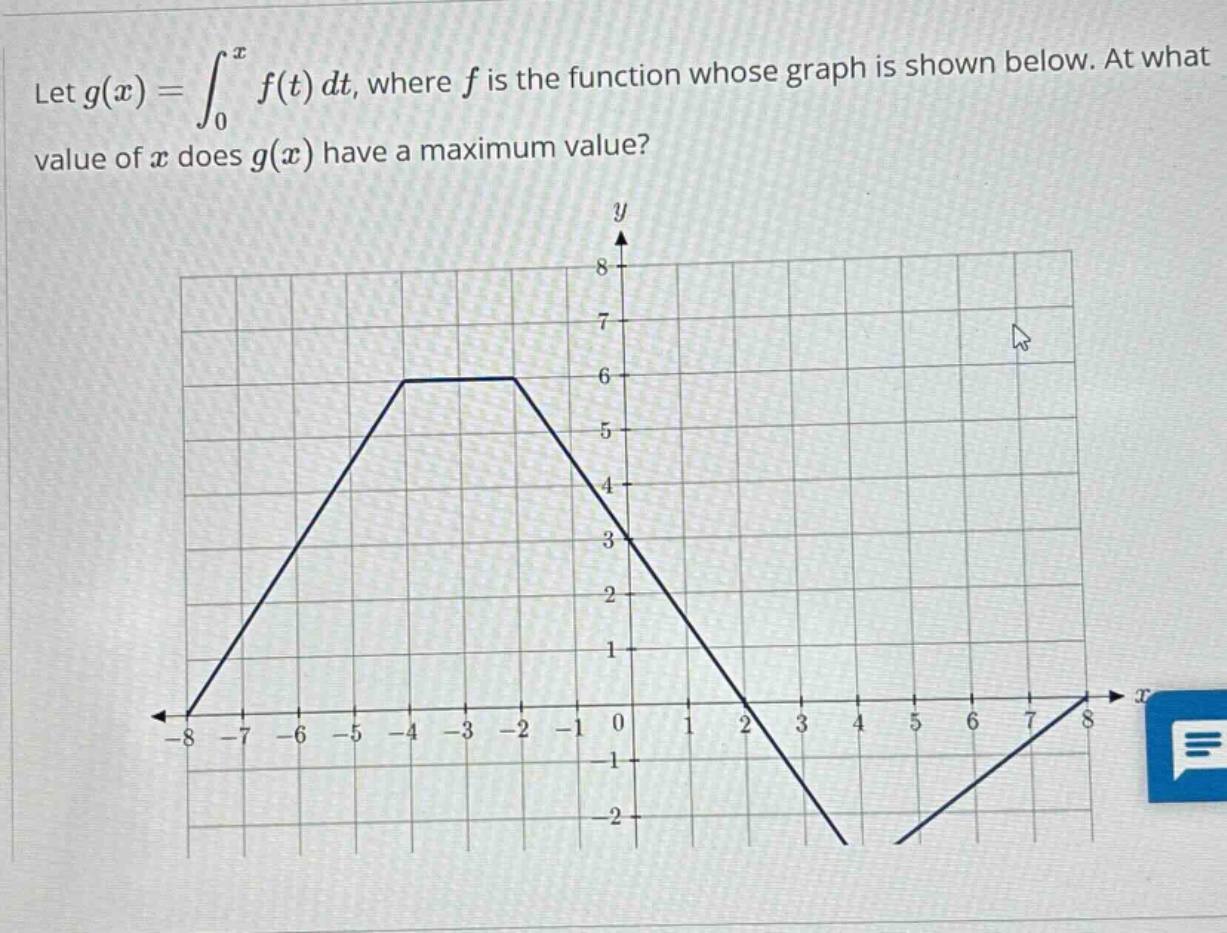
let ( g(x)=int_{0}^{x} f(t) d t ), where ( f ) is the function whose graph is shown below. at what value of ( x ) does ( g(x) ) have a maximum value?
Answer
Answer:
2
Explanation:
Step 1: Apply Fundamental Theorem of Calculus
$g'(x) = f(x)$
Step 2: Analyze sign changes of $f(x)$
$f(x) > 0$ for $x < 2$, $f(x) < 0$ for $x > 2$
Step 3: Identify maximum condition
$g(x)$ increases when $f(x) > 0$ and decreases when $f(x) < 0$, peaking at $x=2$