let lim f(x)=9 and lim g(x)=5. use the limit rules to find the following limit. x→5 x→5 f(x)+g(x) lim x→5…
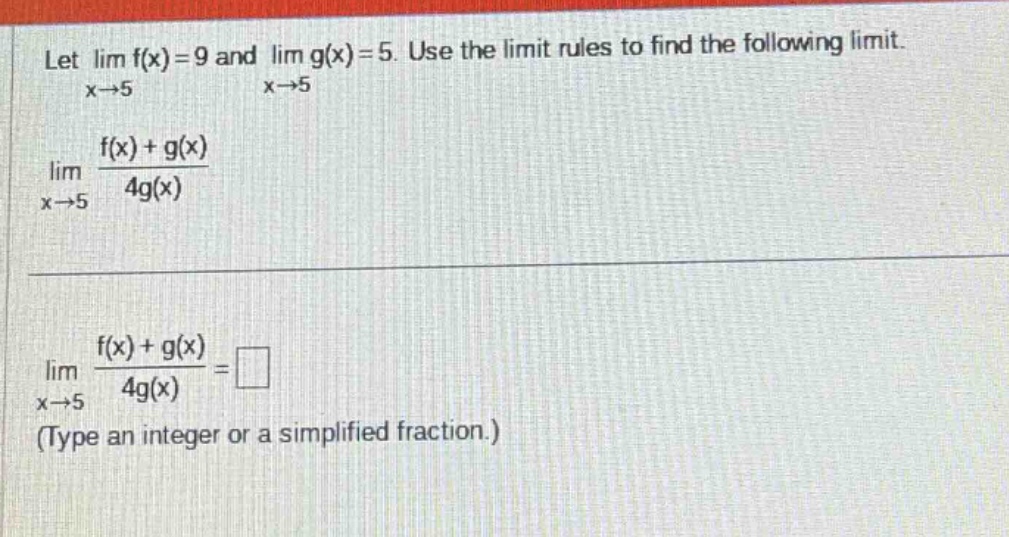
let lim f(x)=9 and lim g(x)=5. use the limit rules to find the following limit. x→5 x→5 f(x)+g(x) lim x→5 4g(x) f(x)+g(x) lim =□ x→5 4g(x) (type an integer or a simplified fraction.)
Answer
Explanation:
Step1: Apply limit - sum and quotient rules
By the sum rule of limits $\lim_{x\rightarrow a}(f(x)+g(x))=\lim_{x\rightarrow a}f(x)+\lim_{x\rightarrow a}g(x)$ and the quotient rule $\lim_{x\rightarrow a}\frac{u(x)}{v(x)}=\frac{\lim_{x\rightarrow a}u(x)}{\lim_{x\rightarrow a}v(x)}$ (where $\lim_{x\rightarrow a}v(x)\neq0$), we have $\lim_{x\rightarrow5}\frac{f(x)+g(x)}{4g(x)}=\frac{\lim_{x\rightarrow5}(f(x)+g(x))}{\lim_{x\rightarrow5}(4g(x))}$.
Step2: Apply constant - multiple rule
The constant - multiple rule of limits states that $\lim_{x\rightarrow a}(cf(x)) = c\lim_{x\rightarrow a}f(x)$ for a constant $c$. So, $\lim_{x\rightarrow5}(4g(x)) = 4\lim_{x\rightarrow5}g(x)$ and $\lim_{x\rightarrow5}(f(x)+g(x))=\lim_{x\rightarrow5}f(x)+\lim_{x\rightarrow5}g(x)$.
Step3: Substitute the given limit values
We know that $\lim_{x\rightarrow5}f(x)=9$ and $\lim_{x\rightarrow5}g(x)=5$. Substituting these values, we get $\frac{\lim_{x\rightarrow5}f(x)+\lim_{x\rightarrow5}g(x)}{4\lim_{x\rightarrow5}g(x)}=\frac{9 + 5}{4\times5}$.
Step4: Simplify the fraction
$\frac{9 + 5}{4\times5}=\frac{14}{20}=\frac{7}{10}$.
Answer:
$\frac{7}{10}$