1. let f(x)=ln(x - 4) be a logarithmic function and let f^(-1)(x) represent the inverse of f(x). which of…
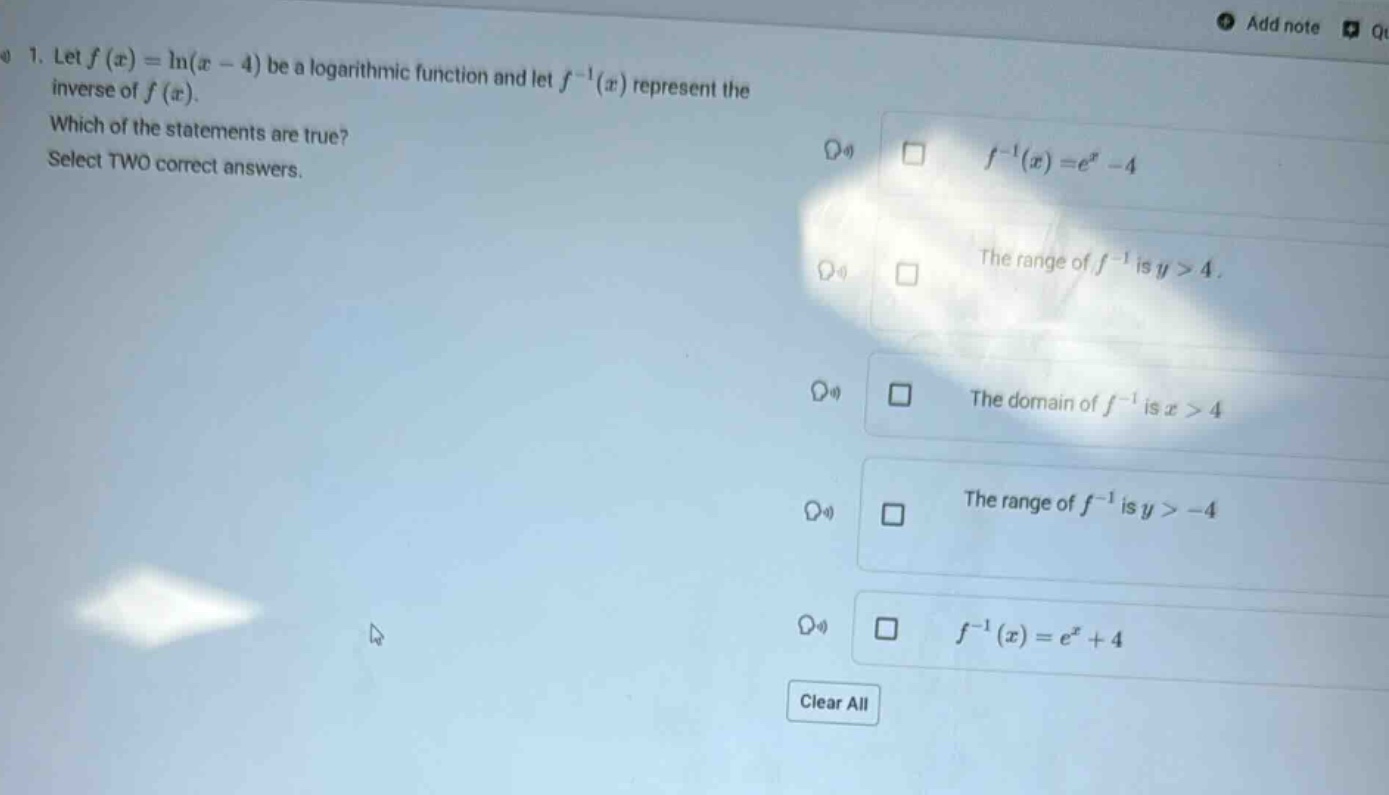
1. let f(x)=ln(x - 4) be a logarithmic function and let f^(-1)(x) represent the inverse of f(x). which of the statements are true? select two correct answers. f^(-1)(x)=e^x - 4 the range of f^(-1) is y > 4. the domain of f^(-1) is x > 4 the range of f^(-1) is y > -4 f^(-1)(x)=e^x + 4 clear all
Answer
Explanation:
Step1: Find the inverse function
Let $y = \ln(x - 4)$. Rewrite in exponential - form: $e^{y}=x - 4$, then $x=e^{y}+4$. Swap $x$ and $y$ to get the inverse function $f^{-1}(x)=e^{x}+4$.
Step2: Analyze the domain and range of the inverse function
The domain of the exponential function $y = e^{x}+4$ is all real numbers, i.e., $x\in(-\infty,\infty)$. The range of the exponential function $y = e^{x}$ is $y>0$, so the range of $y = e^{x}+4$ is $y>4$.
Answer:
The range of $f^{-1}$ is $y > 4$, $f^{-1}(x)=e^{x}+4$