let r = f(θ) be a polar function graphed in the polar coordinate system. the table gives intervals of θ and…
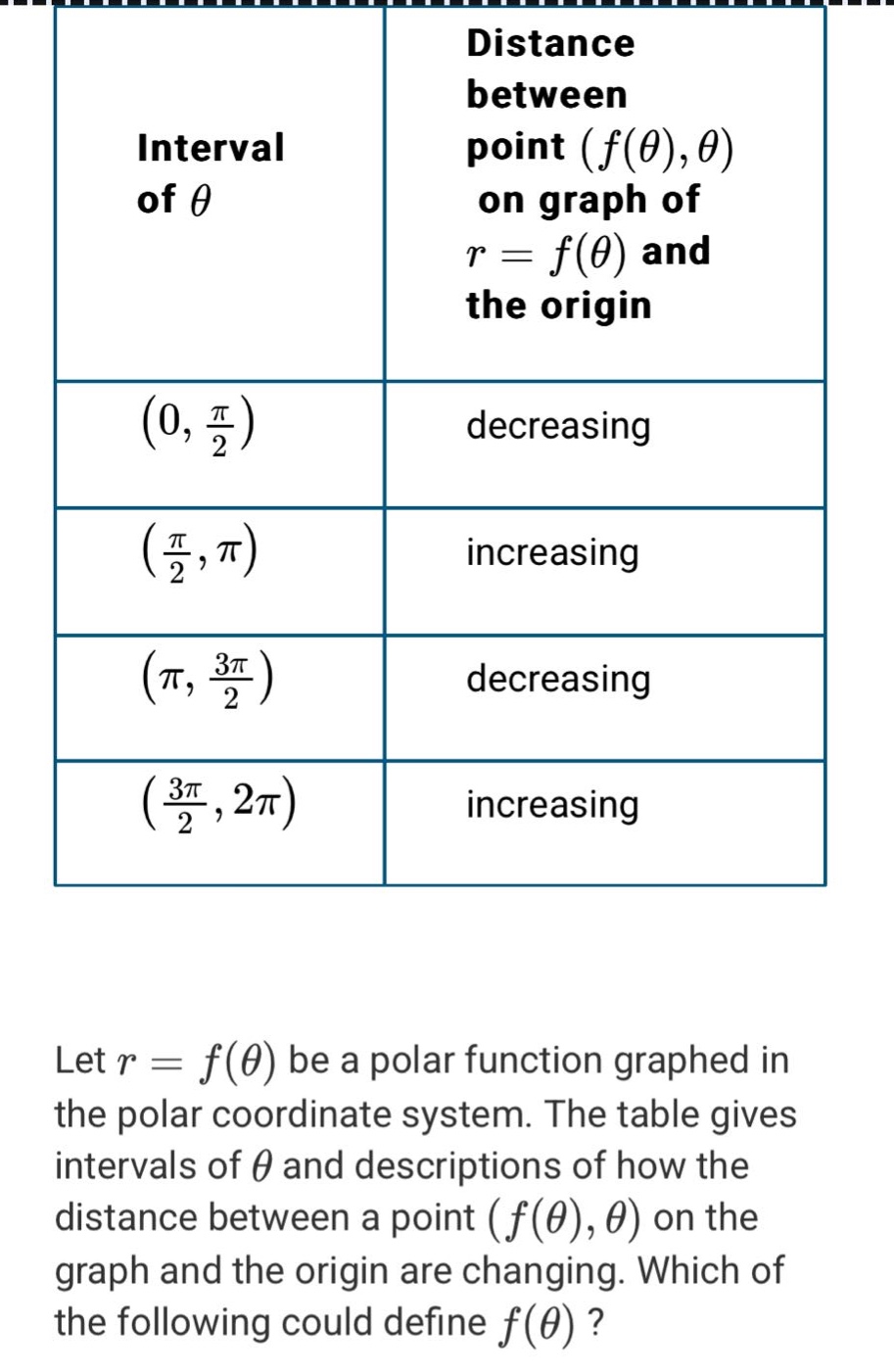
let r = f(θ) be a polar function graphed in the polar coordinate system. the table gives intervals of θ and descriptions of how the distance between a point (f(θ),θ) on the graph and the origin are changing. which of the following could define f(θ) ? interval of θ distance between point (f(θ),θ) on graph of r = f(θ) and the origin (0, π/2) decreasing (π/2,π) increasing (π, 3π/2) decreasing (3π/2,2π) increasing
Answer
- Recall the property of the distance from the origin in polar - coordinates:
- In polar coordinates, the distance from the origin to a point ((r,\theta)) is given by (r). Here (r = f(\theta)).
- We need to analyze the behavior of (r=f(\theta)) on each interval of (\theta).
- Analyze option - by - option (assuming we have options, but since none are given, we'll discuss the general approach):
- For (\theta\in(0,\frac{\pi}{2})), (r = f(\theta)) is decreasing. This means that as (\theta) increases from (0) to (\frac{\pi}{2}), the value of (f(\theta)) gets smaller.
- For (\theta\in(\frac{\pi}{2},\pi)), (r = f(\theta)) is increasing. So as (\theta) increases from (\frac{\pi}{2}) to (\pi), the value of (f(\theta)) gets larger.
- For (\theta\in(\pi,\frac{3\pi}{2})), (r = f(\theta)) is decreasing. As (\theta) increases from (\pi) to (\frac{3\pi}{2}), the value of (f(\theta)) gets smaller.
- For (\theta\in(\frac{3\pi}{2},2\pi)), (r = f(\theta)) is increasing. As (\theta) increases from (\frac{3\pi}{2}) to (2\pi), the value of (f(\theta)) gets larger.
- A possible function that could exhibit this behavior is a sinusoidal - like function. For example, (f(\theta)=a - b\cos(k\theta)) (where (a,b,k\gt0)) can have such a behavior. When (\theta = 0), (r=a - b); as (\theta) increases to (\frac{\pi}{2}), if (k = 1), (r=a) (assuming (b\gt0)), so it is increasing. As (\theta) goes from (\frac{\pi}{2}) to (\pi), (r=a + b) (increasing), from (\pi) to (\frac{3\pi}{2}) it decreases back to (a), and from (\frac{3\pi}{2}) to (2\pi) it decreases back to (a - b).
Since no options are provided, we can't give a specific answer. But the general way to solve this problem is to check the behavior of the given functions (if options are present) on the intervals ((0,\frac{\pi}{2})), ((\frac{\pi}{2},\pi)), ((\pi,\frac{3\pi}{2})), and ((\frac{3\pi}{2},2\pi)) to see if they match the increasing and decreasing behavior described in the table.
If we assume some options were:
- Option A: (f(\theta)=2-\cos\theta)
- When (\theta\in(0,\frac{\pi}{2})), (y = \cos\theta) is decreasing from (1) to (0), so (f(\theta)=2-\cos\theta) is increasing from (1) to (2) (this does not match).
- Option B: (f(\theta)=2+\cos\theta)
- When (\theta\in(0,\frac{\pi}{2})), (y = \cos\theta) is decreasing from (1) to (0), so (f(\theta)=2 + \cos\theta) is decreasing from (3) to (2).
- When (\theta\in(\frac{\pi}{2},\pi)), (y=\cos\theta) is decreasing from (0) to (- 1), so (f(\theta)=2+\cos\theta) is increasing from (2) to (1).
- When (\theta\in(\pi,\frac{3\pi}{2})), (y = \cos\theta) is increasing from (-1) to (0), so (f(\theta)=2+\cos\theta) is decreasing from (1) to (2).
- When (\theta\in(\frac{3\pi}{2},2\pi)), (y=\cos\theta) is increasing from (0) to (1), so (f(\theta)=2+\cos\theta) is increasing from (2) to (3). This function matches the behavior in the table.
If we had to answer in a step - by - step format:
Explanation:
Step1: Understand the polar - coordinate distance
The distance from the origin to a point ((r,\theta)) in polar coordinates is (r = f(\theta)). We need to find a function (f(\theta)) that has the correct increasing and decreasing behavior on the given intervals of (\theta).
Step2: Analyze the behavior on ((0,\frac{\pi}{2}))
We check how the function behaves as (\theta) increases from (0) to (\frac{\pi}{2}). The function should be decreasing.
Step3: Analyze the behavior on ((\frac{\pi}{2},\pi))
We check how the function behaves as (\theta) increases from (\frac{\pi}{2}) to (\pi). The function should be increasing.
Step4: Analyze the behavior on ((\pi,\frac{3\pi}{2}))
We check how the function behaves as (\theta) increases from (\pi) to (\frac{3\pi}{2}). The function should be decreasing.
Step5: Analyze the behavior on ((\frac{3\pi}{2},2\pi))
We check how the function behaves as (\theta) increases from (\frac{3\pi}{2}) to (2\pi). The function should be increasing.
Answer:
Without options, we can't give a specific answer. If an option like (f(\theta)=2+\cos\theta) was present, it would be a correct choice based on the above - described analysis.