let (d) be the region (0leq yleq x) and (0leq xleq 4). evaluate the integral by making the change of…
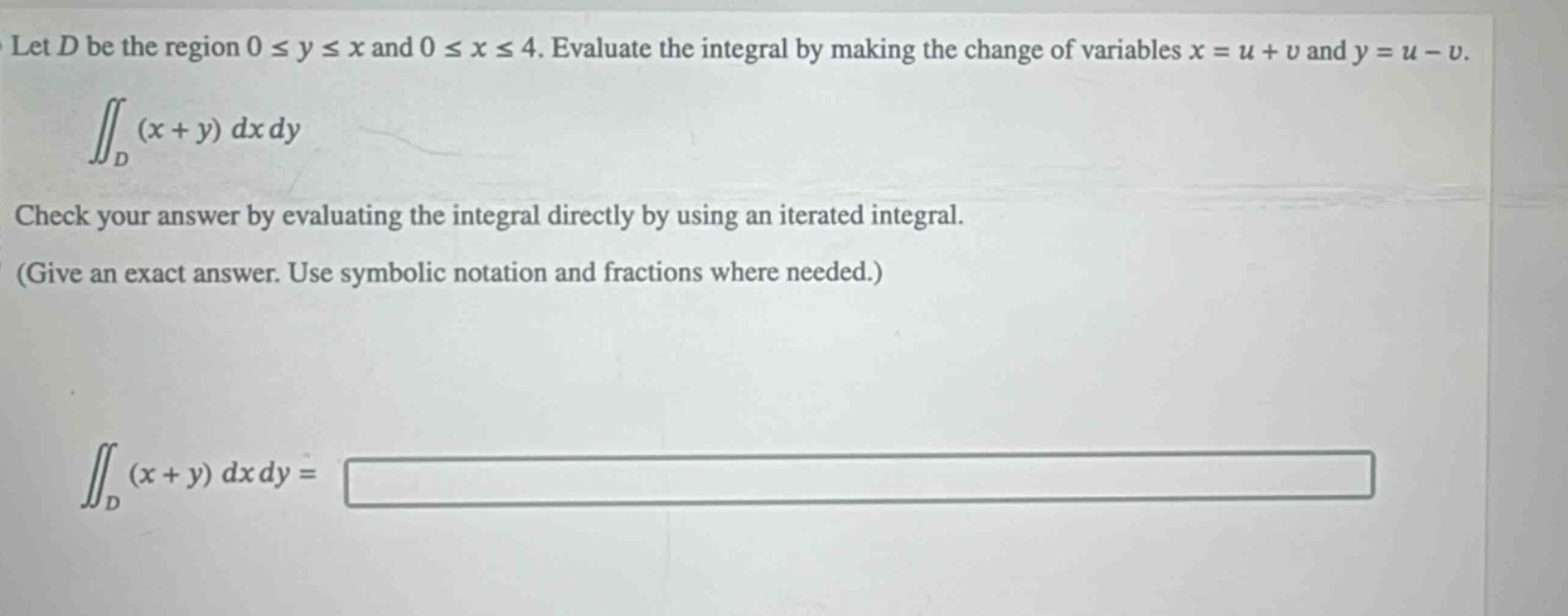
let (d) be the region (0leq yleq x) and (0leq xleq 4). evaluate the integral by making the change of variables (x = u + v) and (y = u - v). (iint_{d}(x + y)dxdy) check your answer by evaluating the integral directly by using an iterated integral. (give an exact answer. use symbolic notation and fractions where needed.) (iint_{d}(x + y)dxdy=)
Answer
Explanation:
Step1: Find the Jacobian
First, find the partial - derivatives. Given $x = u + v$ and $y=u - v$, we have $\frac{\partial x}{\partial u}=1$, $\frac{\partial x}{\partial v}=1$, $\frac{\partial y}{\partial u}=1$, $\frac{\partial y}{\partial v}=-1$. The Jacobian $J=\begin{vmatrix}\frac{\partial x}{\partial u}&\frac{\partial x}{\partial v}\\frac{\partial y}{\partial u}&\frac{\partial y}{\partial v}\end{vmatrix}=\begin{vmatrix}1&1\1& - 1\end{vmatrix}=-1 - 1=-2$, and $|J| = 2$. Also, $x + y=(u + v)+(u - v)=2u$.
Step2: Find the new limits of integration
From $0\leq y\leq x$ and $0\leq x\leq4$. Substitute $x = u + v$ and $y = u - v$. $y\leq x$ gives $u - v\leq u + v$, which simplifies to $v\geq0$. $y\geq0$ gives $u - v\geq0$ or $u\geq v$. $x\leq4$ gives $u + v\leq4$. $x\geq0$ and $y\geq0$ also imply non - negative values for $u$ and $v$. The new region in the $uv$ - plane is $0\leq v\leq u$ and $0\leq u\leq4$.
Step3: Evaluate the integral using the change of variables
The double - integral $\iint_{D}(x + y)dxdy$ becomes $\iint_{D^{*}}2u|J|dudv=\int_{0}^{4}\int_{0}^{u}2u\times2dvdu$. First, integrate with respect to $v$: $\int_{0}^{4}2u\times2\left[v\right]{0}^{u}du=\int{0}^{4}4u\times udu=\int_{0}^{4}4u^{2}du$. Then, integrate with respect to $u$: $4\times\frac{u^{3}}{3}\big|_{0}^{4}=\frac{4\times4^{3}}{3}=\frac{256}{3}$.
Step4: Evaluate the integral directly
The original integral $\iint_{D}(x + y)dxdy=\int_{0}^{4}\int_{0}^{x}(x + y)dydx$. First, integrate with respect to $y$: $\int_{0}^{4}\left[xy+\frac{y^{2}}{2}\right]{0}^{x}dx=\int{0}^{4}\left(x\cdot x+\frac{x^{2}}{2}-0\right)dx=\int_{0}^{4}\left(x^{2}+\frac{x^{2}}{2}\right)dx=\int_{0}^{4}\frac{3x^{2}}{2}dx$. Then, integrate with respect to $x$: $\frac{3}{2}\times\frac{x^{3}}{3}\big|_{0}^{4}=\frac{1}{2}\times4^{3}=\frac{64}{2}\times2=\frac{256}{3}$.
Answer:
$\frac{256}{3}$