let the region r be the area enclosed by the function f(x)=2e^x and g(x)=5x + 2. if the region r is the base…
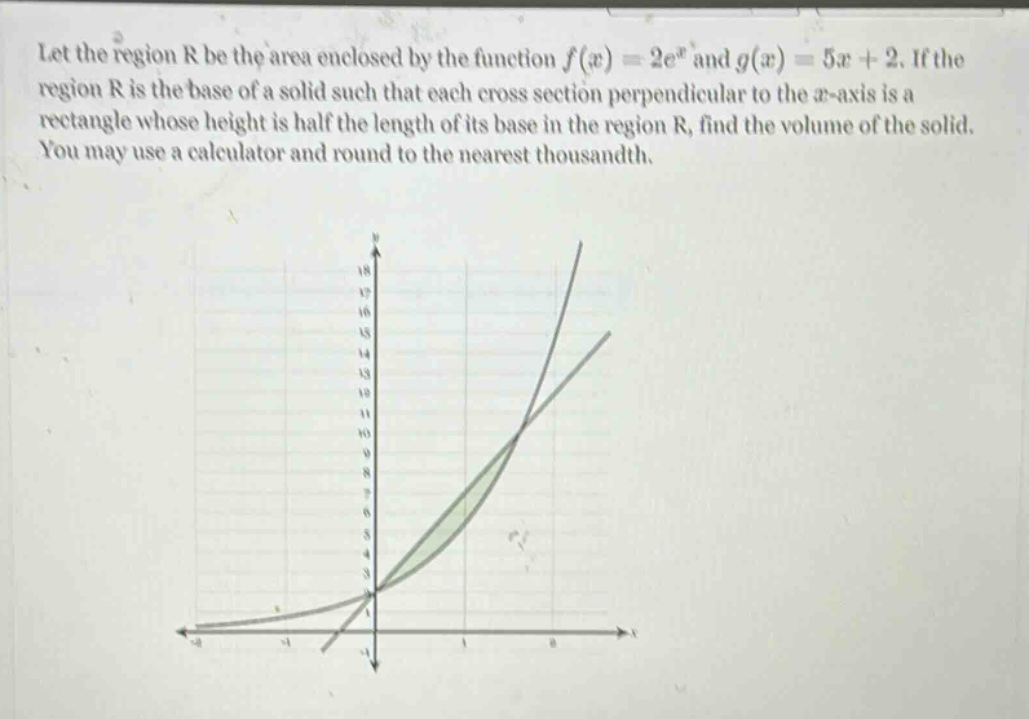
let the region r be the area enclosed by the function f(x)=2e^x and g(x)=5x + 2. if the region r is the base of a solid such that each cross - section perpendicular to the x - axis is a rectangle whose height is half the length of its base in the region r, find the volume of the solid. you may use a calculator and round to the nearest thousandth.
Answer
Explanation:
Step1: Find intersection points
Set $2e^{x}=5x + 2$. Using a calculator, the intersection points are $x = 0$ and $x\approx1.678$.
Step2: Determine base of cross - section
The base $b$ of each rectangular cross - section perpendicular to the $x$ - axis is $b=\vert2e^{x}-(5x + 2)\vert$. Since $2e^{x}\geq5x + 2$ on the interval of interest, $b = 2e^{x}-5x - 2$.
Step3: Determine height of cross - section
The height $h$ of the rectangular cross - section is $h=\frac{1}{2}(2e^{x}-5x - 2)$.
Step4: Set up volume integral
The volume $V$ of the solid using the cross - sectional area formula $A(x)=b\times h$ and integrating over the interval $[a,b]$ is $V=\int_{a}^{b}A(x)dx$. Here, $A(x)=(2e^{x}-5x - 2)\times\frac{1}{2}(2e^{x}-5x - 2)=\frac{1}{2}(2e^{x}-5x - 2)^{2}$, and $a = 0$, $b\approx1.678$. So $V=\frac{1}{2}\int_{0}^{1.678}(2e^{x}-5x - 2)^{2}dx$.
Step5: Expand the integrand
$(2e^{x}-5x - 2)^{2}=(2e^{x})^{2}-2(2e^{x})(5x + 2)+(5x + 2)^{2}=4e^{2x}-20xe^{x}-8e^{x}+25x^{2}+20x + 4$.
Step6: Integrate term - by - term
$\int 4e^{2x}dx = 2e^{2x}+C_1$, $\int-20xe^{x}dx=-20(xe^{x}-e^{x})+C_2$ (using integration by parts $u = x$, $dv=e^{x}dx$), $\int-8e^{x}dx=-8e^{x}+C_3$, $\int25x^{2}dx=\frac{25}{3}x^{3}+C_4$, $\int20xdx = 10x^{2}+C_5$, $\int4dx = 4x+C_6$.
Step7: Evaluate the definite integral
$V=\frac{1}{2}\left[2e^{2x}-20(xe^{x}-e^{x})-8e^{x}+\frac{25}{3}x^{3}+10x^{2}+4x\right]_{0}^{1.678}$. $V=\frac{1}{2}\left[\left(2e^{2\times1.678}-20(1.678e^{1.678}-e^{1.678})-8e^{1.678}+\frac{25}{3}(1.678)^{3}+10(1.678)^{2}+4(1.678)\right)-\left(2e^{0}-20(0\times e^{0}-e^{0})-8e^{0}+\frac{25}{3}(0)^{3}+10(0)^{2}+4(0)\right)\right]$. Using a calculator: $V\approx10.377$
Answer:
$10.377$