let the region r be the area enclosed by the function f(x)=2x^(1/3) and g(x)=(1/2)x. if the region r is the…
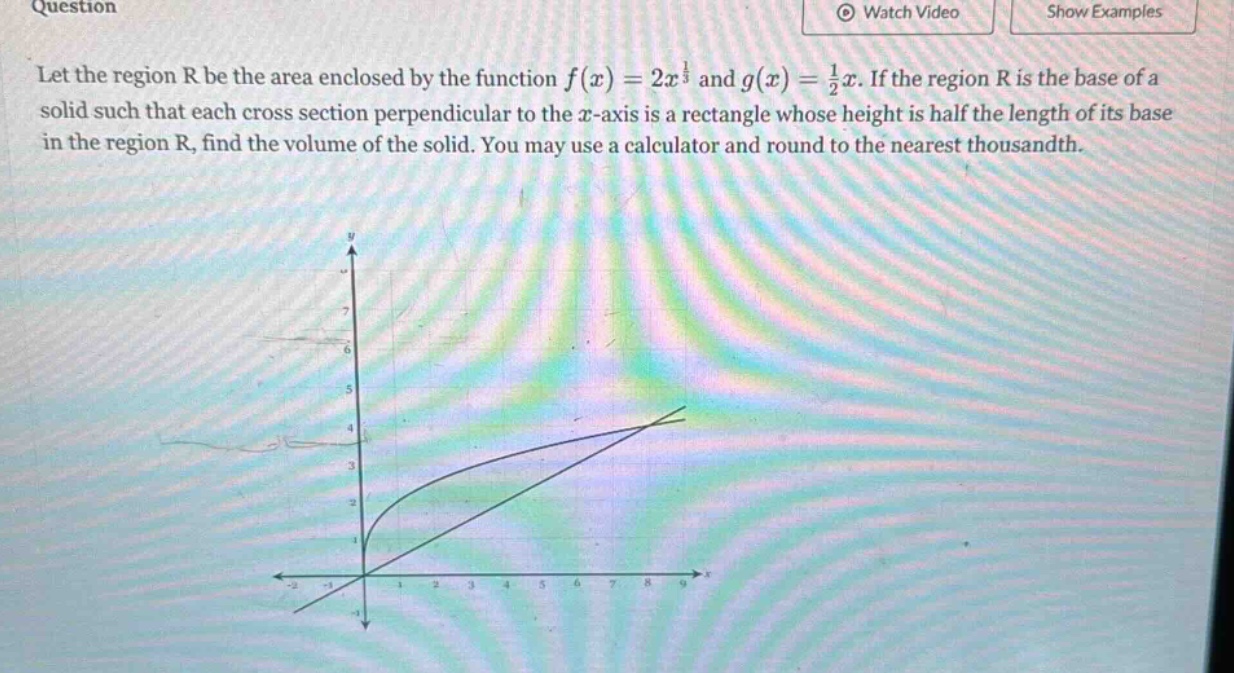
let the region r be the area enclosed by the function f(x)=2x^(1/3) and g(x)=(1/2)x. if the region r is the base of a solid such that each cross - section perpendicular to the x - axis is a rectangle whose height is half the length of its base in the region r, find the volume of the solid. you may use a calculator and round to the nearest thousandth.
Answer
Explanation:
Step1: Find intersection points
Set $2x^{\frac{1}{2}}=\frac{1}{2}x$. Rearranging gives $\frac{1}{2}x - 2x^{\frac{1}{2}}=0$. Let $u = x^{\frac{1}{2}}$, then $\frac{1}{2}u^{2}-2u = 0$, $u(\frac{1}{2}u - 2)=0$. So $u = 0$ or $u = 4$. Substituting back $u = x^{\frac{1}{2}}$, we get $x = 0$ and $x = 16$.
Step2: Determine base - height relationship
The base of the rectangle cross - section perpendicular to the $x$ - axis is $b=2x^{\frac{1}{2}}-\frac{1}{2}x$. The height $h=\frac{1}{2}(2x^{\frac{1}{2}}-\frac{1}{2}x)$.
Step3: Find the volume formula
The volume $V$ of the solid with cross - sectional area $A(x)$ from $x = a$ to $x = b$ is $V=\int_{a}^{b}A(x)dx$. Here, $A(x)=b\times h=(2x^{\frac{1}{2}}-\frac{1}{2}x)\times\frac{1}{2}(2x^{\frac{1}{2}}-\frac{1}{2}x)=\frac{1}{2}(2x^{\frac{1}{2}}-\frac{1}{2}x)^{2}$.
Step4: Expand the integrand
$\frac{1}{2}(2x^{\frac{1}{2}}-\frac{1}{2}x)^{2}=\frac{1}{2}(4x - 2x^{\frac{3}{2}}+\frac{1}{4}x^{2}) = 2x - x^{\frac{3}{2}}+\frac{1}{8}x^{2}$.
Step5: Integrate
$V=\int_{0}^{16}(2x - x^{\frac{3}{2}}+\frac{1}{8}x^{2})dx=\left[x^{2}-\frac{2}{5}x^{\frac{5}{2}}+\frac{1}{24}x^{3}\right]_{0}^{16}$.
Step6: Evaluate the definite integral
$V=(16^{2}-\frac{2}{5}\times16^{\frac{5}{2}}+\frac{1}{24}\times16^{3})$ $V = 256-\frac{2}{5}\times1024+\frac{1}{24}\times4096$ $V = 256-\frac{2048}{5}+\frac{512}{3}$ $V=\frac{3840 - 6144+2560}{15}=\frac{256}{15}\approx17.067$
Answer:
$17.067$