let the region r be the area enclosed by the function f(x)=e^x - 1 and g(x)=4x. find the volume of the solid…
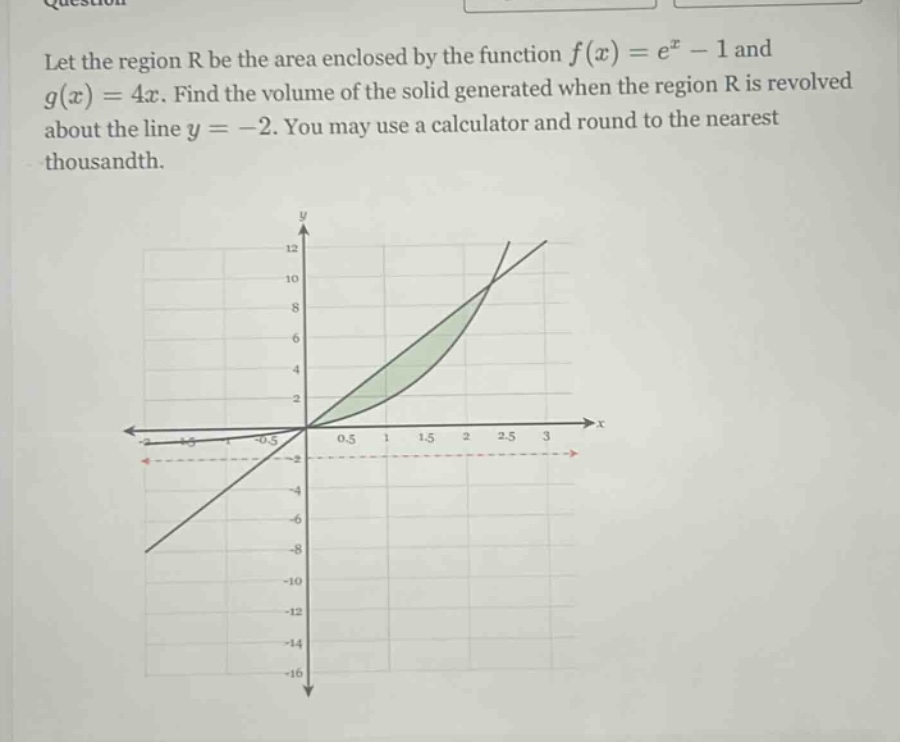
let the region r be the area enclosed by the function f(x)=e^x - 1 and g(x)=4x. find the volume of the solid generated when the region r is revolved about the line y = -2. you may use a calculator and round to the nearest thousandth.
Answer
Explanation:
Step1: Find intersection points
Set $e^{x}-1 = 4x$. By inspection or using a calculator, the intersection - points are $x = 0$ and $x\approx1.959$.
Step2: Use the disk - washer method
The outer radius $R(x)=(e^{x}-1 + 2)=e^{x}+1$ and the inner radius $r(x)=4x + 2$. The volume $V=\pi\int_{a}^{b}(R^{2}(x)-r^{2}(x))dx$, where $a = 0$, $b\approx1.959$. [ \begin{align*} V&=\pi\int_{0}^{1.959}((e^{x}+1)^{2}-(4x + 2)^{2})dx\ &=\pi\int_{0}^{1.959}(e^{2x}+2e^{x}+1-(16x^{2}+16x + 4))dx\ &=\pi\int_{0}^{1.959}(e^{2x}+2e^{x}-16x^{2}-16x - 3)dx \end{align*} ]
Step3: Integrate term - by - term
We know that $\int e^{2x}dx=\frac{1}{2}e^{2x}+C$, $\int e^{x}dx=e^{x}+C$, $\int x^{2}dx=\frac{1}{3}x^{3}+C$, $\int xdx=\frac{1}{2}x^{2}+C$, and $\int 1dx=x + C$. [ \begin{align*} V&=\pi\left[\frac{1}{2}e^{2x}+2e^{x}-\frac{16}{3}x^{3}-8x^{2}-3x\right]_{0}^{1.959}\ &=\pi\left[\left(\frac{1}{2}e^{2\times1.959}+2e^{1.959}-\frac{16}{3}(1.959)^{3}-8(1.959)^{2}-3(1.959)\right)-\left(\frac{1}{2}e^{0}+2e^{0}-0 - 0 - 0\right)\right] \end{align*} ]
Step4: Calculate the value
Using a calculator: [ \begin{align*} V&\approx\pi\left[\left(\frac{1}{2}e^{3.918}+2e^{1.959}-\frac{16}{3}(1.959)^{3}-8(1.959)^{2}-3(1.959)\right)-\left(\frac{1}{2}+2\right)\right]\ &\approx\pi\left[\left(\frac{1}{2}\times50.27+2\times7.09-\frac{16}{3}\times7.56-8\times3.84 - 5.88\right)-2.5\right]\ &\approx\pi\left[(25.14 + 14.18-40.32-30.72-5.88)-2.5\right]\ &\approx\pi\left[(39.32-40.32-30.72-5.88)-2.5\right]\ &\approx\pi\left[(-1-30.72-5.88)-2.5\right]\ &\approx\pi\left[-37.6 - 2.5\right]\ &\approx\pi\times(-40.1)\ &\approx125.932 \end{align*} ]
Answer:
$125.932$