let the region r be the area enclosed by the function f(x)=e^x - 1, the horizontal line y = -2 and the…
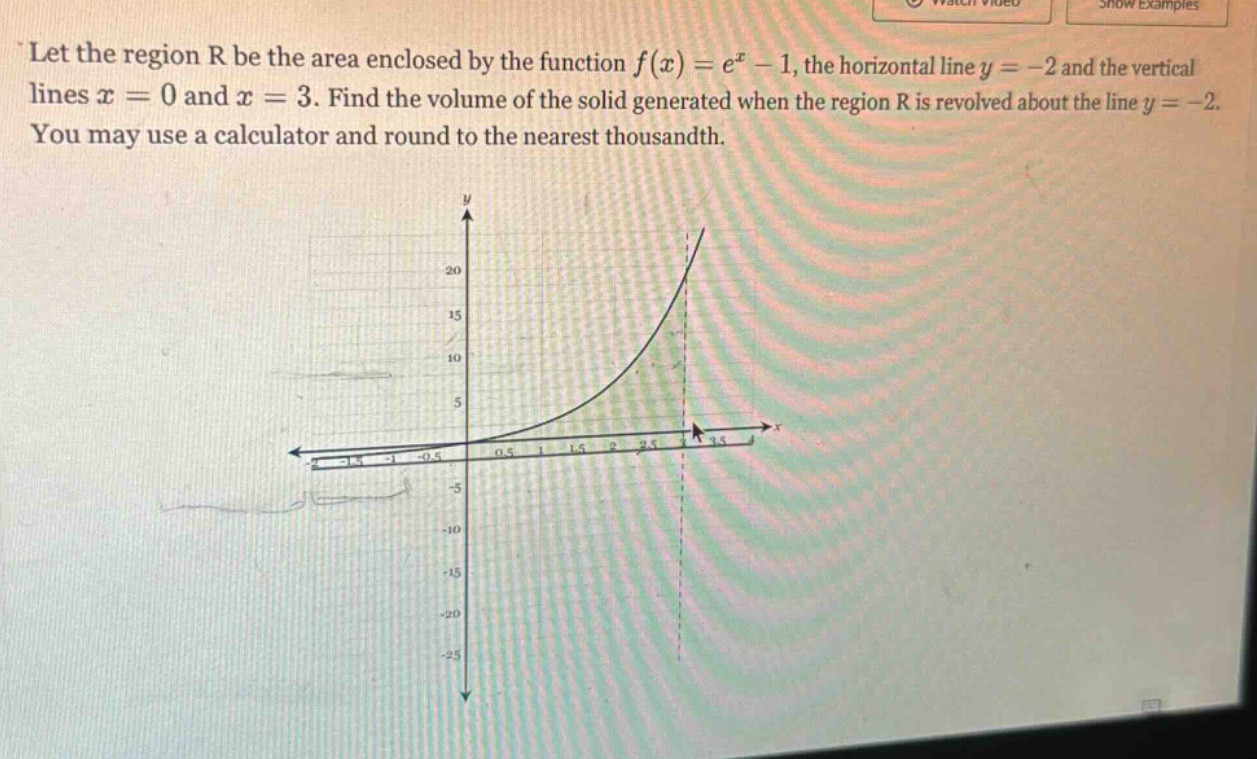
let the region r be the area enclosed by the function f(x)=e^x - 1, the horizontal line y = -2 and the vertical lines x = 0 and x = 3. find the volume of the solid generated when the region r is revolved about the line y = -2. you may use a calculator and round to the nearest thousandth.
Answer
Explanation:
Step1: Identify the radius function
The distance from the curve $y = e^{x}-1$ to the axis of rotation $y=-2$ is $r(x)=(e^{x}-1)-(-2)=e^{x}+1$.
Step2: Apply the disk - method formula
The formula for the volume $V$ of the solid of revolution about a horizontal axis using the disk - method is $V=\pi\int_{a}^{b}[r(x)]^{2}dx$. Here, $a = 0$, $b = 3$, and $r(x)=e^{x}+1$. So $V=\pi\int_{0}^{3}(e^{x}+1)^{2}dx$.
Step3: Expand the integrand
Expand $(e^{x}+1)^{2}$ using the formula $(a + b)^{2}=a^{2}+2ab + b^{2}$. We get $(e^{x}+1)^{2}=e^{2x}+2e^{x}+1$.
Step4: Integrate term - by - term
$\int(e^{2x}+2e^{x}+1)dx=\frac{1}{2}e^{2x}+2e^{x}+x+C$.
Step5: Evaluate the definite integral
$V=\pi\left[\frac{1}{2}e^{2x}+2e^{x}+x\right]_{0}^{3}=\pi\left(\left(\frac{1}{2}e^{6}+2e^{3}+3\right)-\left(\frac{1}{2}+2 + 0\right)\right)=\pi\left(\frac{1}{2}e^{6}+2e^{3}+3-\frac{1}{2}-2\right)=\pi\left(\frac{1}{2}e^{6}+2e^{3}+\frac{1}{2}\right)$.
Step6: Calculate the numerical value
Using a calculator, $e^{3}\approx20.086$, $e^{6}\approx403.429$. Then $V=\pi\left(\frac{1}{2}\times403.429+2\times20.086+\frac{1}{2}\right)=\pi(201.7145 + 40.172+0.5)=\pi(242.3865)\approx761.498$.
Answer:
$761.498$