let the region r be the area enclosed by the function ( f(x)=ln(x)+1 ) and ( g(x)=\frac{1}{2}x - 1 ). write…
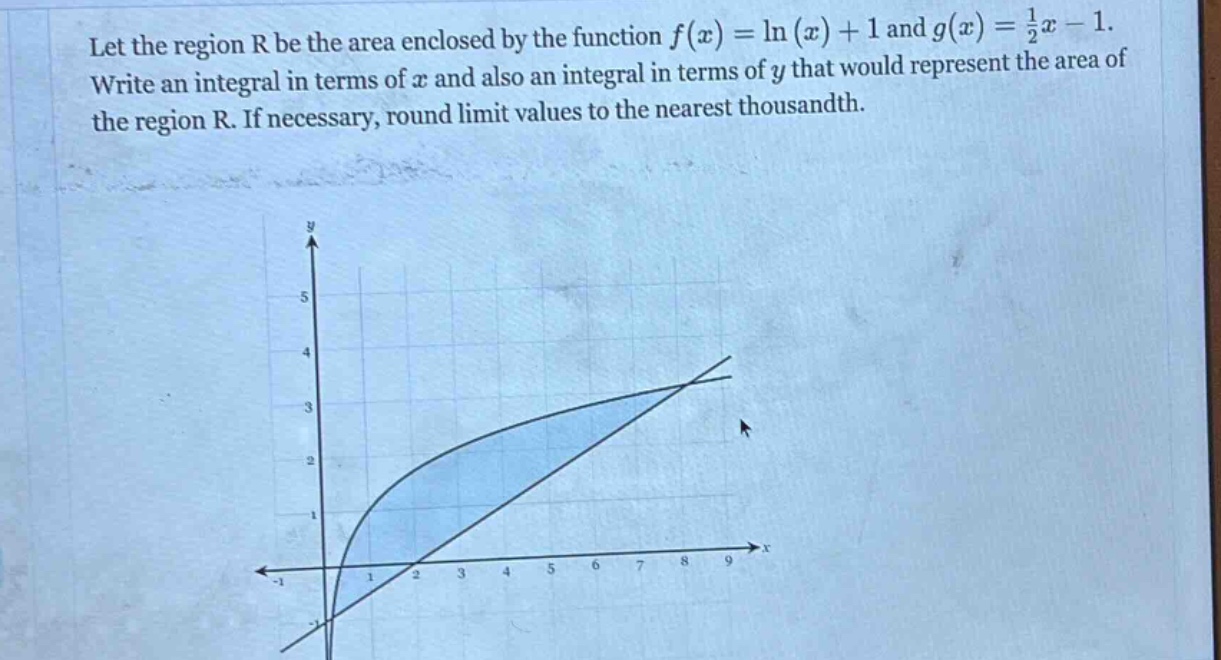
let the region r be the area enclosed by the function ( f(x)=ln(x)+1 ) and ( g(x)=\frac{1}{2}x - 1 ). write an integral in terms of ( x ) and also an integral in terms of ( y ) that would represent the area of the region r. if necessary, round limit values to the nearest thousandth.
Answer
Explanation:
Step1: Find intersection points
Set (f(x)=g(x)), so (\ln(x)+1=\frac{1}{2}x - 1). Using a graphing utility or numerical methods (e.g., Newton - Raphson), we find the intersection points. Let (h(x)=\ln(x)+1-\frac{1}{2}x + 1=\ln(x)-\frac{1}{2}x+2). (h^{\prime}(x)=\frac{1}{x}-\frac{1}{2}). Starting with an initial guess (x_0 = 1), (x_1=x_0-\frac{h(x_0)}{h^{\prime}(x_0)}), after a few iterations (or using a calculator), we find (x\approx1.146) and (x = 8) (by checking (h(8)=\ln(8)-\frac{1}{2}\times8 + 2=\ln(8)-2\approx2.079 - 2=0.079\approx0) (approximate value due to rounding in steps)).
Step2: Integral in terms of (x)
The formula for the area between two curves (y = f(x)) and (y = g(x)) is (A=\int_{a}^{b}\left|f(x)-g(x)\right|dx). Since (f(x)\geq g(x)) on the interval ([1.146,8]), the area (A=\int_{1.146}^{8}\left[(\ln(x)+1)-(\frac{1}{2}x - 1)\right]dx=\int_{1.146}^{8}(\ln(x)+2-\frac{1}{2}x)dx).
Step3: Integral in terms of (y)
First, solve (y = f(x)) for (x): (x = e^{y - 1}). Solve (y = g(x)) for (x): (x = 2(y + 1)). Find the (y) - values of the intersection points. When (x = 1.146), (y=\ln(1.146)+1\approx0.136+1 = 1.136). When (x = 8), (y=\ln(8)+1\approx2.079+1=3.079). The formula for the area between two curves (x = x_1(y)) and (x = x_2(y)) is (A=\int_{c}^{d}\left|x_1(y)-x_2(y)\right|dy). Since (x = e^{y - 1}\geq x = 2(y + 1)) on the interval ([1.136,3.079]), the area (A=\int_{1.136}^{3.079}(e^{y - 1}-2(y + 1))dy).
Answer:
Integral in terms of (x): (\int_{1.146}^{8}(\ln(x)+2-\frac{1}{2}x)dx) Integral in terms of (y): (\int_{1.136}^{3.079}(e^{y - 1}-2(y + 1))dy)