let the region r be the area enclosed by the function f(x)=x^(1/3)+2 and g(x)=(1/4)x + 2. write an integral…
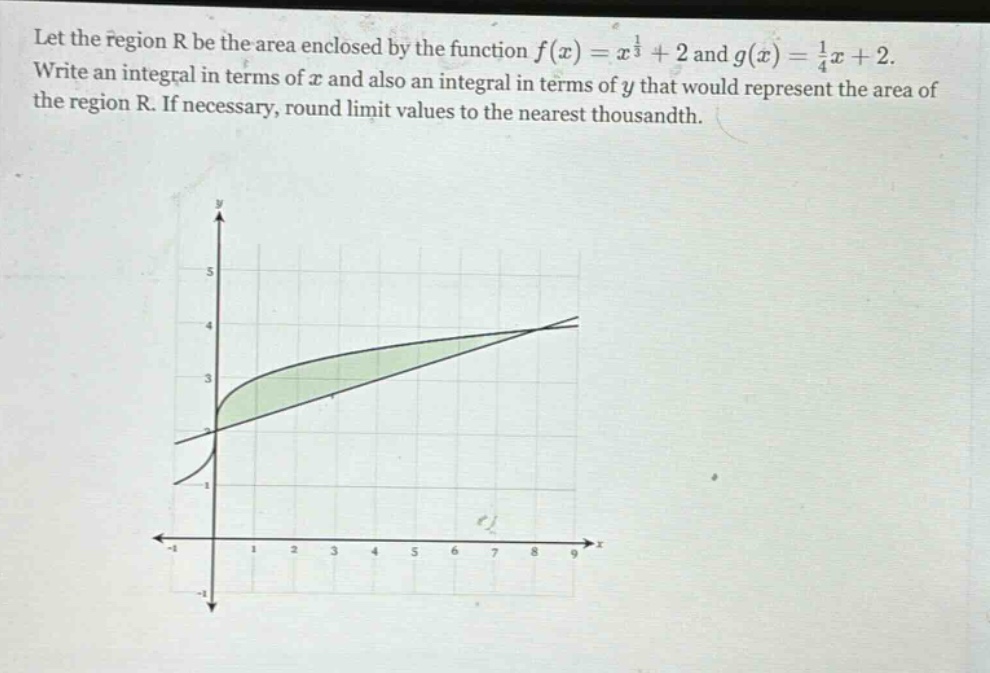
let the region r be the area enclosed by the function f(x)=x^(1/3)+2 and g(x)=(1/4)x + 2. write an integral in terms of x and also an integral in terms of y that would represent the area of the region r. if necessary, round limit values to the nearest thousandth.
Answer
Explanation:
Step1: Find intersection points
Set $x^{\frac{1}{3}}+2=\frac{1}{4}x + 2$. Then $x^{\frac{1}{3}}=\frac{1}{4}x$. Let $t = x^{\frac{1}{3}}$, so $t=\frac{1}{4}t^{3}$. Rearranging gives $\frac{1}{4}t^{3}-t = 0$, $t(\frac{1}{4}t^{2}-1)=0$. Factoring further, $t(t - 2)(t + 2)=0$. So $t=0,2,-2$ and $x = 0,8,- 8$. But from the graph, we consider non - negative $x$ values, so the intersection points are $x = 0$ and $x = 8$.
Step2: Integral in terms of $x$
The area $A_x$ between two curves $y = f(x)$ and $y = g(x)$ from $x=a$ to $x = b$ is given by $A_x=\int_{a}^{b}|f(x)-g(x)|dx$. Here, for $0\leq x\leq8$, $f(x)=x^{\frac{1}{3}}+2$ and $g(x)=\frac{1}{4}x + 2$, and $f(x)\geq g(x)$. So $A_x=\int_{0}^{8}(x^{\frac{1}{3}}+2-(\frac{1}{4}x + 2))dx=\int_{0}^{8}(x^{\frac{1}{3}}-\frac{1}{4}x)dx$.
Step3: Integral in terms of $y$
First, solve the equations for $x$ in terms of $y$. From $y=x^{\frac{1}{3}}+2$, we get $x=(y - 2)^{3}$. From $y=\frac{1}{4}x+2$, we get $x = 4(y - 2)$. The intersection points in terms of $y$ are when $x$ values are equal. Substituting $x$ values, $(y - 2)^{3}=4(y - 2)$. Let $u=y - 2$, then $u^{3}-4u=0$, $u(u^{2}-4)=0$, $u(u - 2)(u + 2)=0$. So $y=2,4$. The area $A_y$ between two curves $x = h(y)$ and $x = k(y)$ from $y=c$ to $y = d$ is $A_y=\int_{c}^{d}|h(y)-k(y)|dy$. Here, for $2\leq y\leq4$, $h(y)=(y - 2)^{3}$ and $k(y)=4(y - 2)$, and $k(y)\geq h(y)$. So $A_y=\int_{2}^{4}(4(y - 2)-(y - 2)^{3})dy$.
Answer:
Integral in terms of $x$: $\int_{0}^{8}(x^{\frac{1}{3}}-\frac{1}{4}x)dx$; Integral in terms of $y$: $\int_{2}^{4}(4(y - 2)-(y - 2)^{3})dy$