let r be the region bounded by the curves y = e^2x, y = 0, x = -3, and x = 3. what is the volume of the…
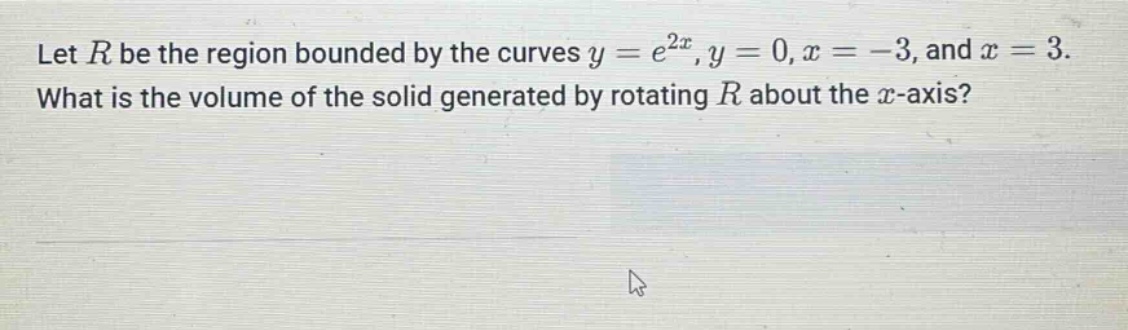
let r be the region bounded by the curves y = e^2x, y = 0, x = -3, and x = 3. what is the volume of the solid generated by rotating r about the x - axis?
Answer
Explanation:
Step1: Recall volume - of - revolution formula
The formula for the volume $V$ of the solid generated by rotating the region bounded by $y = f(x)$, $y = 0$, $x=a$, and $x = b$ about the $x$-axis using the disk method is $V=\pi\int_{a}^{b}[f(x)]^{2}dx$. Here, $f(x)=e^{2x}$, $a=-3$, and $b = 3$.
Step2: Set up the integral
$V=\pi\int_{-3}^{3}(e^{2x})^{2}dx=\pi\int_{-3}^{3}e^{4x}dx$.
Step3: Integrate $e^{4x}$
The antiderivative of $e^{4x}$ is $\frac{1}{4}e^{4x}$. Using the fundamental theorem of calculus $\int_{-3}^{3}e^{4x}dx=\left[\frac{1}{4}e^{4x}\right]_{-3}^{3}$.
Step4: Evaluate the definite - integral
$\left[\frac{1}{4}e^{4x}\right]_{-3}^{3}=\frac{1}{4}e^{4\times3}-\frac{1}{4}e^{4\times(-3)}=\frac{1}{4}(e^{12}-e^{- 12})$.
Step5: Find the volume
$V=\pi\times\frac{1}{4}(e^{12}-e^{-12})=\frac{\pi}{4}(e^{12}-\frac{1}{e^{12}})$.
Answer:
$\frac{\pi}{4}(e^{12}-\frac{1}{e^{12}})$