let r be the region bounded by half of one petal of the rose curve, r = 7 sin(8θ) as shown in the diagram…
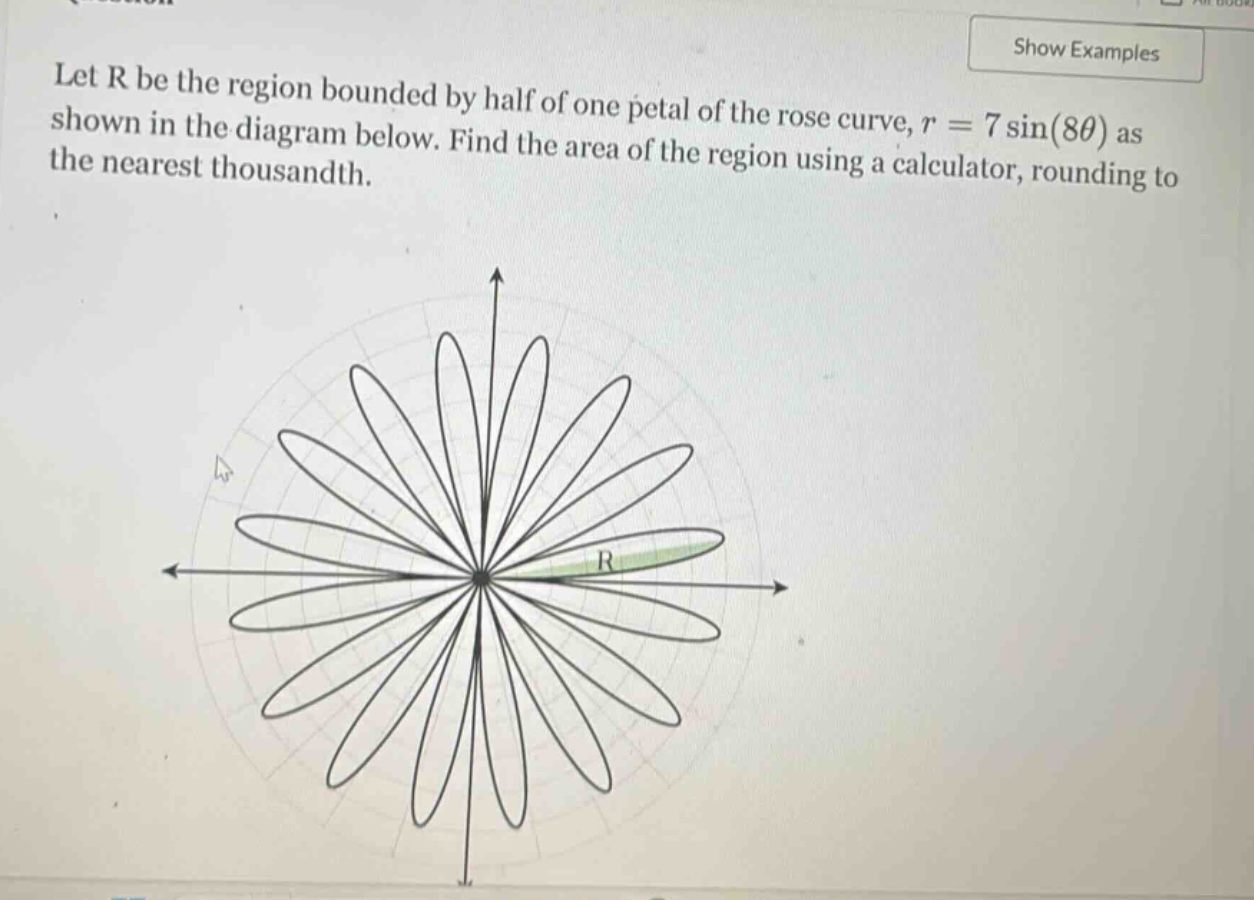
let r be the region bounded by half of one petal of the rose curve, r = 7 sin(8θ) as shown in the diagram below. find the area of the region using a calculator, rounding to the nearest thousandth.
Answer
Explanation:
Step1: Recall area formula in polar - coordinates
The area $A$ of a polar - region bounded by the curve $r = f(\theta)$ from $\theta=a$ to $\theta = b$ is given by $A=\frac{1}{2}\int_{a}^{b}r^{2}d\theta$. For the rose curve $r = 7\sin(8\theta)$, one petal is formed when $r = 0$. So, we set $7\sin(8\theta)=0$, which gives $8\theta = k\pi$, or $\theta=\frac{k\pi}{8}$, $k\in\mathbb{Z}$. For half - of one petal, we can choose the limits of integration. Let's find the limits for one petal first. When $k = 0$, $\theta = 0$ and when $k = 1$, $\theta=\frac{\pi}{8}$. So, for half - of one petal, we can use the limits $\theta = 0$ to $\theta=\frac{\pi}{16}$.
Step2: Substitute $r$ into the area formula
Substitute $r = 7\sin(8\theta)$ into the area formula $A=\frac{1}{2}\int_{a}^{b}r^{2}d\theta$. We get $A=\frac{1}{2}\int_{0}^{\frac{\pi}{16}}(7\sin(8\theta))^{2}d\theta=\frac{1}{2}\int_{0}^{\frac{\pi}{16}}49\sin^{2}(8\theta)d\theta$.
Step3: Use the double - angle formula $\sin^{2}\alpha=\frac{1 - \cos(2\alpha)}{2}$
Since $\sin^{2}(8\theta)=\frac{1-\cos(16\theta)}{2}$, the integral becomes $A=\frac{49}{2}\int_{0}^{\frac{\pi}{16}}\frac{1 - \cos(16\theta)}{2}d\theta=\frac{49}{4}\int_{0}^{\frac{\pi}{16}}(1-\cos(16\theta))d\theta$.
Step4: Integrate term - by - term
Integrating, we have $\frac{49}{4}\left[\int_{0}^{\frac{\pi}{16}}1d\theta-\int_{0}^{\frac{\pi}{16}}\cos(16\theta)d\theta\right]$. The integral of $1$ with respect to $\theta$ is $\theta$, and the integral of $\cos(16\theta)$ with respect to $\theta$ is $\frac{1}{16}\sin(16\theta)$. So, $A=\frac{49}{4}\left[\theta-\frac{1}{16}\sin(16\theta)\right]_{0}^{\frac{\pi}{16}}$.
Step5: Evaluate the definite integral
Substitute the upper and lower limits: $A=\frac{49}{4}\left[\left(\frac{\pi}{16}-\frac{1}{16}\sin\left(16\times\frac{\pi}{16}\right)\right)-\left(0-\frac{1}{16}\sin(0)\right)\right]=\frac{49}{4}\left(\frac{\pi}{16}-0 - 0+0\right)=\frac{49\pi}{64}\approx2.405$.
Answer:
$2.405$