let r be the region inside the polar curve r = 6 cos(7θ) and outside the polar curve r = 1 as shown in the…
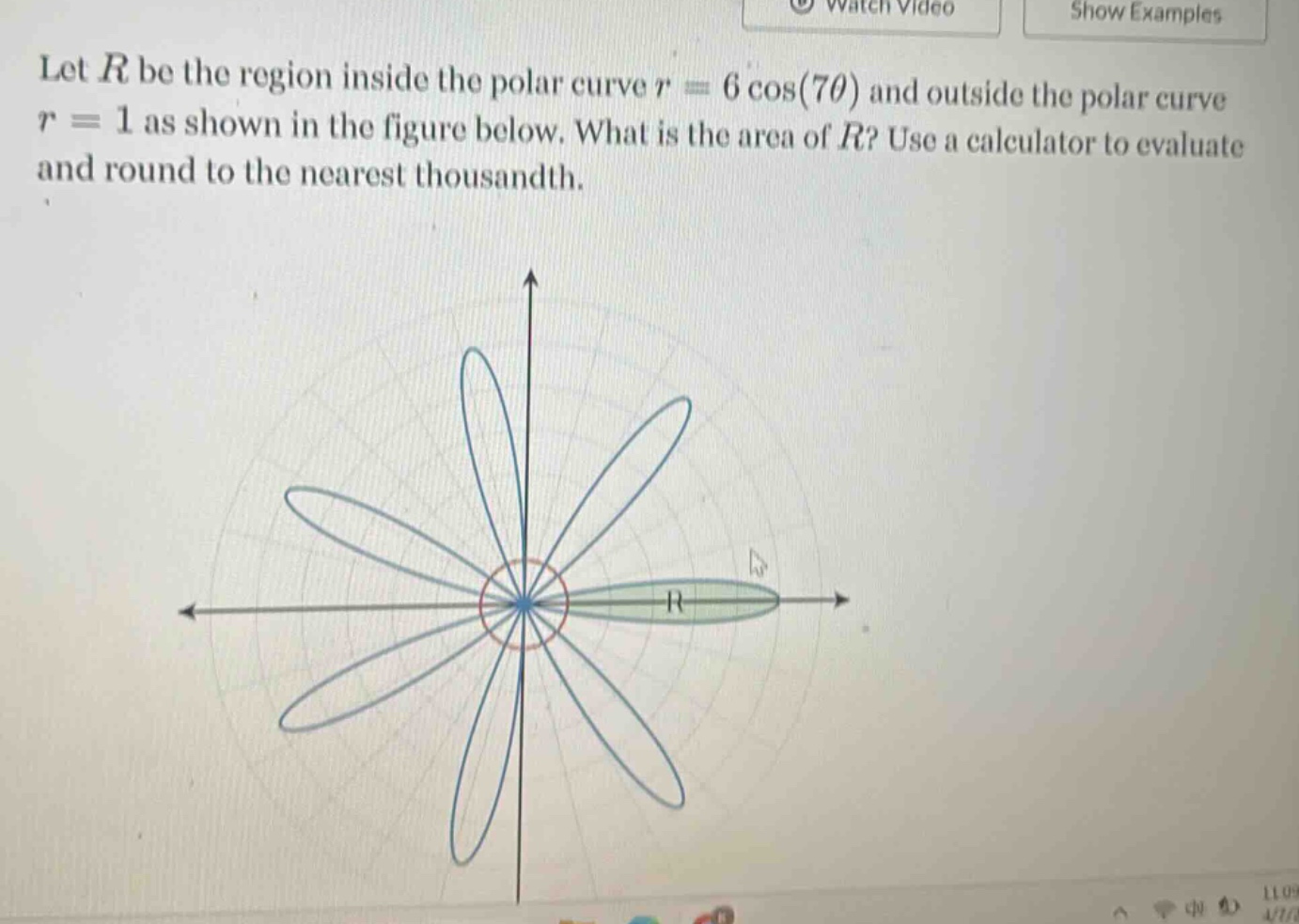
let r be the region inside the polar curve r = 6 cos(7θ) and outside the polar curve r = 1 as shown in the figure below. what is the area of r? use a calculator to evaluate and round to the nearest thousandth.
Answer
Answer:
52.927
Explanation:
Step1: Recall area - formula in polar coordinates
The area $A$ of a region in polar coordinates between two curves $r = r_1(\theta)$ and $r = r_2(\theta)$ is given by $A=\frac{1}{2}\int_{\alpha}^{\beta}(r_1^{2}(\theta)-r_2^{2}(\theta))d\theta$. First, find the intersection points of $r = 6\cos(7\theta)$ and $r = 1$. Set $6\cos(7\theta)=1$, then $\cos(7\theta)=\frac{1}{6}$, and $7\theta=\pm\cos^{- 1}(\frac{1}{6})+2k\pi,k\in\mathbb{Z}$, $\theta=\pm\frac{1}{7}\cos^{-1}(\frac{1}{6})+\frac{2k\pi}{7}$. For one - petal, we can find the limits of integration. Since the function $y = \cos(7\theta)$ has period $\frac{2\pi}{7}$, and by symmetry, we can find the area of one - petal and multiply by 7. For one petal, let's find the limits of integration by solving $6\cos(7\theta)=1$. The area of the region between the two curves for one petal is $A_1=\frac{1}{2}\int_{-\frac{1}{7}\cos^{-1}(\frac{1}{6})}^{\frac{1}{7}\cos^{-1}(\frac{1}{6})}((6\cos(7\theta))^{2}-1^{2})d\theta$.
Step2: Expand the integrand
Expand $(6\cos(7\theta))^{2}-1^{2}=36\cos^{2}(7\theta)-1$. Recall the double - angle formula $\cos^{2}x=\frac{1 + \cos(2x)}{2}$, so $\cos^{2}(7\theta)=\frac{1+\cos(14\theta)}{2}$. Then $36\cos^{2}(7\theta)-1=36\times\frac{1 + \cos(14\theta)}{2}-1=18 + 18\cos(14\theta)-1=17+18\cos(14\theta)$.
Step3: Integrate the function
$\int(17 + 18\cos(14\theta))d\theta=17\theta+\frac{18}{14}\sin(14\theta)+C$. Evaluate the definite integral: $\frac{1}{2}\left[17\theta+\frac{9}{7}\sin(14\theta)\right]_{-\frac{1}{7}\cos^{-1}(\frac{1}{6})}^{\frac{1}{7}\cos^{-1}(\frac{1}{6})}=\frac{1}{2}\left[\left(17\times\frac{1}{7}\cos^{-1}(\frac{1}{6})+\frac{9}{7}\sin\left(2\cos^{-1}(\frac{1}{6})\right)\right)-\left(-17\times\frac{1}{7}\cos^{-1}(\frac{1}{6})-\frac{9}{7}\sin\left(2\cos^{-1}(\frac{1}{6})\right)\right)\right]=\frac{1}{2}\times\frac{34}{7}\cos^{-1}(\frac{1}{6})+\frac{9}{7}\sin\left(2\cos^{-1}(\frac{1}{6})\right)$. Using the double - angle formula $\sin(2x) = 2\sin x\cos x$ and $\sin x=\sqrt{1-\cos^{2}x}$ when $x = \cos^{-1}(\frac{1}{6})$, $\sin\left(2\cos^{-1}(\frac{1}{6})\right)=2\times\frac{\sqrt{35}}{6}\times\frac{1}{6}=\frac{\sqrt{35}}{18}$. The area of one petal $A_1$ is calculated. Then the total area $A = 7A_1$. Using a calculator, $A\approx52.927$.