let $r$ be the region to the right of the line $x = 1$, and enclosed by it, the line $y = 4$, and the curve…
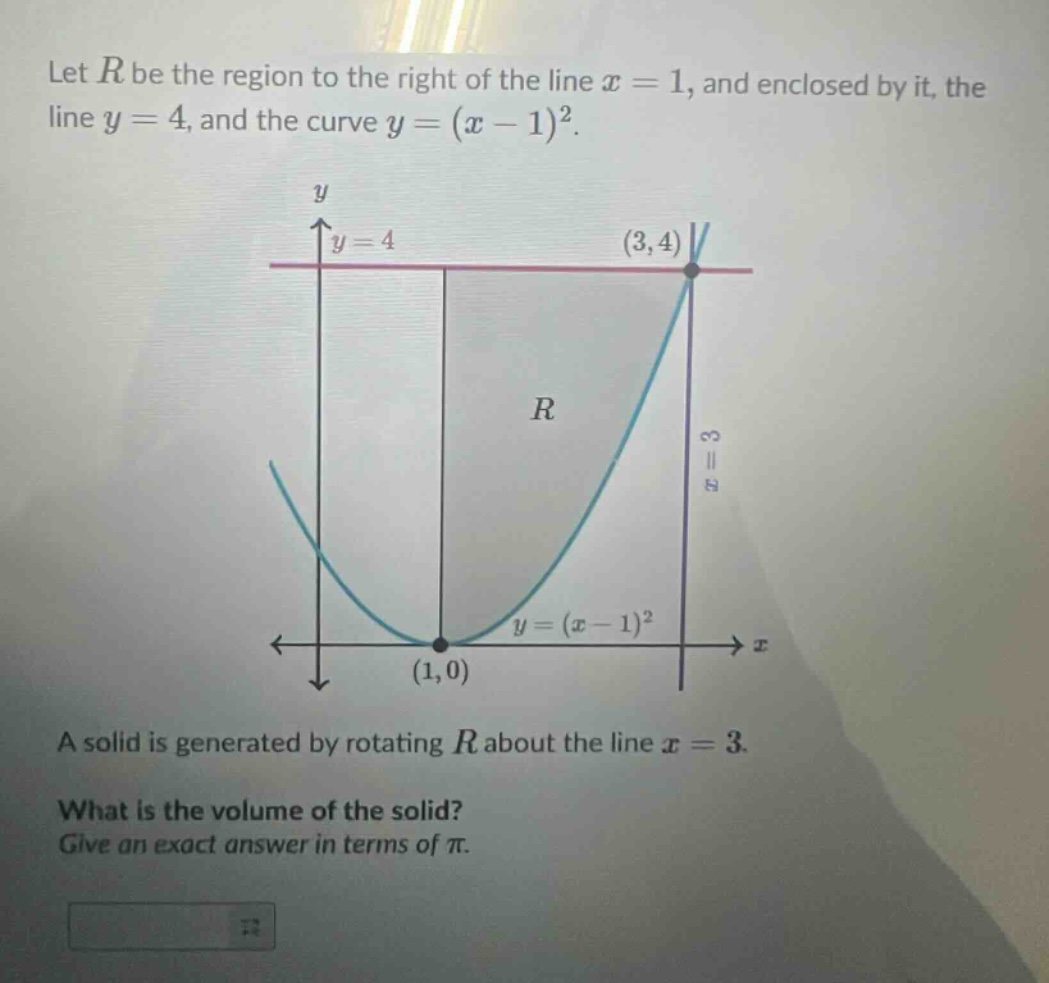
let $r$ be the region to the right of the line $x = 1$, and enclosed by it, the line $y = 4$, and the curve $y=(x - 1)^2$. a solid is generated by rotating $r$ about the line $x = 3$. what is the volume of the solid? give an exact answer in terms of $pi$.
Answer
Explanation:
Step1: Determine the method (cylindrical - shells)
The volume $V$ of a solid of revolution using the cylindrical - shells method when rotating about a vertical line $x = a$ is given by $V=2\pi\int_{c}^{d}(a - x)h(x)dx$, where $(a - x)$ is the radius of the shell and $h(x)$ is the height of the shell. Here, $a = 3$, and we need to find the limits of integration and the height function. First, find the intersection of $y=(x - 1)^2$ and $y = 4$. Set $(x - 1)^2=4$, then $x-1=\pm2$. Since we are interested in the region to the right of $x = 1$, $x=3$. The limits of integration for $x$ are from $x = 1$ to $x = 3$. The height of the shell $h(x)=4-(x - 1)^2$.
Step2: Set up the integral
The volume formula becomes $V = 2\pi\int_{1}^{3}(3 - x)\left(4-(x - 1)^2\right)dx$. Expand the integrand: [ \begin{align*} (3 - x)\left(4-(x - 1)^2\right)&=(3 - x)(4-(x^{2}-2x + 1))\ &=(3 - x)(3 + 2x-x^{2})\ &=9+6x-3x^{2}-3x-2x^{2}+x^{3}\ &=x^{3}-5x^{2}+3x + 9 \end{align*} ]
Step3: Integrate the expanded function
[ \begin{align*} V&=2\pi\int_{1}^{3}(x^{3}-5x^{2}+3x + 9)dx\ &=2\pi\left[\frac{x^{4}}{4}-\frac{5x^{3}}{3}+\frac{3x^{2}}{2}+9x\right]_{1}^{3} \end{align*} ]
Step4: Evaluate the definite - integral
[ \begin{align*} &\text{When }x = 3:\frac{3^{4}}{4}-\frac{5\times3^{3}}{3}+\frac{3\times3^{2}}{2}+9\times3=\frac{81}{4}-45+\frac{27}{2}+27\ &=\frac{81}{4}-45+\frac{54}{4}+27=\frac{81 + 54}{4}-45 + 27=\frac{135}{4}-18=\frac{135-72}{4}=\frac{63}{4}\ &\text{When }x = 1:\frac{1^{4}}{4}-\frac{5\times1^{3}}{3}+\frac{3\times1^{2}}{2}+9\times1=\frac{1}{4}-\frac{5}{3}+\frac{3}{2}+9\ &=\frac{3 - 20+18 + 108}{12}=\frac{109}{12}\ &V=2\pi\left(\frac{63}{4}-\frac{109}{12}\right)\ &=2\pi\left(\frac{189 - 109}{12}\right)\ &=2\pi\times\frac{80}{12}=\frac{40\pi}{3} \end{align*} ]
Answer:
$\frac{40\pi}{3}$