let ∑n = 1∞an be a series with nonzero terms. let ρ=limn→∞|an + 1an|. according to the ratio test, if ρ>1 or…
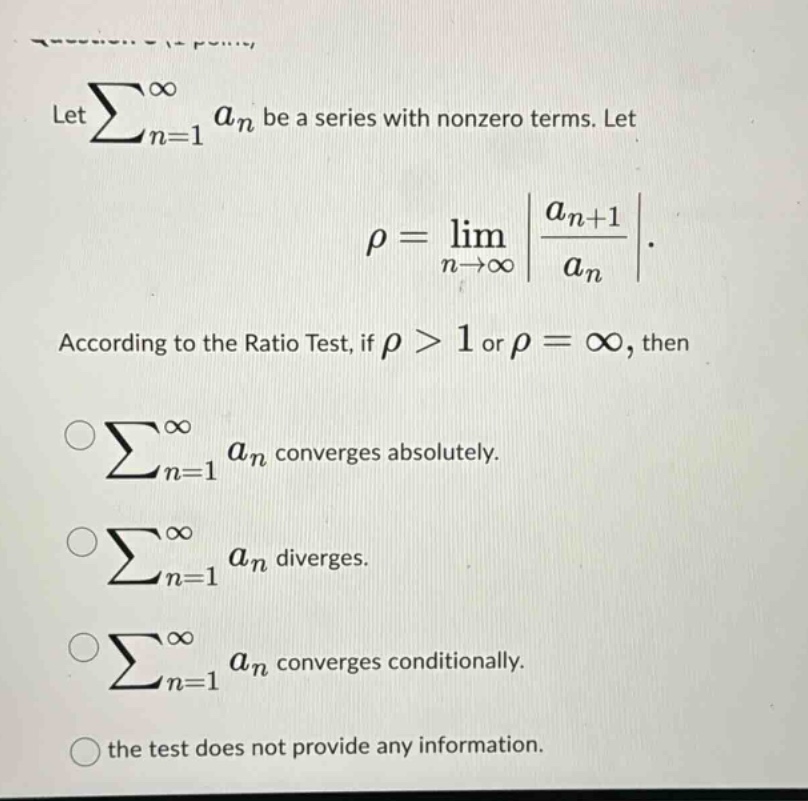
let ∑n = 1∞an be a series with nonzero terms. let ρ=limn→∞|an + 1an|. according to the ratio test, if ρ>1 or ρ=∞, then ∑n = 1∞an converges absolutely. ∑n = 1∞an diverges. ∑n = 1∞an converges conditionally. the test does not provide any information.
Answer
Explanation:
Step1: Recall Ratio - Test rules
The Ratio - Test states that for a series $\sum_{n = 1}^{\infty}a_{n}$ with $a_{n}\neq0$, if $\rho=\lim_{n\rightarrow\infty}\left|\frac{a_{n + 1}}{a_{n}}\right|>1$ or $\rho=\infty$, the terms of the series do not approach zero as $n\rightarrow\infty$.
Step2: Determine convergence or divergence
If the terms of a series $\sum_{n = 1}^{\infty}a_{n}$ do not approach zero as $n\rightarrow\infty$, then by the Divergence Test (a series $\sum_{n = 1}^{\infty}a_{n}$ diverges if $\lim_{n\rightarrow\infty}a_{n}\neq0$), the series $\sum_{n = 1}^{\infty}a_{n}$ diverges.
Answer:
$\sum_{n = 1}^{\infty}a_{n}$ diverges.