let g(x)=sin(π/2 x)+4 and h(x)= -x³ + 6x. if f satisfies g(x)≤f(x)≤h(x) for -1 < x < 2, what is lim(x→1)…
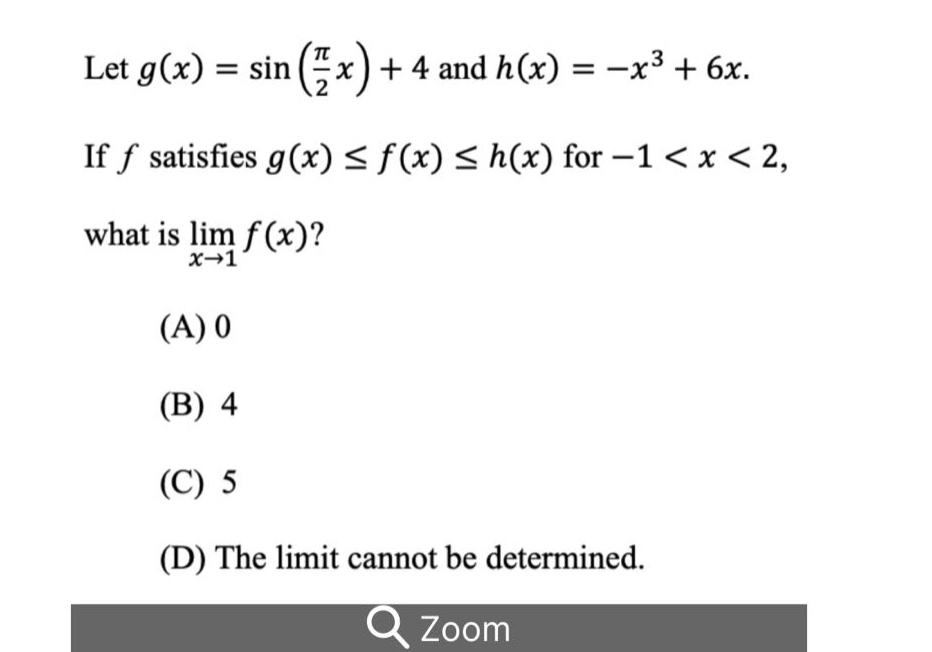
let g(x)=sin(π/2 x)+4 and h(x)= -x³ + 6x. if f satisfies g(x)≤f(x)≤h(x) for -1 < x < 2, what is lim(x→1) f(x)? (a) 0 (b) 4 (c) 5 (d) the limit cannot be determined.
Answer
Explanation:
Step1: Apply Squeeze - Theorem
The Squeeze - Theorem states that if (g(x)\leq f(x)\leq h(x)) for all (x) in an open interval containing (a) (except possibly at (x = a)) and (\lim_{x\rightarrow a}g(x)=\lim_{x\rightarrow a}h(x)=L), then (\lim_{x\rightarrow a}f(x)=L). Here (a = 1), and (-1<x<2) contains (x = 1).
Step2: Calculate (\lim_{x\rightarrow1}g(x))
We have (g(x)=\sin(\frac{\pi}{2}x)+4). Using the limit property (\lim_{x\rightarrow a}(\sin(u(x)) + c)=\sin(\lim_{x\rightarrow a}u(x))+c) (where (u(x)=\frac{\pi}{2}x) and (c = 4)). (\lim_{x\rightarrow1}\frac{\pi}{2}x=\frac{\pi}{2}), and (\sin(\frac{\pi}{2}) = 1). So (\lim_{x\rightarrow1}g(x)=\sin(\frac{\pi}{2}\times1)+4=1 + 4=5).
Step3: Calculate (\lim_{x\rightarrow1}h(x))
We have (h(x)=-x^{3}+6x). Using the limit properties (\lim_{x\rightarrow a}(u(x)+v(x))=\lim_{x\rightarrow a}u(x)+\lim_{x\rightarrow a}v(x)) and (\lim_{x\rightarrow a}cx^{n}=c(\lim_{x\rightarrow a}x)^{n}). (\lim_{x\rightarrow1}h(x)=-\lim_{x\rightarrow1}x^{3}+6\lim_{x\rightarrow1}x=-1^{3}+6\times1=- 1 + 6=5).
Answer:
C. 5