let $square$ be the closed, piece - wise smooth curve formed by traveling in straight lines between the…
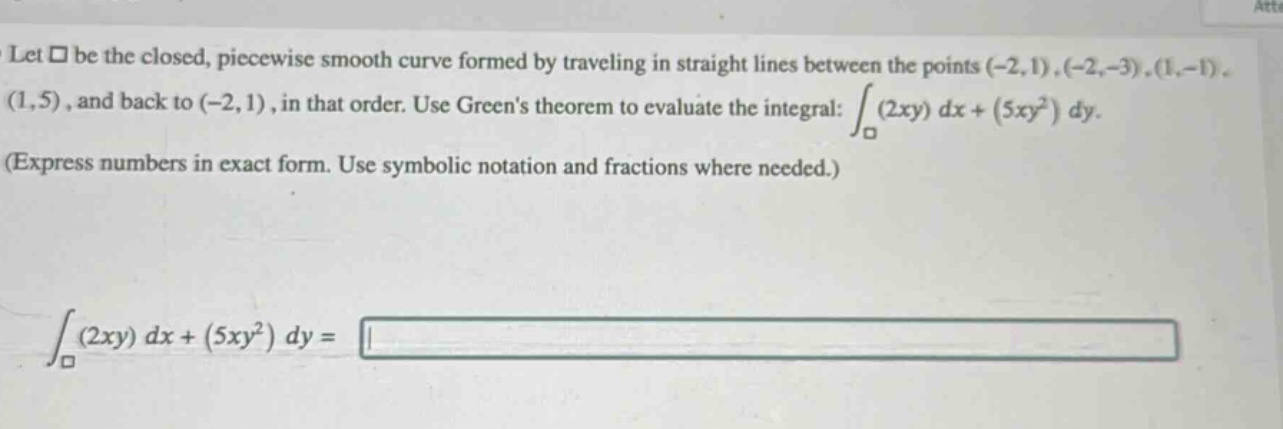
let $square$ be the closed, piece - wise smooth curve formed by traveling in straight lines between the points $(-2,1),(-2, - 3),(1,-1),(1,5)$, and back to $(-2,1)$, in that order. use greens theorem to evaluate the integral: $int_{square}(2xy)dx+(5xy^{2})dy$. (express numbers in exact form. use symbolic notation and fractions where needed.) $int_{square}(2xy)dx+(5xy^{2})dy=$
Answer
Explanation:
Step1: Recall Green's theorem
Green's theorem states that $\oint_{C}Pdx + Qdy=\iint_{D}(\frac{\partial Q}{\partial x}-\frac{\partial P}{\partial y})dA$, where $P = 2xy$, $Q = 5xy^{2}$, $C$ is the closed - curve and $D$ is the region bounded by $C$. First, find $\frac{\partial Q}{\partial x}$ and $\frac{\partial P}{\partial y}$. $\frac{\partial Q}{\partial x}=5y^{2}$ and $\frac{\partial P}{\partial y}=2x$.
Step2: Calculate $\frac{\partial Q}{\partial x}-\frac{\partial P}{\partial y}$
$\frac{\partial Q}{\partial x}-\frac{\partial P}{\partial y}=5y^{2}-2x$.
Step3: Determine the limits of integration
The region $D$ is a polygon with vertices $(-2,1),(-2, - 3),(1,-1),(1,5)$. The $x$ - values range from $x=-2$ to $x = 1$. For a fixed $x$, the $y$ - values range from the lower - bound $y_1$ to the upper - bound $y_2$. We need to find the equations of the lines bounding the region. But we can also use the double - integral $\iint_{D}(5y^{2}-2x)dA=\int_{x=-2}^{1}\int_{y = y_{lower}}^{y_{upper}}(5y^{2}-2x)dydx$. We can also use the fact that $\iint_{D}(5y^{2}-2x)dA=\int_{x=-2}^{1}\left[\int_{y_{lower}}^{y_{upper}}5y^{2}dy-\int_{y_{lower}}^{y_{upper}}2xdy\right]dx$. First, integrate with respect to $y$: $\int 5y^{2}dy=\frac{5}{3}y^{3}+C$ and $\int 2xdy = 2xy + C$. The lower and upper bounds of $y$ for a given $x$: The left - hand side is $x=-2$ and the right - hand side is $x = 1$. $\iint_{D}(5y^{2}-2x)dA=\int_{-2}^{1}\left[\frac{5}{3}y^{3}-2xy\right]{y=-3}^{5}dx$ $=\int{-2}^{1}\left(\frac{5}{3}(5^{3}-(-3)^{3})-2x(5 - (-3))\right)dx$ $=\int_{-2}^{1}\left(\frac{5}{3}(125 + 27)-16x\right)dx$ $=\int_{-2}^{1}\left(\frac{5}{3}\times152-16x\right)dx$ $=\int_{-2}^{1}\left(\frac{760}{3}-16x\right)dx$.
Step4: Integrate with respect to $x$
$\int\left(\frac{760}{3}-16x\right)dx=\frac{760}{3}x-8x^{2}+C$. Evaluating the definite integral: $\left[\frac{760}{3}x-8x^{2}\right]_{-2}^{1}=\left(\frac{760}{3}\times1-8\times1^{2}\right)-\left(\frac{760}{3}\times(-2)-8\times(-2)^{2}\right)$ $=\frac{760}{3}-8+\frac{1520}{3}+32$ $=\frac{760 + 1520}{3}+24$ $=\frac{2280}{3}+24$ $=760 + 24$ $=784$.
Answer:
$784$