let g(x)=2^x. can we use the mean value theorem to say the equation g(x)=16 has a solution where 3<x<5…
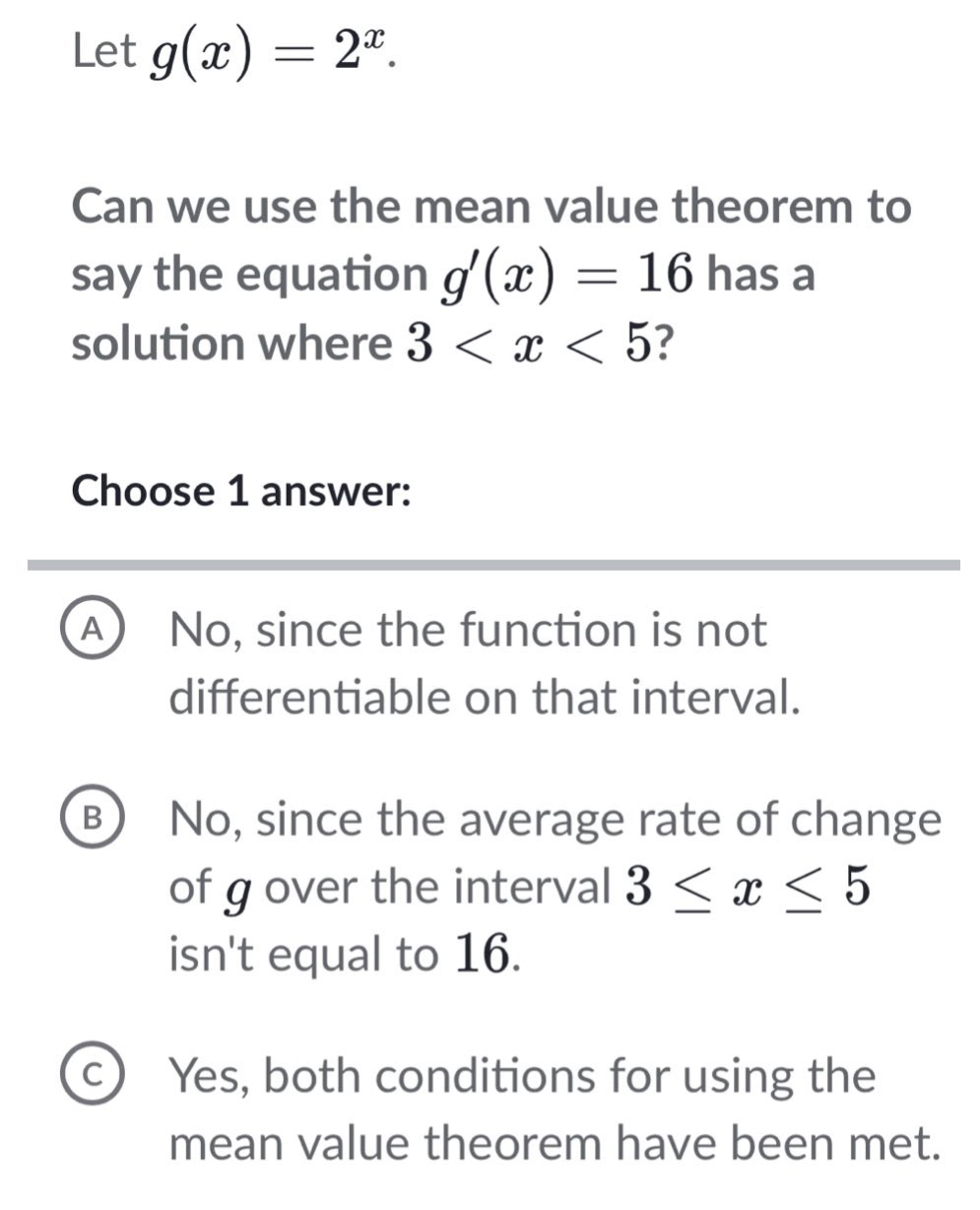
let g(x)=2^x. can we use the mean value theorem to say the equation g(x)=16 has a solution where 3<x<5? choose 1 answer: a no, since the function is not differentiable on that interval. b no, since the average rate of change of g over the interval 3≤x≤5 isnt equal to 16. c yes, both conditions for using the mean value theorem have been met.
Answer
Explanation:
Step1: Recall mean - value theorem conditions
The mean - value theorem states that if a function $y = g(x)$ is continuous on the closed interval $[a,b]$ and differentiable on the open interval $(a,b)$, then there exists at least one $c\in(a,b)$ such that $g^{\prime}(c)=\frac{g(b)-g(a)}{b - a}$. The function $g(x)=2^{x}$ is continuous and differentiable for all real numbers. Here $a = 3$ and $b = 5$.
Step2: Calculate $g(3)$ and $g(5)$
$g(3)=2^{3}=8$ and $g(5)=2^{5}=32$.
Step3: Calculate the average rate of change
The average rate of change of $g(x)$ over the interval $[3,5]$ is $\frac{g(5)-g(3)}{5 - 3}=\frac{32 - 8}{2}=\frac{24}{2}=12$. Since the average rate of change $\frac{g(5)-g(3)}{5 - 3}=12\neq16$, we cannot use the mean - value theorem to say that $g^{\prime}(x)=16$ has a solution in the interval $(3,5)$.
Answer:
B. No, since the average rate of change of $g$ over the interval $3\leq x\leq5$ isn't equal to $16$.