if lim f(x) exists with lim f(x) < 5 and f(6) = 10, which of the following statements must be false? a lim…
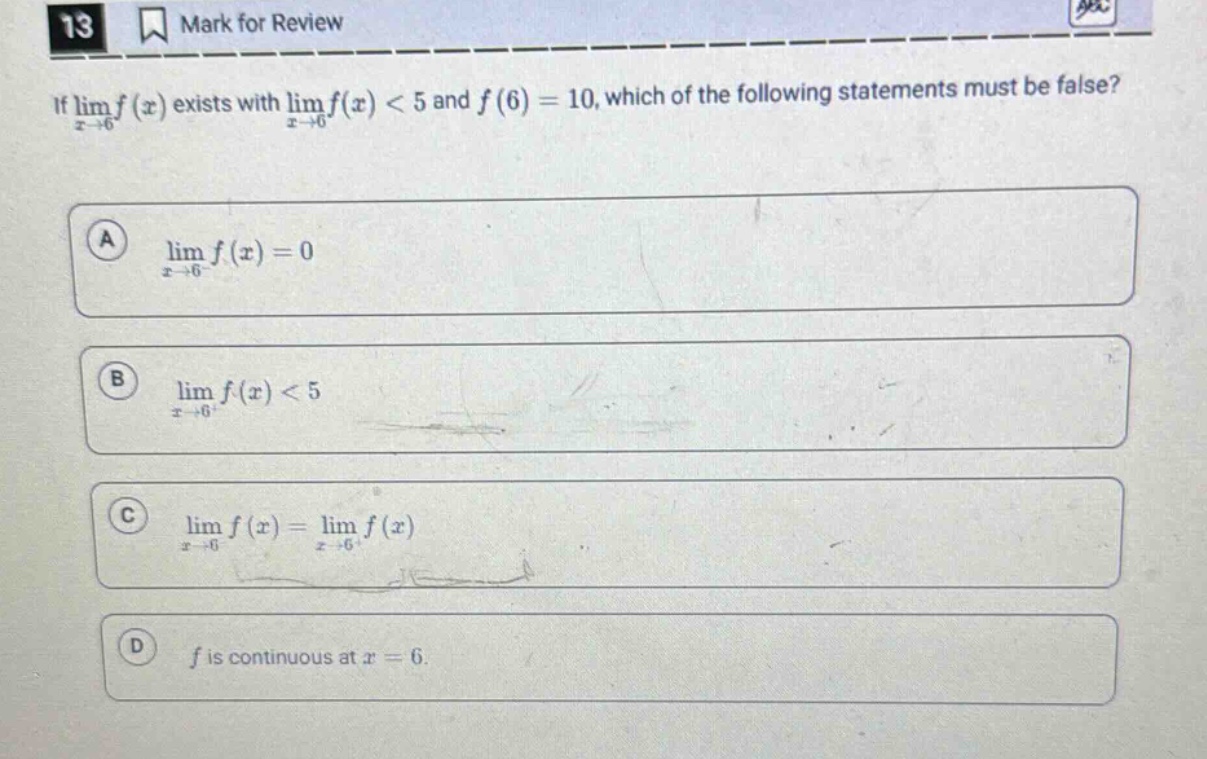
if lim f(x) exists with lim f(x) < 5 and f(6) = 10, which of the following statements must be false? a lim f(x) = 0 b lim f(x) < 5 c lim f(x) = lim f(x) d f is continuous at x = 6.
Answer
Explanation:
Step1: Recall the definition of continuity
For a function $y = f(x)$ to be continuous at $x = a$, $\lim_{x\rightarrow a}f(x)=f(a)$.
Step2: Analyze the given conditions
We are given that $\lim_{x\rightarrow 6}f(x)$ exists and $\lim_{x\rightarrow 6}f(x)<5$, while $f(6) = 10$. Since $\lim_{x\rightarrow 6}f(x)\neq f(6)$, the function cannot be continuous at $x = 6$.
Step3: Analyze other options
Option A: $\lim_{x\rightarrow 6}f(x)=0$ is possible as $0<5$. Option B: $\lim_{x\rightarrow 6^{+}}f(x)<5$ is consistent with the given $\lim_{x\rightarrow 6}f(x)<5$. Option C: Since $\lim_{x\rightarrow 6}f(x)$ exists, by the definition of the existence of a limit, $\lim_{x\rightarrow 6^{-}}f(x)=\lim_{x\rightarrow 6^{+}}f(x)$.
Answer:
D. $f$ is continuous at $x = 6$.