9) $lim_{h \to 0}\frac{(1 + h)^{1/3}-1}{h}$ blue\nuse the graph to estimate the specified limit.\n10) find…
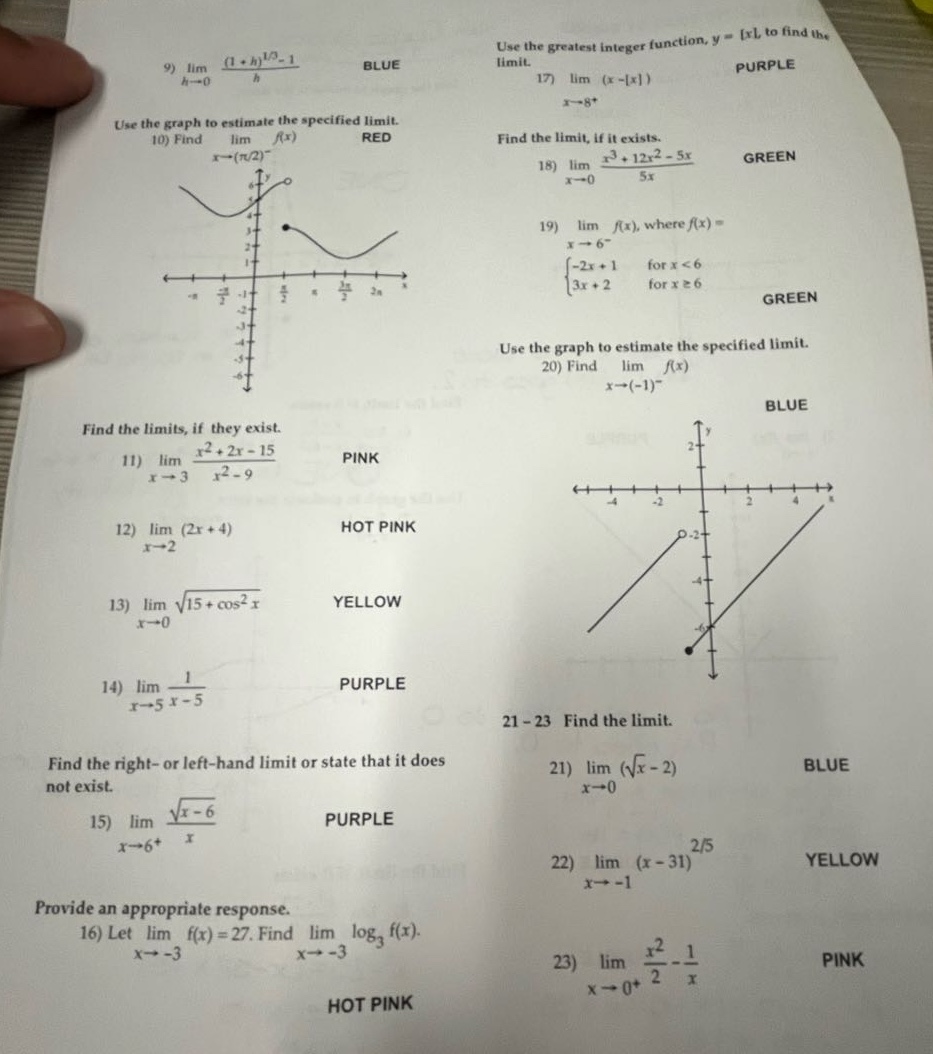
9) $lim_{h \to 0}\frac{(1 + h)^{1/3}-1}{h}$ blue\nuse the graph to estimate the specified limit.\n10) find $lim_{x \to (pi/2)^{-}}f(x)$ red\nfind the limits, if they exist.\n11) $lim_{x \to 3}\frac{x^{2}+2x - 15}{x^{2}-9}$ pink\n12) $lim_{x \to 2}(2x + 4)$ hot pink\n13) $lim_{x \to 0}sqrt{15+cos^{2}x}$ yellow\n14) $lim_{x \to 5}\frac{1}{x - 5}$ purple\nfind the right - or left - hand limit or state that it does not exist.\n15) $lim_{x \to 6^{+}}\frac{sqrt{x - 6}}{x}$ purple\nprovide an appropriate response.\n16) let $lim_{x \to - 3}f(x)=27$. find $lim_{x \to - 3}log_{3}f(x)$. hot pink\nuse the greatest integer function, $y = x$, to find the limit.\n17) $lim_{x \to 8^{+}}(x - x)$ purple\nfind the limit, if it exists.\n18) $lim_{x \to 0}\frac{x^{3}+12x^{2}-5x}{5x}$ green\n19) $lim_{x \to 6^{-}}f(x)$, where $f(x)=\begin{cases}-2x + 1& \text{for }x<6\\3x + 2& \text{for }xgeq6end{cases}$ green\nuse the graph to estimate the specified limit.\n20) find $lim_{x \to (-1)^{-}}f(x)$ blue\n21 - 23 find the limit.\n21) $lim_{x \to 0}(sqrt{x}-2)$ blue\n22) $lim_{x \to - 1}(x - 31)^{2/5}$ yellow\n23) $lim_{x \to 0^{+}}\frac{x^{2}}{2}-\frac{1}{x}$ pink
Answer
Explanation:
Step1: Recall limit - related rules
For example, for rational - function limits, we may simplify the function first. For limits involving square - roots or trigonometric functions, we use their properties.
Step2: Solve problem 9
We use the binomial expansion ((a + b)^n=a^n+na^{n - 1}b+\cdots+b^n). Here (a = 1), (b=h), and (n=\frac{1}{3}). ((1 + h)^{\frac{1}{3}}=1+\frac{1}{3}h+O(h^2)). Then (\lim_{h\rightarrow0}\frac{(1 + h)^{\frac{1}{3}}-1}{h}=\lim_{h\rightarrow0}\frac{1+\frac{1}{3}h+O(h^2)-1}{h}=\lim_{h\rightarrow0}\frac{\frac{1}{3}h+O(h^2)}{h}=\frac{1}{3}).
Step3: Solve problem 10
Estimate the limit from the graph. As (x\rightarrow(\frac{\pi}{2})^{-}), we look at the value that the function (y = f(x)) approaches from the left - hand side of (x=\frac{\pi}{2}) on the graph.
Step4: Solve problem 11
Factor the numerator and denominator: (\frac{x^{2}+2x - 15}{x^{2}-9}=\frac{(x + 5)(x - 3)}{(x + 3)(x - 3)}). Cancel out the common factor ((x - 3)) (since (x\rightarrow3) but (x\neq3)), then (\lim_{x\rightarrow3}\frac{x^{2}+2x - 15}{x^{2}-9}=\lim_{x\rightarrow3}\frac{x + 5}{x + 3}=\frac{3+5}{3+3}=\frac{4}{3}).
Step5: Solve problem 12
Use the direct - substitution property of limits. (\lim_{x\rightarrow2}(2x + 4)=2\times2+4=8).
Step6: Solve problem 13
Since (\cos(0)=1), then (\lim_{x\rightarrow0}\sqrt{15+\cos^{2}x}=\sqrt{15 + 1^2}=4).
Step7: Solve problem 14
As (x\rightarrow5), the denominator (x - 5\rightarrow0) and the numerator is a non - zero constant. So (\lim_{x\rightarrow5}\frac{1}{x - 5}) does not exist (the limit is either (\infty) or (-\infty)).
Step8: Solve problem 15
As (x\rightarrow6^{+}), (\sqrt{x - 6}\rightarrow0^{+}) and (x\rightarrow6^{+}). So (\lim_{x\rightarrow6^{+}}\frac{\sqrt{x - 6}}{x}=0).
Step9: Solve problem 16
Use the property of limits and logarithms. If (\lim_{x\rightarrow - 3}f(x)=27), then (\lim_{x\rightarrow - 3}\log_{3}f(x)=\log_{3}(\lim_{x\rightarrow - 3}f(x))=\log_{3}27 = 3).
Step10: Solve problem 17
The greatest - integer function ([x]) gives the greatest integer less than or equal to (x). As (x\rightarrow8^{+}), ([x]=8), so (\lim_{x\rightarrow8^{+}}(x-[x])=\lim_{x\rightarrow8^{+}}(x - 8)=0).
Step11: Solve problem 18
Simplify the function (\frac{x^{3}+12x^{2}-5x}{5x}=\frac{x(x^{2}+12x - 5)}{5x}=\frac{x^{2}+12x - 5}{5}) (for (x\neq0)). Then (\lim_{x\rightarrow0}\frac{x^{3}+12x^{2}-5x}{5x}=\lim_{x\rightarrow0}\frac{x^{2}+12x - 5}{5}=\frac{0^{2}+12\times0 - 5}{5}=-1).
Step12: Solve problem 19
As (x\rightarrow6^{-}), (f(x)=-2x + 1). So (\lim_{x\rightarrow6^{-}}f(x)=-2\times6+1=-11).
Step13: Solve problem 20
Estimate the limit from the graph. As (x\rightarrow(-1)^{-}), we look at the value that the function (y = f(x)) approaches from the left - hand side of (x=-1) on the graph.
Step14: Solve problem 21
As (x\rightarrow0), (\lim_{x\rightarrow0}(\sqrt{x}-2)) does not exist in the set of real numbers since (\sqrt{x}) is not a real number for (x\lt0) in the real - number system. If we consider the right - hand limit (\lim_{x\rightarrow0^{+}}(\sqrt{x}-2)=-2).
Step15: Solve problem 22
Use the direct - substitution property. (\lim_{x\rightarrow - 1}(x - 31)^{\frac{2}{5}}=((-1)-31)^{\frac{2}{5}}=(-32)^{\frac{2}{5}}=((-2)^5)^{\frac{2}{5}}=4).
Step16: Solve problem 23
Rewrite the function (\frac{x^{2}}{2}-\frac{1}{x}=\frac{x^{3}-2}{2x}). As (x\rightarrow0^{+}), the numerator (x^{3}-2\rightarrow - 2) and the denominator (2x\rightarrow0^{+}), so (\lim_{x\rightarrow0^{+}}\frac{x^{2}}{2}-\frac{1}{x}=-\infty).
Answer:
- (\frac{1}{3})
- Estimated from the graph
- (\frac{4}{3})
- (8)
- (4)
- Does not exist
- (0)
- (3)
- (0)
- (-1)
- (-11)
- Estimated from the graph
- Right - hand limit is (-2)
- (4)
- (-\infty)