8) $lim_{x\rightarrow\frac{3pi}{4}^{-}}2sec(2x)$
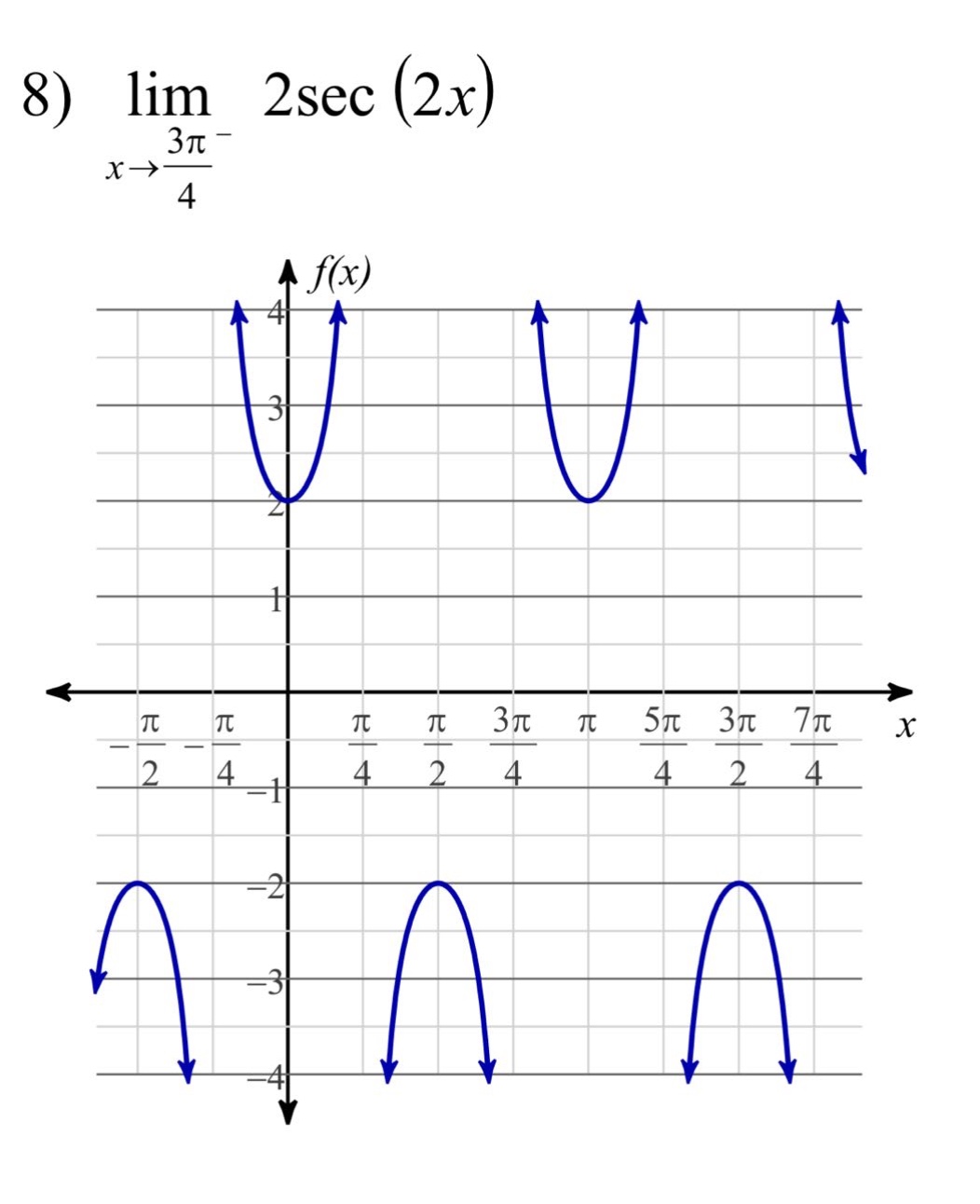
8) $lim_{x\rightarrow\frac{3pi}{4}^{-}}2sec(2x)$
Answer
Explanation:
Step1: Rewrite the secant function in terms of cosine.
The function is $f(x) = 2\sec(2x)$. We can rewrite $\sec(2x)$ as $\frac{1}{\cos(2x)}$. $$f(x) = \frac{2}{\cos(2x)}$$ We need to find the limit: $$\lim_{x \to \frac{3\pi}{4}^-} \frac{2}{\cos(2x)}$$
Step2: Analyze the argument of the cosine function as $x$ approaches $\frac{3\pi}{4}$ from the left.
Let $u = 2x$. As $x \to \frac{3\pi}{4}^-$, $u \to 2 \cdot \frac{3\pi}{4}^- = \frac{3\pi}{2}^-$. This means $u$ approaches $\frac{3\pi}{2}$ from values slightly less than $\frac{3\pi}{2}$.
Step3: Evaluate the cosine function as its argument approaches $\frac{3\pi}{2}$ from the left.
As $u \to \frac{3\pi}{2}^-$, we consider values of $u$ in the third quadrant, close to $\frac{3\pi}{2}$. In the third quadrant, the cosine function is negative. As $u \to \frac{3\pi}{2}$, $\cos(u) \to \cos(\frac{3\pi}{2}) = 0$. Since $u$ is approaching $\frac{3\pi}{2}$ from the left (e.g., $u = \frac{3\pi}{2} - \epsilon$ where $\epsilon$ is a small positive number), $\cos(u)$ will be a small negative number. So, $\cos(2x) \to 0^-$ as $x \to \frac{3\pi}{4}^-$.
Step4: Evaluate the limit of the function.
Now we can evaluate the limit: $$\lim_{x \to \frac{3\pi}{4}^-} \frac{2}{\cos(2x)} = \frac{2}{0^-}$$ When the numerator is a positive constant and the denominator approaches 0 from the negative side, the limit tends to negative infinity. $$\lim_{x \to \frac{3\pi}{4}^-} 2\sec(2x) = -\infty$$ This is also confirmed by the provided graph, where as $x$ approaches $\frac{3\pi}{4}$ from the left, the function $f(x)$ tends towards $-\infty$.
Answer:
$$-\infty$$