$$lim_{x\rightarrow0}\frac{cos x - 1}{e^{x}+e^{-x}-2}$$
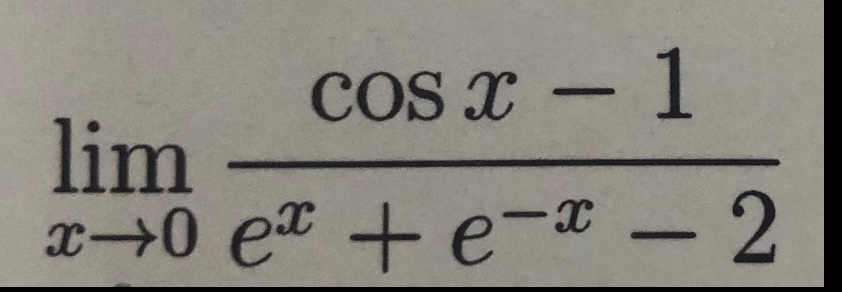
$$lim_{x\rightarrow0}\frac{cos x - 1}{e^{x}+e^{-x}-2}$$
Answer
Explanation:
Step1: Apply L - H rule
Since $\lim_{x\rightarrow0}\frac{\cos x - 1}{e^{x}+e^{-x}-2}$ is in the $\frac{0}{0}$ form (when $x = 0$, $\cos(0)-1=1 - 1=0$ and $e^{0}+e^{-0}-2=1 + 1-2 = 0$), we differentiate the numerator and denominator. The derivative of $\cos x-1$ is $-\sin x$, and the derivative of $e^{x}+e^{-x}-2$ is $e^{x}-e^{-x}$. So we get $\lim_{x\rightarrow0}\frac{-\sin x}{e^{x}-e^{-x}}$.
Step2: Check the form and apply L - H rule again
When $x = 0$, $\frac{-\sin(0)}{e^{0}-e^{-0}}=\frac{0}{1 - 1}=\frac{0}{0}$. Differentiate the numerator and denominator again. The derivative of $-\sin x$ is $-\cos x$, and the derivative of $e^{x}-e^{-x}$ is $e^{x}+e^{-x}$. So we have $\lim_{x\rightarrow0}\frac{-\cos x}{e^{x}+e^{-x}}$.
Step3: Substitute $x = 0$
Substitute $x = 0$ into $\frac{-\cos x}{e^{x}+e^{-x}}$. We get $\frac{-\cos(0)}{e^{0}+e^{-0}}=\frac{-1}{1 + 1}=-\frac{1}{2}$.
Answer:
$-\frac{1}{2}$