a linear function and an exponential function are shown below.\nover which interval does the growth rate of…
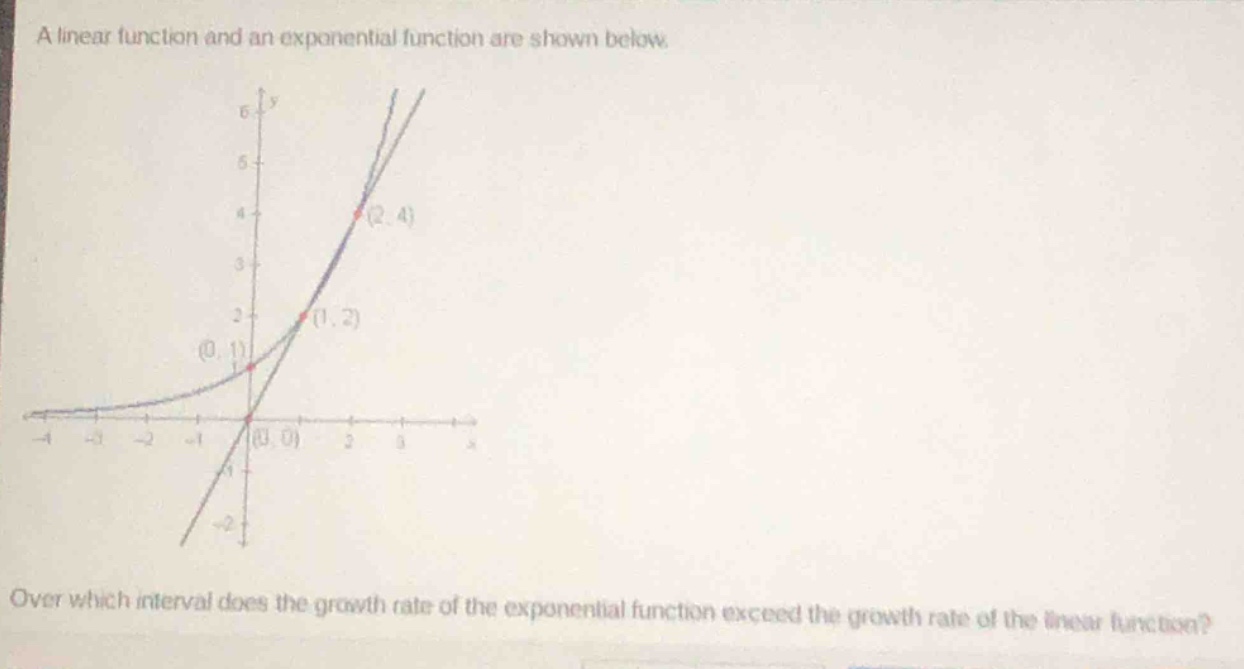
a linear function and an exponential function are shown below.\nover which interval does the growth rate of the exponential function exceed the growth rate of the linear function?
Answer
Explanation:
Step1: Recall growth - rate concept
The growth - rate of a linear function $y = mx + b$ is its slope $m$, and for an exponential function $y=a\cdot b^{x}$ is related to its derivative (or we can use the average rate of change). The average rate of change of a function $y = f(x)$ over the interval $[x_1,x_2]$ is $\frac{f(x_2)-f(x_1)}{x_2 - x_1}$. Let the linear function pass through the points $(0,0)$ and $(2,4)$. The slope $m$ of the linear function using the formula $m=\frac{y_2 - y_1}{x_2 - x_1}$ is $m=\frac{4 - 0}{2-0}=2$. Let the exponential function pass through the points $(0,1)$, $(1,2)$ and $(2,4)$. The average rate of change of the exponential function over $[0,1]$ is $\frac{2 - 1}{1-0}=1$, over $[1,2]$ is $\frac{4 - 2}{2 - 1}=2$.
Step2: Analyze intervals
For $x<2$, the average rate of change of the exponential function is less than or equal to the slope of the linear function. For $x>2$, as $x$ increases, the exponential function $y = 2^{x}$ (since $a = 1,b = 2$ from the points $(0,1)$ and $(1,2)$) will have a faster - growing rate. The average rate of change of the exponential function over an interval $[x_1,x_2]$ with $x_1>2$ will be greater than 2.
Answer:
$x>2$