lionel computed the average rate of change in the depth of a pool over a two - week interval to be zero…
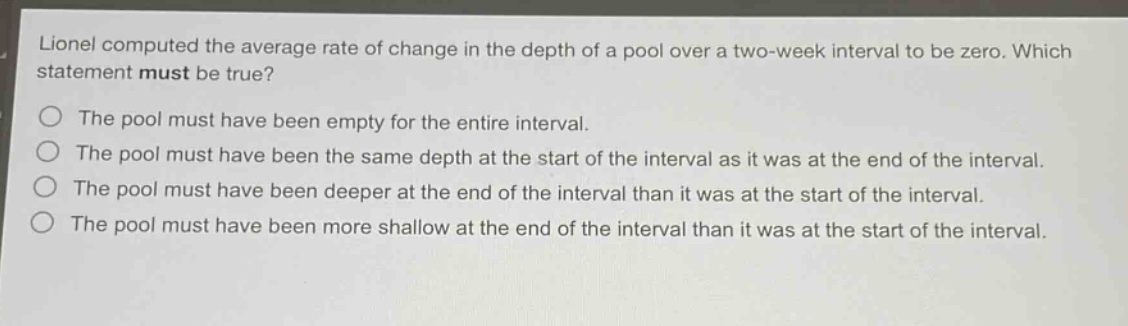
lionel computed the average rate of change in the depth of a pool over a two - week interval to be zero. which statement must be true? the pool must have been empty for the entire interval. the pool must have been the same depth at the start of the interval as it was at the end of the interval. the pool must have been deeper at the end of the interval than it was at the start of the interval. the pool must have been more shallow at the end of the interval than it was at the start of the interval.
Answer
Brief Explanations:
The average rate of change of a quantity over an interval is calculated as $\frac{\text{Change in Quantity}}{\text{Change in Time}}$. If the average rate of change is zero, it means the change in the quantity (depth of the pool here) is zero over the time - interval. So, the initial and final values of the quantity are the same.
Answer:
The pool must have been the same depth at the start of the interval as it was at the end of the interval.