f(x)=ln(x + 2)-3\na) what are the domain and range of f? enter your answers in interval notation.\ndomain\n(…
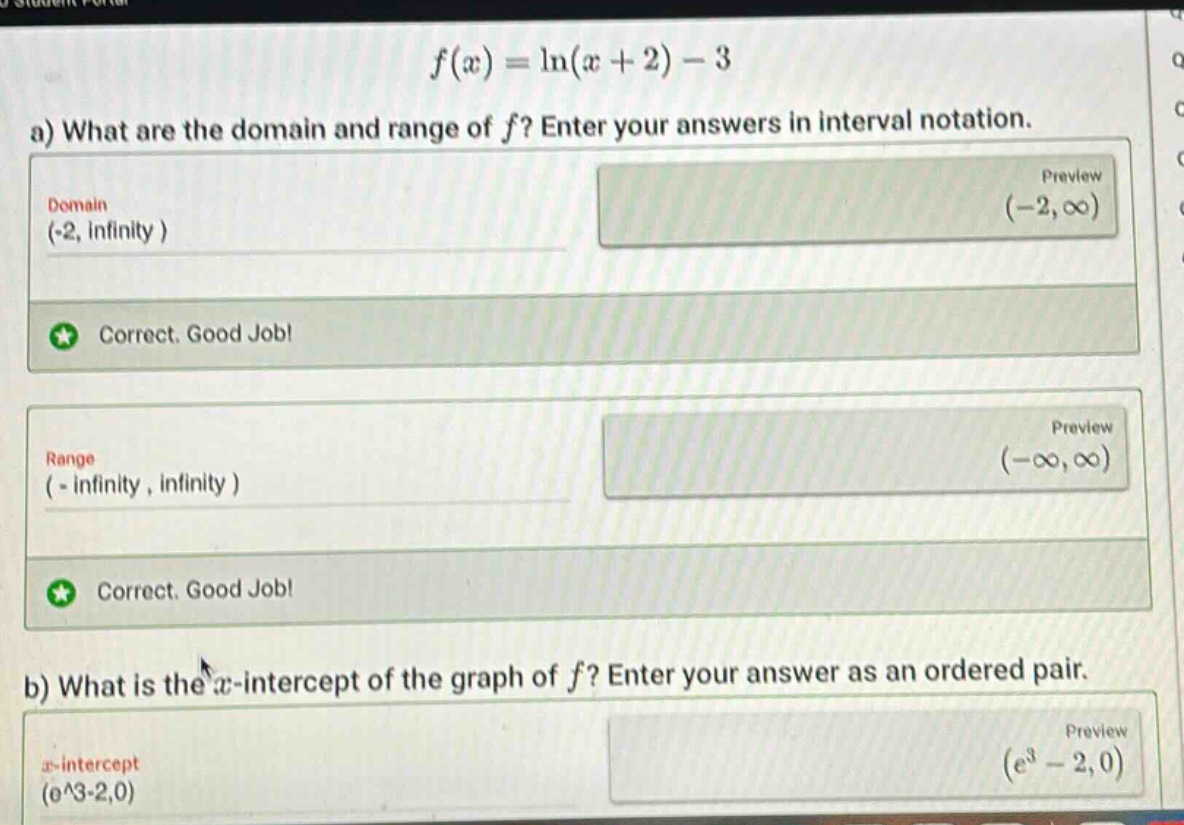
f(x)=ln(x + 2)-3\na) what are the domain and range of f? enter your answers in interval notation.\ndomain\n(-2, infinity )\npreview\n(-2,∞)\ncorrect. good job!\nrange\n(-infinity, infinity )\npreview\n(-∞,∞)\ncorrect. good job!\nb) what is the x - intercept of the graph of f? enter your answer as an ordered pair.\nx - intercept\n(e^3 - 2,0)\n(e^3-2,0)
Answer
Explanation:
Step1: Recall x - intercept definition
Set (y = f(x)=0), so (\ln(x + 2)-3=0).
Step2: Isolate the natural - logarithm term
Add 3 to both sides: (\ln(x + 2)=3).
Step3: Convert from logarithmic to exponential form
By the definition (y=\ln u) is equivalent to (e^{y}=u), we have (x + 2=e^{3}).
Step4: Solve for x
Subtract 2 from both sides: (x=e^{3}-2).
Answer:
((e^{3}-2,0))