1/2 ∫₀.₁₅₈₅₉³.₁₄₆₁₉ ((ln(x) - 2) - (x - 4))² dx
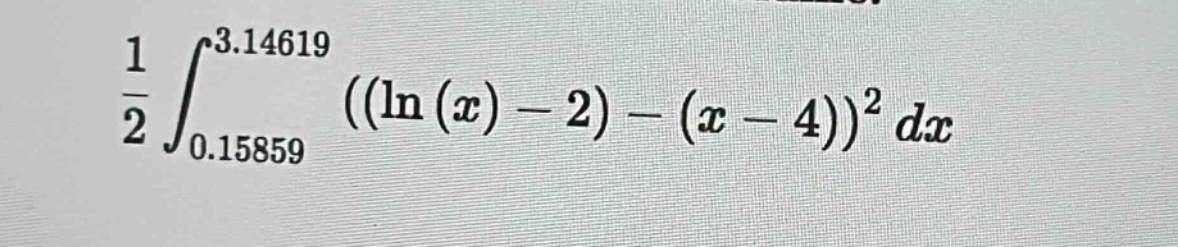
1/2 ∫₀.₁₅₈₅₉³.₁₄₆₁₉ ((ln(x) - 2) - (x - 4))² dx
Answer
Explanation:
Step1: Expand the integrand
First, expand $((\ln(x)-2)-(x - 4))^{2}=(\ln(x)-x + 2)^{2}=(\ln(x))^{2}-2x\ln(x)+4\ln(x)+x^{2}-4x + 4$.
Step2: Integrate term - by - term
- $\int(\ln(x))^{2}dx=x(\ln(x))^{2}-2x\ln(x)+2x+C_1$ (using integration by parts twice, let $u = (\ln(x))^{2},dv=dx$ for the first step and then for the resulting integral).
- $\int(-2x\ln(x))dx=-x^{2}\ln(x)+\frac{1}{2}x^{2}+C_2$ (using integration by parts with $u=\ln(x),dv = 2xdx$).
- $\int4\ln(x)dx=4x\ln(x)-4x+C_3$ (using integration by parts with $u = \ln(x),dv=4dx$).
- $\int x^{2}dx=\frac{1}{3}x^{3}+C_4$.
- $\int(-4x)dx=-2x^{2}+C_5$.
- $\int4dx=4x+C_6$. The integral of the expanded function is $\int((\ln(x))^{2}-2x\ln(x)+4\ln(x)+x^{2}-4x + 4)dx=x(\ln(x))^{2}-2x\ln(x)+2x - x^{2}\ln(x)+\frac{1}{2}x^{2}+4x\ln(x)-4x+\frac{1}{3}x^{3}-2x^{2}+4x+C$. Simplify it to $x(\ln(x))^{2}-x^{2}\ln(x)+2x\ln(x)+\frac{1}{3}x^{3}-\frac{3}{2}x^{2}+2x+C$.
Step3: Evaluate the definite integral
$\frac{1}{2}\left[\left(x(\ln(x))^{2}-x^{2}\ln(x)+2x\ln(x)+\frac{1}{3}x^{3}-\frac{3}{2}x^{2}+2x\right)\big|_{0.15859}^{3.14619}\right]$. Let $F(x)=x(\ln(x))^{2}-x^{2}\ln(x)+2x\ln(x)+\frac{1}{3}x^{3}-\frac{3}{2}x^{2}+2x$. $F(3.14619)=3.14619(\ln(3.14619))^{2}-(3.14619)^{2}\ln(3.14619)+2\times3.14619\ln(3.14619)+\frac{1}{3}(3.14619)^{3}-\frac{3}{2}(3.14619)^{2}+2\times3.14619$. $F(0.15859)=0.15859(\ln(0.15859))^{2}-(0.15859)^{2}\ln(0.15859)+2\times0.15859\ln(0.15859)+\frac{1}{3}(0.15859)^{3}-\frac{3}{2}(0.15859)^{2}+2\times0.15859$. Calculate $F(3.14619)-F(0.15859)$ and then multiply by $\frac{1}{2}$.
Answer:
(The numerical result after performing the above - mentioned calculations)