for ( f(x)=x-ln x ), and ( 0.1 leq x leq 2 ), find the following.\n(a) find the values of ( x ) for which (…
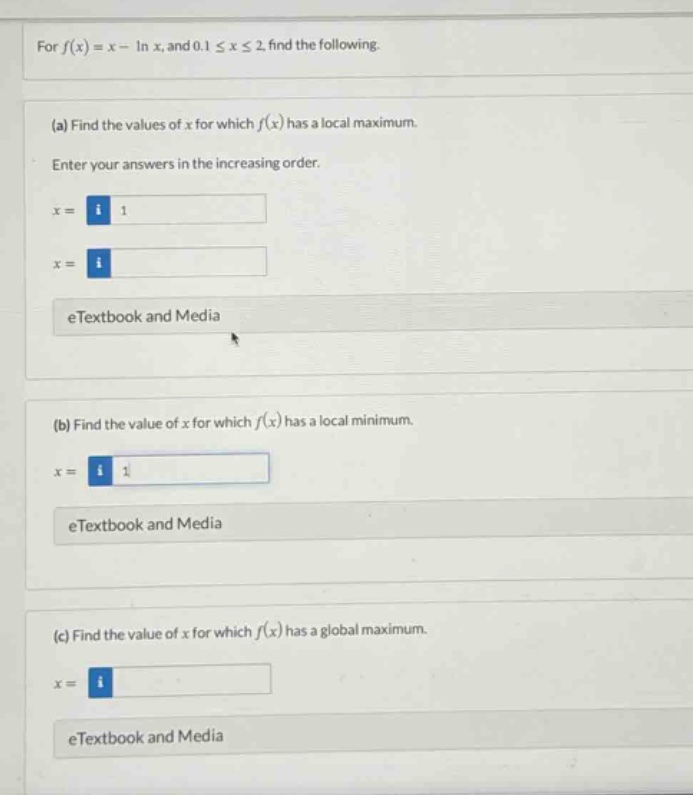
for ( f(x)=x-ln x ), and ( 0.1 leq x leq 2 ), find the following.\n(a) find the values of ( x ) for which ( f(x) ) has a local maximum.\nenter your answers in the increasing order.\n( x=)\n( x=)\n(b) find the value of ( x ) for which ( f(x) ) has a local minimum.\n( x=)\n(c) find the value of ( x ) for which ( f(x) ) has a global maximum.\n( x=)
Answer
Explanation:
Step1: Find the first - derivative
The function is (f(x)=x - \ln x), and its derivative (f^{\prime}(x)=\frac{d}{dx}(x)-\frac{d}{dx}(\ln x)). Using the power rule (\frac{d}{dx}(x^{n})=nx^{n - 1}) ((n = 1) for (y=x)) and the formula (\frac{d}{dx}(\ln x)=\frac{1}{x}), we get (f^{\prime}(x)=1-\frac{1}{x}=\frac{x - 1}{x}).
Step2: Find the critical points
Set (f^{\prime}(x)=0), so (\frac{x - 1}{x}=0). Since (x\neq0) (because the domain of (y = \ln x) is (x>0)), then (x - 1=0), which gives (x = 1).
Step3: Use the second - derivative test
Find the second - derivative (f^{\prime\prime}(x)=\frac{d}{dx}(1-\frac{1}{x})). (f^{\prime\prime}(x)=\frac{1}{x^{2}}). When (x = 1), (f^{\prime\prime}(1)=1>0). So (x = 1) is a local minimum.
Step4: Evaluate the function at the endpoints and the critical point
The endpoints of the interval ([0.1,2]) are (x = 0.1) and (x = 2), and the critical point is (x = 1). (f(0.1)=0.1-\ln(0.1)=0.1+2.3026\approx2.4026). (f(1)=1-\ln(1)=1). (f(2)=2-\ln(2)\approx2 - 0.6931 = 1.3069).
Answer:
(a) There is no local maximum. (b) (x = 1) (c) (x=0.1)