o y = ln x - 3\no y = ln x - 4\no y = e^x - 3\no y = e^x - 4
o y = ln x - 3\no y = ln x - 4\no y = e^x - 3\no y = e^x - 4
Answer
Explanation:
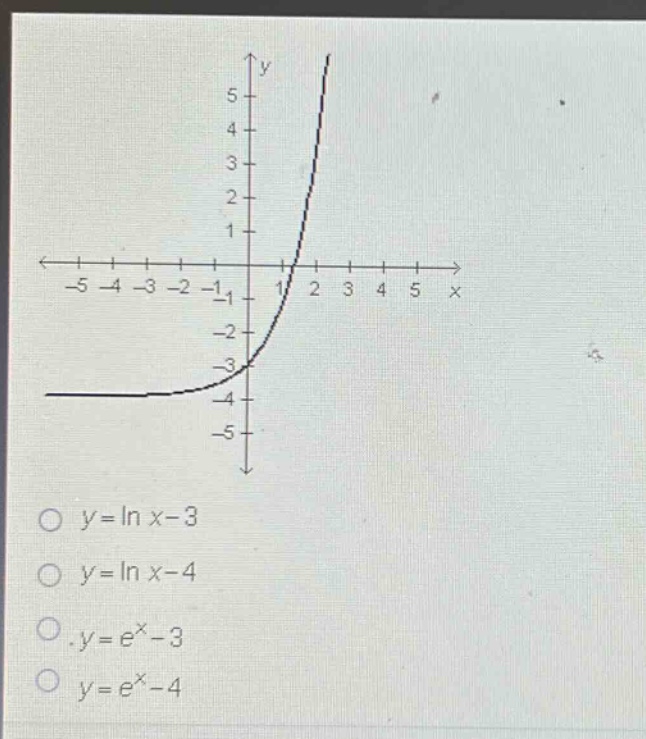
Step1: Analyze the y - intercept
The y - intercept of a function (y = f(x)) is found by setting (x = 0). For the given graph, the y - intercept is around (y=-3). For (y=\ln x - 3) and (y=\ln x - 4), the natural - logarithm function (\ln x) is undefined for (x = 0), so these two functions can be excluded. For (y = e^{x}-3), when (x = 0), (y=e^{0}-3=1 - 3=-2). For (y = e^{x}-4), when (x = 0), (y=e^{0}-4=1 - 4=-3).
Step2: Analyze the general shape
The exponential function (y = e^{x}) has a horizontal asymptote at (y = 0). The function (y=e^{x}-4) has a horizontal asymptote at (y=-4), which is consistent with the graph. The function (y = e^{x}-3) has a horizontal asymptote at (y=-3), but from the y - intercept analysis, (y = e^{x}-4) is a better fit.
Answer:
(y = e^{x}-4)