o y = ln x\no y = ln x + 1\no y = e^x\no y = e^x + 1
o y = ln x\no y = ln x + 1\no y = e^x\no y = e^x + 1
Answer
Explanation:
Step1: Analyze domain of functions
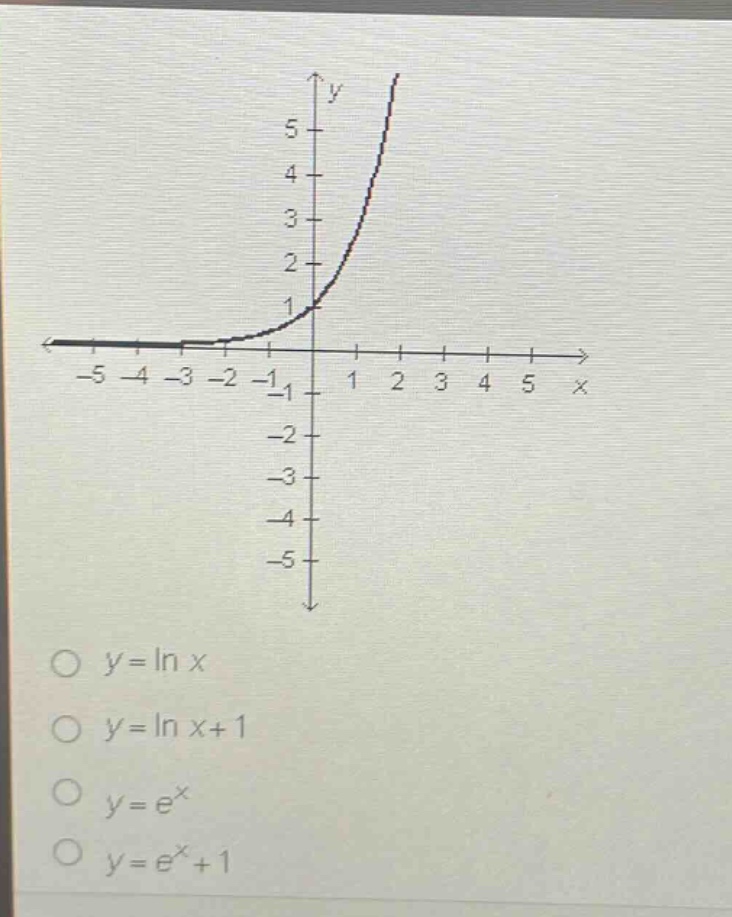
The domain of $y = \ln x$ and $y=\ln x + 1$ is $x>0$. But the given graph has points for $x < 0$, so these two options are not correct.
Step2: Analyze $y = e^x$ and $y=e^x + 1$
The function $y = e^x$ has a $y$-intercept at $(0,1)$ since when $x = 0$, $y=e^0=1$. The function $y=e^x + 1$ has a $y$-intercept at $(0,2)$ since when $x = 0$, $y=e^0 + 1=2$. The graph in the picture has a $y$-intercept at $(0,1)$.
Answer:
$y = e^x$