o y = e^x o y = e^x - 1 o y = ln x o y = ln x - 1
o y = e^x o y = e^x - 1 o y = ln x o y = ln x - 1
Answer
Explanation:
Step1: Check y - intercept
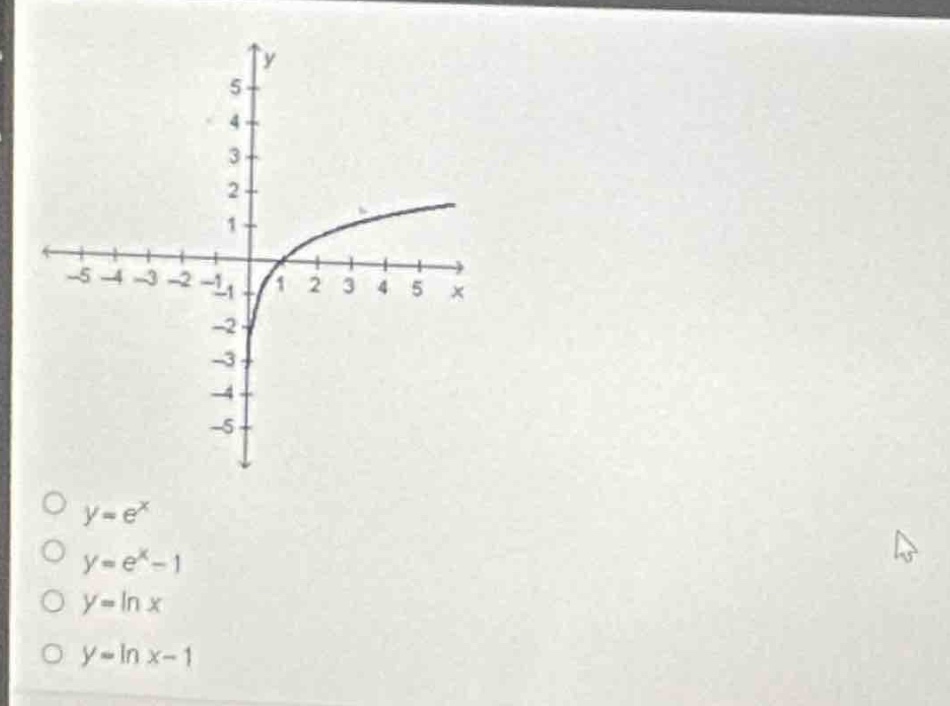
For $y = e^{x}$, when $x = 0$, $y=e^{0}=1$. For $y = e^{x}-1$, when $x = 0$, $y=e^{0}-1=0$. For $y=\ln x$, the function is not defined at $x = 0$. For $y=\ln x - 1$, the function is not defined at $x = 0$. The graph has a y - intercept around $y=- 1$ which eliminates $y = e^{x}$ and $y = e^{x}-1$ since they are exponential functions and defined for all real $x$ and have non - negative y - intercepts.
Step2: Analyze domain and behavior
The domain of $y=\ln x$ and $y=\ln x - 1$ is $x>0$. The general shape of the natural logarithm function $y = \ln x$ passes through the point $(1,0)$. The function $y=\ln x-1$ is a vertical shift of $y = \ln x$ down by 1 unit. When $x = 1$, $y=\ln(1)-1=0 - 1=-1$. The graph shown has a point close to $(1, - 1)$ and has the characteristic shape of a logarithmic function.
Answer:
$y=\ln x - 1$