f(x) = ln(6 - x)\nstep 1\nwe must first recognize that f(x) = ln(6 - x) is an anti - derivative of a more…
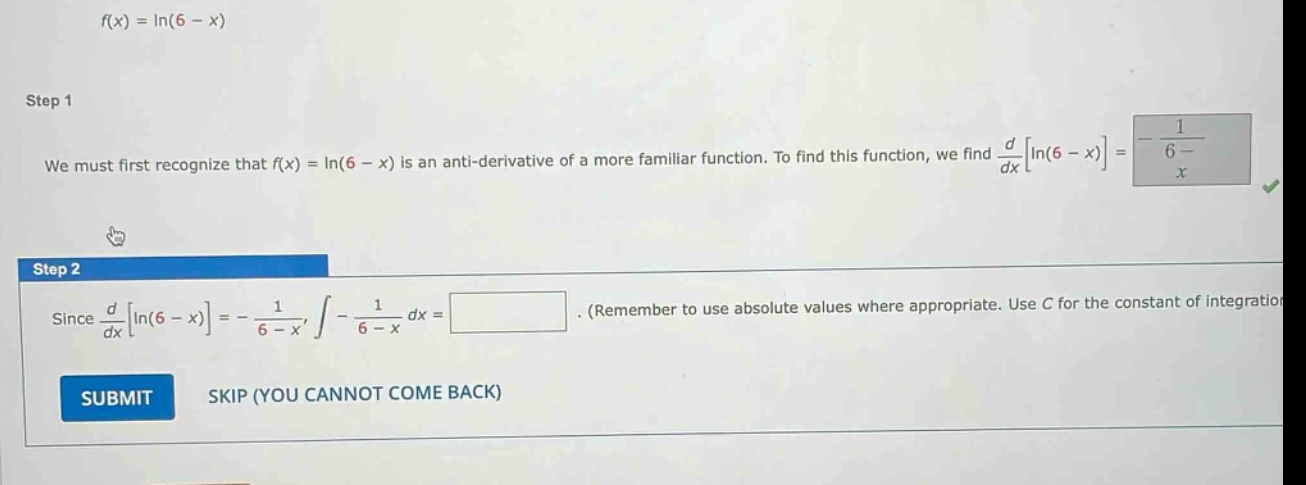
f(x) = ln(6 - x)\nstep 1\nwe must first recognize that f(x) = ln(6 - x) is an anti - derivative of a more familiar function. to find this function, we find d/dxln(6 - x) = -1/(6 - x)\nstep 2\nsince d/dxln(6 - x) = -1/(6 - x), ∫ -1/(6 - x) dx = (remember to use absolute values where appropriate. use c for the constant of integration)\nsubmit skip (you cannot come back)
Answer
Explanation:
Step1: Recall integration - derivative relationship
If $\frac{d}{dx}F(x)=f(x)$, then $\int f(x)dx = F(x)+C$. Here $F(x)=\ln(6 - x)$ and $f(x)=-\frac{1}{6 - x}$.
Step2: Apply the integration formula
Since $\frac{d}{dx}[\ln(6 - x)]=-\frac{1}{6 - x}$, by the fundamental theorem of calculus, $\int-\frac{1}{6 - x}dx=\ln|6 - x|+C$.
Answer:
$\ln|6 - x|+C$