locate the critical points of the following function. then use the second derivative test to determine…
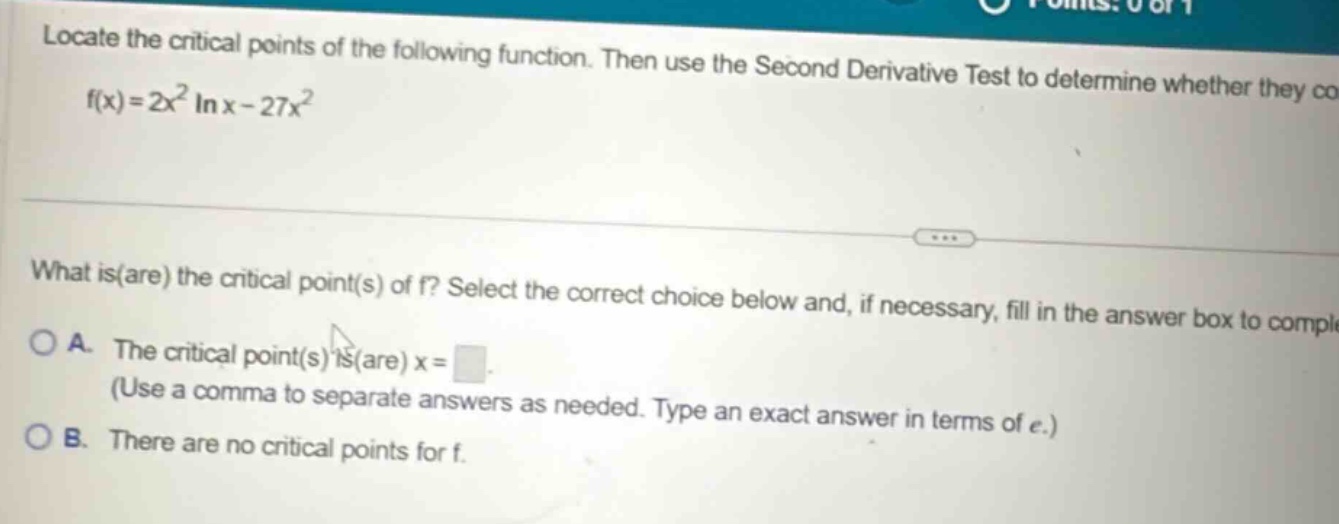
locate the critical points of the following function. then use the second derivative test to determine whether they co f(x)=2x² in x - 27x² what is(are) the critical point(s) of f? select the correct choice below and, if necessary, fill in the answer box to compl o a. the critical point(s) is(are) x = (use a comma to separate answers as needed. type an exact answer in terms of e.) o b. there are no critical points for f.
Answer
Explanation:
Step1: Find the first - derivative
Use product rule $(uv)^\prime = u^\prime v+uv^\prime$ where $u = 2x^{2}$ and $v=\ln x$. The derivative of $2x^{2}\ln x$ is $4x\ln x + 2x$, and the derivative of $-27x^{2}$ is $-54x$. So $f^\prime(x)=4x\ln x + 2x-54x=4x\ln x - 52x=4x(\ln x - 13)$.
Step2: Set the first - derivative equal to zero
Set $f^\prime(x)=0$. Since $4x(\ln x - 13)=0$, we have two cases: $4x = 0$ or $\ln x - 13=0$. The domain of $y = f(x)$ is $x>0$ (because of $\ln x$), so we ignore $x = 0$. Solving $\ln x - 13=0$ gives $\ln x=13$, and then $x = e^{13}$.
Answer:
A. The critical point(s) is(are) $x = e^{13}$