locate the critical points of the following function. then use the second derivative test to determine…
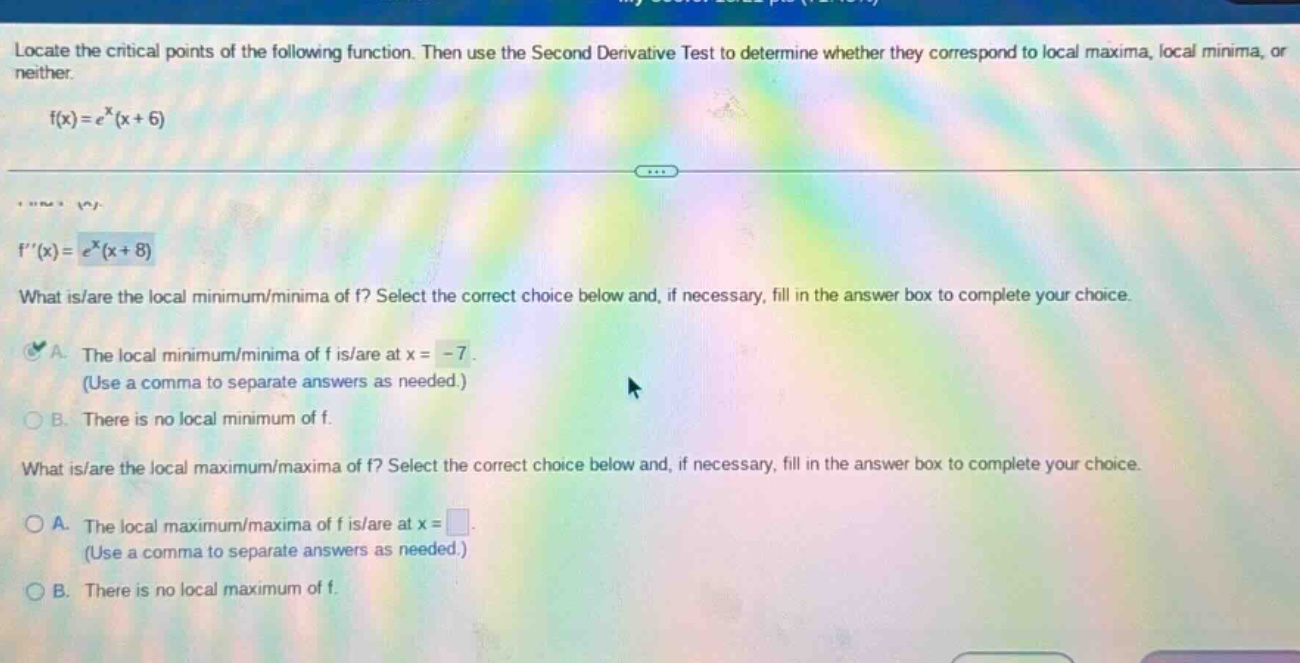
locate the critical points of the following function. then use the second derivative test to determine whether they correspond to local maxima, local minima, or neither. f(x)=e^x(x + 6) f(x)=e^x(x + 8) what is/are the local minimum/minima of f? select the correct choice below and, if necessary, fill in the answer box to complete your choice. a. the local minimum/minima of f is/are at x = -7. (use a comma to separate answers as needed.) b. there is no local minimum of f. what is/are the local maximum/maxima of f? select the correct choice below and, if necessary, fill in the answer box to complete your choice. a. the local maximum/maxima of f is/are at x = . (use a comma to separate answers as needed.) b. there is no local maximum of f.
Answer
Explanation:
Step1: Find the first - derivative
Use the product rule $(uv)^\prime = u^\prime v+uv^\prime$, where $u = e^{x}$ and $v=x + 6$. Then $u^\prime=e^{x}$ and $v^\prime = 1$. So $f^\prime(x)=e^{x}(x + 6)+e^{x}=e^{x}(x + 7)$. Set $f^\prime(x)=0$. Since $e^{x}\gt0$ for all real $x$, then $x+7 = 0$, and the critical point is $x=-7$.
Step2: Apply the second - derivative test
We are given $f^{\prime\prime}(x)=e^{x}(x + 8)$. Evaluate $f^{\prime\prime}(-7)$: Substitute $x=-7$ into $f^{\prime\prime}(x)$, we get $f^{\prime\prime}(-7)=e^{-7}(-7 + 8)=e^{-7}\gt0$. When $f^{\prime\prime}(c)\gt0$ at a critical point $c$, the function has a local minimum at $x = c$. So $f(x)$ has a local minimum at $x=-7$ and no local maximum.
Answer:
The local minimum/minima of f is/are at x = - 7. There is no local maximum of f. So the answers are: A. The local minimum/minima of f is/are at x = - 7. B. There is no local maximum of f.