logistic function worksheet\ngraphing functions: graph the function. identify the asymptotes, y - intercept…
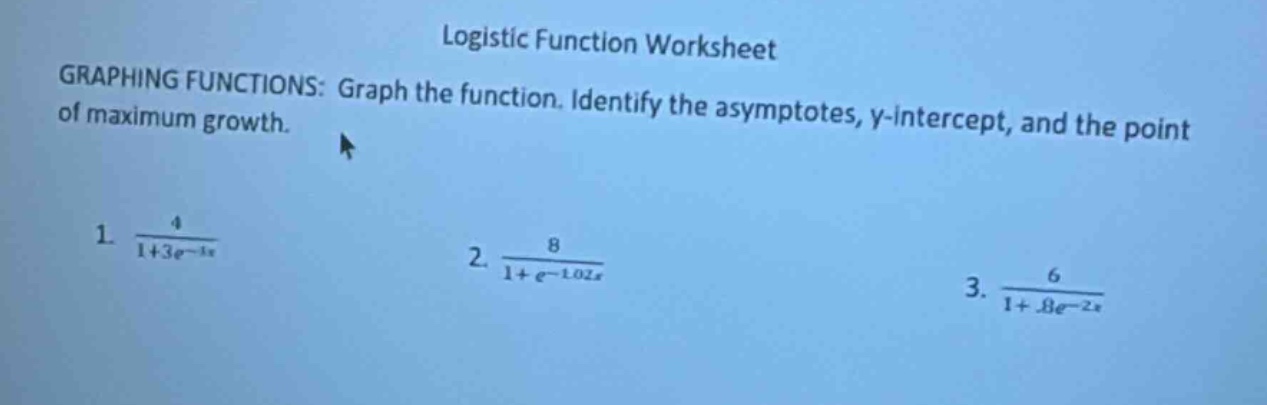
logistic function worksheet\ngraphing functions: graph the function. identify the asymptotes, y - intercept, and the point of maximum growth.\n1. 4 / (1 + 3e^(-3x))\n2. 8 / (1 + e^(-1.02x))\n3. 6 / (1 + 8e^(-2x))
Answer
Explanation:
Step1: Recall logistic - function form
The general form of a logistic function is $y=\frac{L}{1 + ae^{-bx}}$, where $L$ is the upper - horizontal asymptote, $y(0)=\frac{L}{1 + a}$ is the y - intercept, and the point of maximum growth occurs at $x=\frac{\ln a}{b}$.
Step2: For the function $y = \frac{4}{1+3e^{-3x}}$
Asymptotes:
As $x\to\infty$, $e^{-3x}\to0$, so $y\to4$. The upper - horizontal asymptote is $y = 4$. As $x\to-\infty$, $e^{-3x}\to\infty$, so $y\to0$. The lower - horizontal asymptote is $y = 0$.
Y - intercept:
Set $x = 0$. Then $y=\frac{4}{1 + 3e^{0}}=\frac{4}{1+3}=1$.
Point of maximum growth:
Here $a = 3$ and $b = 3$. So $x=\frac{\ln3}{3}$.
Step3: For the function $y=\frac{8}{1+e^{-1.02x}}$
Asymptotes:
As $x\to\infty$, $e^{-1.02x}\to0$, so $y\to8$. The upper - horizontal asymptote is $y = 8$. As $x\to-\infty$, $e^{-1.02x}\to\infty$, so $y\to0$. The lower - horizontal asymptote is $y = 0$.
Y - intercept:
Set $x = 0$. Then $y=\frac{8}{1 + e^{0}}=\frac{8}{2}=4$.
Point of maximum growth:
Here $a = 1$ and $b = 1.02$. So $x=\frac{\ln1}{1.02}=0$.
Step4: For the function $y=\frac{6}{1 + 8e^{-2x}}$
Asymptotes:
As $x\to\infty$, $e^{-2x}\to0$, so $y\to6$. The upper - horizontal asymptote is $y = 6$. As $x\to-\infty$, $e^{-2x}\to\infty$, so $y\to0$. The lower - horizontal asymptote is $y = 0$.
Y - intercept:
Set $x = 0$. Then $y=\frac{6}{1+8e^{0}}=\frac{6}{9}=\frac{2}{3}$.
Point of maximum growth:
Here $a = 8$ and $b = 2$. So $x=\frac{\ln8}{2}=\frac{3\ln2}{2}$.
Answer:
For $y=\frac{4}{1+3e^{-3x}}$: Asymptotes are $y = 0$ and $y = 4$, y - intercept is $1$, point of maximum growth is $x=\frac{\ln3}{3}$. For $y=\frac{8}{1+e^{-1.02x}}$: Asymptotes are $y = 0$ and $y = 8$, y - intercept is $4$, point of maximum growth is $x = 0$. For $y=\frac{6}{1 + 8e^{-2x}}$: Asymptotes are $y = 0$ and $y = 6$, y - intercept is $\frac{2}{3}$, point of maximum growth is $x=\frac{3\ln2}{2}$.