a lumber company estimates the cost of producing $x$ units of a product to be $c(x) = 0.2x^2 + 2240x + 1440$…
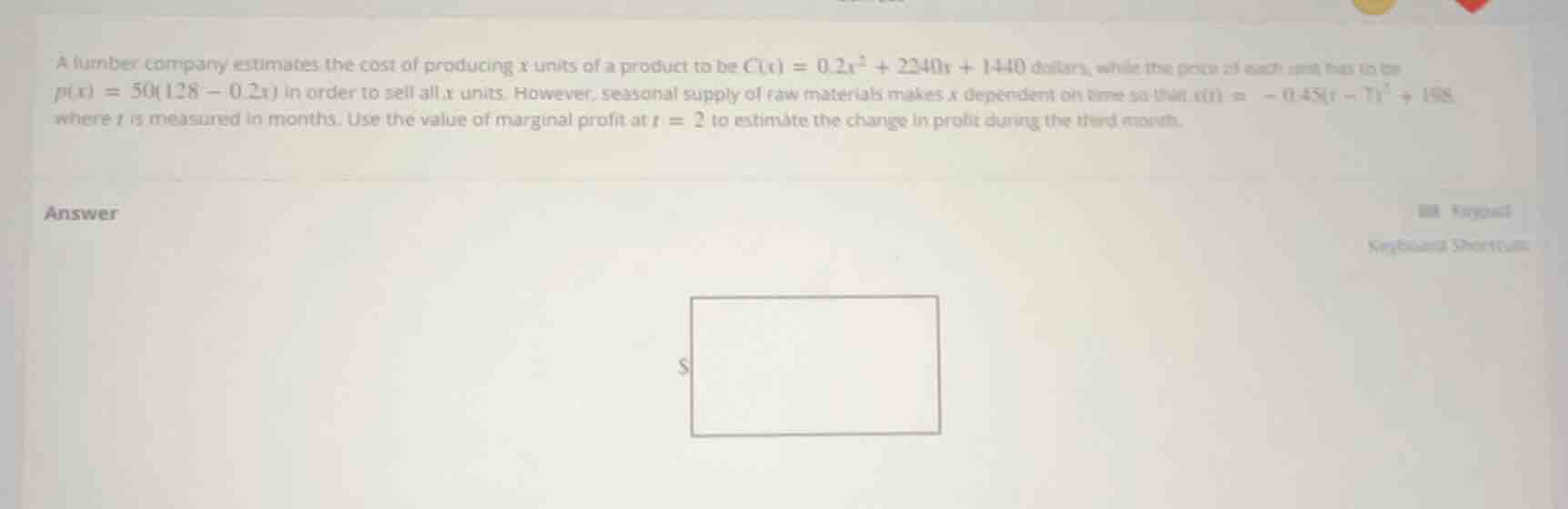
a lumber company estimates the cost of producing $x$ units of a product to be $c(x) = 0.2x^2 + 2240x + 1440$ dollars, while the price of each unit has to be $p(x) = 50(128 - 0.2x)$ in order to sell all $x$ units. however, seasonal supply of raw materials makes $x$ dependent on time so that $x(t) = -0.45(t - 7)^2 + 198$ where $t$ is measured in months. use the value of marginal profit at $t = 2$ to estimate the change in profit during the third month.
Answer
Explanation:
Step1: Define the profit function $P(x)$
Profit is revenue $R(x) = x \cdot p(x)$ minus cost $C(x)$. $$P(x) = x[50(128 - 0.2x)] - (0.2x^2 + 2240x + 1440)$$ $$P(x) = 6400x - 10x^2 - 0.2x^2 - 2240x - 1440$$ $$P(x) = -10.2x^2 + 4160x - 1440$$
Step2: Find marginal profit with respect to $x$
Differentiate $P(x)$ with respect to $x$. $$\frac{dP}{dx} = -20.4x + 4160$$
Step3: Find the derivative of $x$ with respect to $t$
Given $x(t) = -0.45(t - 7)^2 + 198$. $$\frac{dx}{dt} = -0.9(t - 7)$$
Step4: Apply the chain rule for marginal profit
The change in profit over time is $\frac{dP}{dt} = \frac{dP}{dx} \cdot \frac{dx}{dt}$. $$\frac{dP}{dt} = (-20.4x + 4160) \cdot (-0.9(t - 7))$$
Step5: Evaluate $x$ and $\frac{dx}{dt}$ at $t = 2$
$$x(2) = -0.45(2 - 7)^2 + 198 = -0.45(25) + 198 = 186.75$$ $$\frac{dx}{dt}\bigg|_{t=2} = -0.9(2 - 7) = 4.5$$
Step6: Calculate marginal profit at $t = 2$
$$\frac{dP}{dt}\bigg|{t=2} = (-20.4(186.75) + 4160) \cdot 4.5$$ $$\frac{dP}{dt}\bigg|{t=2} = (-3809.7 + 4160) \cdot 4.5 = 350.3 \cdot 4.5 = 1576.35$$
Answer:
$1576.35