make a sign diagram for the derivative of the rational function.\n$f(x)=\frac{18}{x^{2}+4x - 5}$\nfind all…
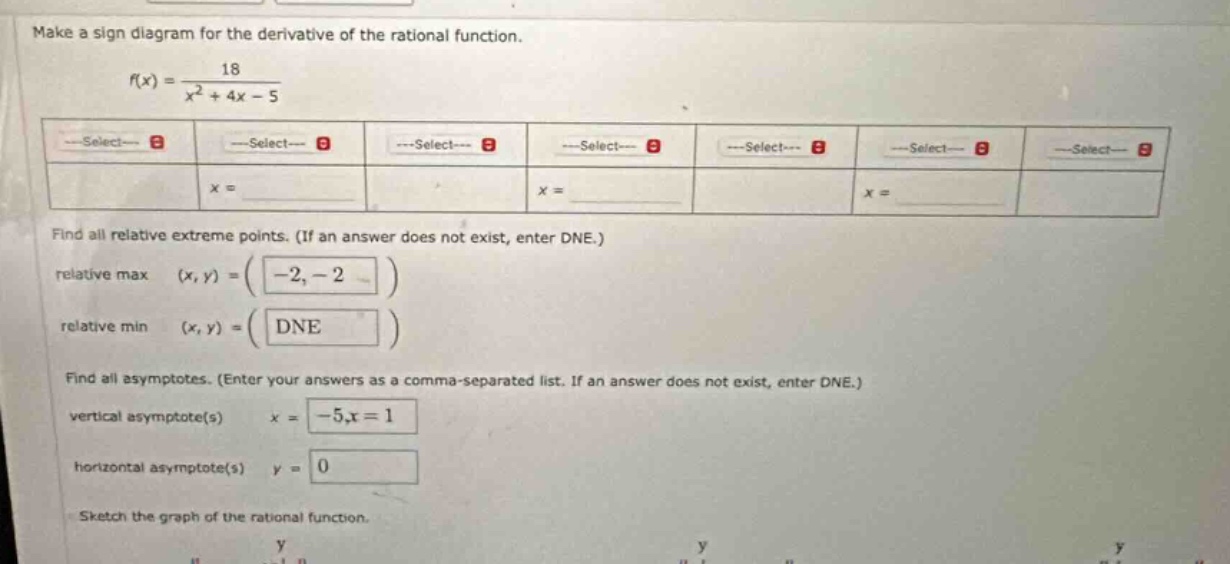
make a sign diagram for the derivative of the rational function.\n$f(x)=\frac{18}{x^{2}+4x - 5}$\nfind all relative extreme points. (if an answer does not exist, enter dne.)\nrelative max $(x,y)=(-2,-2)$\nrelative min $(x,y)=(dne)$\nfind all asymptotes. (enter your answers as a comma - separated list. if an answer does not exist, enter dne.)\nvertical asymptote(s) $x=-5,x = 1$\nhorizontal asymptote(s) $y = 0$\nsketch the graph of the rational function.
Answer
Explanation:
Step1: Rewrite the denominator
First, factor the denominator $x^{2}+4x - 5=(x + 5)(x - 1)$. So, $f(x)=\frac{18}{(x + 5)(x - 1)}$.
Step2: Find the derivative using the quotient - rule
The quotient - rule states that if $y=\frac{u}{v}$, then $y^\prime=\frac{u^\prime v - uv^\prime}{v^{2}}$. Here, $u = 18$, $u^\prime=0$, $v=(x + 5)(x - 1)=x^{2}+4x - 5$, $v^\prime=2x + 4$. Then $f^\prime(x)=\frac{0\times(x^{2}+4x - 5)-18\times(2x + 4)}{(x^{2}+4x - 5)^{2}}=\frac{- 36(x + 2)}{(x + 5)^{2}(x - 1)^{2}}$.
Step3: Find the critical points
Set $f^\prime(x)=0$. Then $-36(x + 2)=0$, which gives $x=-2$. The derivative is undefined at $x=-5$ and $x = 1$ (the vertical asymptotes).
Step4: Create the sign - diagram
Choose test points in the intervals $(-\infty,-5)$, $(-5,-2)$, $(-2,1)$ and $(1,\infty)$.
- For $x=-6$: $f^\prime(-6)=\frac{-36(-6 + 2)}{(-6 + 5)^{2}(-6 - 1)^{2}}=\frac{-36\times(-4)}{(-1)^{2}\times(-7)^{2}}=\frac{144}{49}>0$.
- For $x =-\frac{5}{2}$: $f^\prime(-\frac{5}{2})=\frac{-36(-\frac{5}{2}+2)}{(-\frac{5}{2}+5)^{2}(-\frac{5}{2}-1)^{2}}=\frac{-36\times(-\frac{1}{2})}{(\frac{5}{2})^{2}\times(-\frac{7}{2})^{2}}=\frac{18}{\frac{25}{4}\times\frac{49}{4}}>0$.
- For $x=0$: $f^\prime(0)=\frac{-36(0 + 2)}{(0 + 5)^{2}(0 - 1)^{2}}=\frac{-72}{25}<0$.
- For $x = 2$: $f^\prime(2)=\frac{-36(2[Client Connection Error]