make sure you write dark enough so that the scanner captures your answer. if you do not write dark enough…
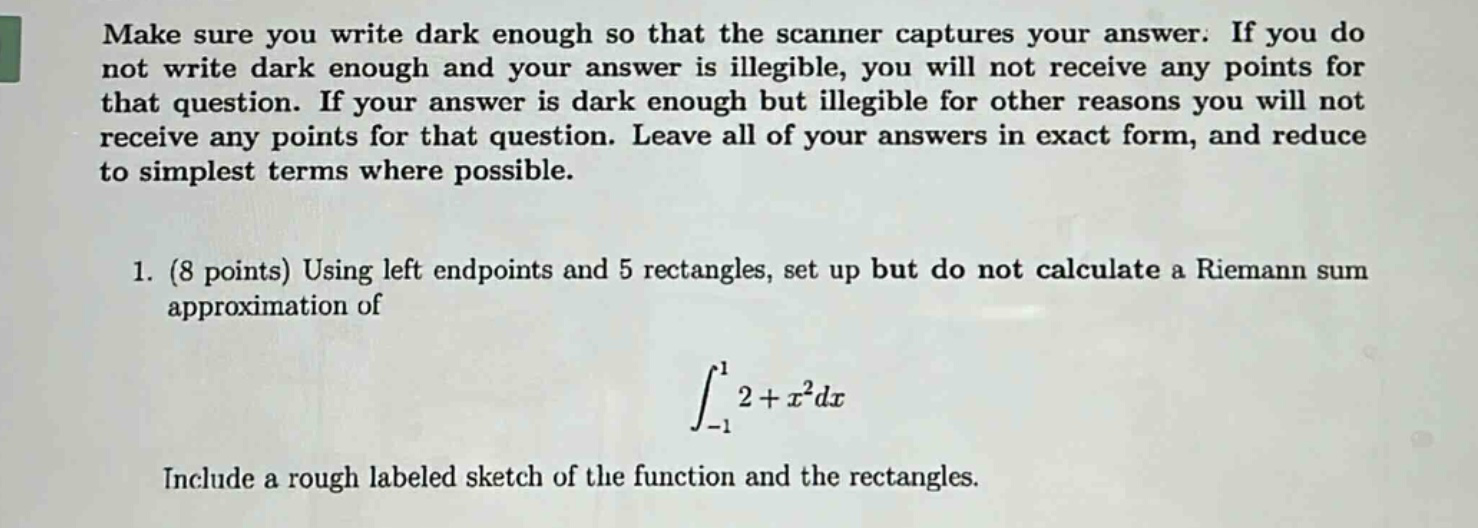
make sure you write dark enough so that the scanner captures your answer. if you do not write dark enough and your answer is illegible, you will not receive any points for that question. if your answer is dark enough but illegible for other reasons you will not receive any points for that question. leave all of your answers in exact form, and reduce to simplest terms where possible. 1. (8 points) using left endpoints and 5 rectangles, set up but do not calculate a riemann sum approximation of ∫-1,1 2 + x²dx include a rough labeled sketch of the function and the rectangles.
Answer
Explanation:
Step1: Find the width of each sub - interval
The interval is $[a,b]=[-1,1]$ and $n = 5$. The width of each sub - interval $\Delta x=\frac{b - a}{n}=\frac{1-(-1)}{5}=\frac{2}{5}$.
Step2: Determine the left - endpoints
The left - endpoints $x_i=a + i\Delta x$ for $i = 0,1,2,3,4$. So $x_0=-1,x_1=-1+\frac{2}{5}=-\frac{3}{5},x_2=-1 + 2\times\frac{2}{5}=-\frac{1}{5},x_3=-1+3\times\frac{2}{5}=\frac{1}{5},x_4=-1 + 4\times\frac{2}{5}=\frac{3}{5}$.
Step3: Set up the Riemann sum
The Riemann sum using left - endpoints $L_n=\sum_{i = 0}^{n - 1}f(x_i)\Delta x$. Here, $f(x)=2 + x^2$ and $n = 5$, so $L_5=\sum_{i = 0}^{4}(2+x_i^2)\Delta x=\frac{2}{5}\left[(2+(-1)^2)+(2+\left(-\frac{3}{5}\right)^2)+(2+\left(-\frac{1}{5}\right)^2)+(2+\left(\frac{1}{5}\right)^2)+(2+\left(\frac{3}{5}\right)^2)\right]$.
Answer:
$L_5=\frac{2}{5}\left[(2 + 1)+(2+\frac{9}{25})+(2+\frac{1}{25})+(2+\frac{1}{25})+(2+\frac{9}{25})\right]$