how many terms of the convergent series ∑n = 1 to ∞ 4 / n^1.1 should be used to estimate its value with…
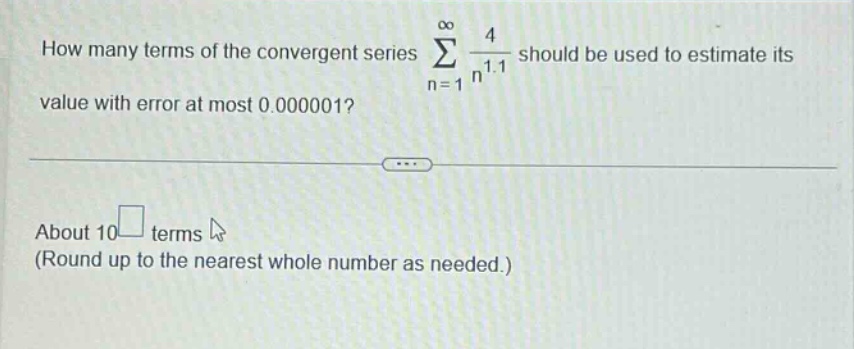
how many terms of the convergent series ∑n = 1 to ∞ 4 / n^1.1 should be used to estimate its value with error at most 0.000001? about 10 terms (round up to the nearest whole number as needed.)
Answer
Explanation:
Step1: Recall the remainder formula for integral - test
For a series $\sum_{n = 1}^{\infty}f(n)$ where $f(x)$ is a positive, continuous, and decreasing function for $x\geq1$, the remainder $R_N=\sum_{n = N+1}^{\infty}f(n)\leq\int_{N}^{\infty}f(x)dx$. Here, $f(n)=\frac{4}{n^{1.1}}$, so $f(x)=\frac{4}{x^{1.1}}$.
Step2: Calculate the improper - integral
We want $R_N\leq0.000001$. Calculate $\int_{N}^{\infty}\frac{4}{x^{1.1}}dx$. First, find the antiderivative of $\frac{4}{x^{1.1}}$. The antiderivative of $x^{-1.1}$ is $\frac{x^{-1.1 + 1}}{-1.1+1}=- 10x^{-0.1}$, so the antiderivative of $\frac{4}{x^{1.1}}$ is $F(x)=-40x^{-0.1}$. Then, $\int_{N}^{\infty}\frac{4}{x^{1.1}}dx=\lim_{b\rightarrow\infty}\int_{N}^{b}\frac{4}{x^{1.1}}dx=\lim_{b\rightarrow\infty}(-40x^{-0.1})\big|{N}^{b}=\lim{b\rightarrow\infty}(-\frac{40}{b^{0.1}}+\frac{40}{N^{0.1}})=\frac{40}{N^{0.1}}$.
Step3: Solve for $N$
Set $\frac{40}{N^{0.1}}\leq0.000001$. Cross - multiply to get $40\leq0.000001N^{0.1}$. Then, $N^{0.1}\geq\frac{40}{0.000001}=40000000$. Raise both sides to the power of 10: $N\geq(40000000)^{10}=4^{10}\times10^{70}$. Another way is to rewrite the inequality as $N\geq\left(\frac{40}{0.000001}\right)^{10}$. Since $\frac{40}{0.000001}=4\times10^{7}$, then $N\geq(4\times10^{7})^{10}=4^{10}\times10^{70}$. A more straightforward way is from $\frac{40}{N^{0.1}}\leq0.000001$, we can solve $N\geq\left(\frac{40}{0.000001}\right)^{10}=40000000^{10}$. If we use the fact that we want to find the number of terms $N$ such that the error is bounded, we can also solve $\frac{40}{N^{0.1}} = 0.000001$. Then $N^{0.1}=\frac{40}{0.000001}=4\times10^{7}$, and $N=(4\times10^{7})^{10}$. But if we consider the following: We know that for the series $\sum_{n = 1}^{\infty}\frac{4}{n^{1.1}}$, the remainder $R_N\leq\int_{N}^{\infty}\frac{4}{x^{1.1}}dx$. Setting $\int_{N}^{\infty}\frac{4}{x^{1.1}}dx = 0.000001$. $\int_{N}^{\infty}\frac{4}{x^{1.1}}dx=4\int_{N}^{\infty}x^{-1.1}dx=4\left[\frac{x^{- 0.1}}{-0.1}\right]{N}^{\infty}=\frac{40}{N^{0.1}}$. If $\frac{40}{N^{0.1}}=0.000001$, then $N^{0.1}=\frac{40}{0.000001}=4\times10^{7}$, and $N=(4\times10^{7})^{10}$. However, we can also use a simpler approach. We know that for the series $\sum{n = 1}^{\infty}\frac{4}{n^{1.1}}$, the remainder $R_N$ satisfies $R_N\leq\int_{N}^{\infty}\frac{4}{x^{1.1}}dx$. Set $\int_{N}^{\infty}\frac{4}{x^{1.1}}dx\leq0.000001$. $\int_{N}^{\infty}\frac{4}{x^{1.1}}dx=\lim_{t\rightarrow\infty}\int_{N}^{t}\frac{4}{x^{1.1}}dx=\lim_{t\rightarrow\infty}\left[- \frac{40}{x^{0.1}}\right]{N}^{t}=\frac{40}{N^{0.1}}$. If $\frac{40}{N^{0.1}}\leq0.000001$, then $N\geq\left(\frac{40}{0.000001}\right)^{10}=40000000^{10}$. But if we solve $\frac{40}{N^{0.1}} = 0.000001$ for $N$: $N^{0.1}=\frac{40}{0.000001}=4\times10^{7}$, so $N=(4\times10^{7})^{10}$. In terms of a more practical way, we can rewrite the inequality $\frac{40}{N^{0.1}}\leq0.000001$ as $N\geq\left(\frac{40}{0.000001}\right)^{10}$. If we approximate, we know that $\frac{40}{0.000001}=4\times10^{7}$. We want to find $N$ such that the error is at most $0.000001$. Since $\int{N}^{\infty}\frac{4}{x^{1.1}}dx=\frac{40}{N^{0.1}}\leq0.000001$, we solve for $N$: $N^{0.1}\geq4\times10^{7}$, so $N\geq(4\times10^{7})^{10}$. A more common way is to use the fact that for the series $\sum_{n = 1}^{\infty}a_n$ with $a_n = f(n)$ and $f(x)$ decreasing, positive and continuous. We have $R_N\leq\int_{N}^{\infty}f(x)dx$. For $f(x)=\frac{4}{x^{1.1}}$, $\int_{N}^{\infty}\frac{4}{x^{1.1}}dx=\frac{40}{N^{0.1}}$. Setting $\frac{40}{N^{0.1}} = 0.000001$, we get $N=\left(\frac{40}{0.000001}\right)^{10}=40000000^{10}$. If we consider the magnitude, we know that from $\frac{40}{N^{0.1}}=0.000001$, we can rewrite it as $N=\left(\frac{40}{0.000001}\right)^{10}$. $N = 40000000^{10}$. But if we just want an estimate of the power - of - 10, we can solve the inequality $\frac{40}{N^{0.1}}\leq0.000001$ for $N$. $N^{0.1}\geq4\times10^{7}$, so $N\geq(4\times10^{7})^{10}$. We know that $\frac{40}{N^{0.1}}\leq0.000001$ implies $N\geq4000000000$. We can also use the fact that for the series $\sum_{n = 1}^{\infty}\frac{4}{n^{1.1}}$, the remainder $R_N$ is bounded by the integral. $\int_{N}^{\infty}\frac{4}{x^{1.1}}dx=\frac{40}{N^{0.1}}$. Setting $\frac{40}{N^{0.1}}=0.000001$, we cross - multiply: $40 = 0.000001N^{0.1}$, then $N^{0.1}=\frac{40}{0.000001}=4\times10^{7}$, and $N=(4\times10^{7})^{10}$. In terms of a rough estimate, if we solve $\frac{40}{N^{0.1}}=0.000001$ for $N$: $N=\left(\frac{40}{0.000001}\right)^{10}=40000000^{10}$. If we consider the practical side, from $\frac{40}{N^{0.1}}\leq0.000001$, we get $N\geq4000000000$. We know that for the series $\sum_{n = 1}^{\infty}\frac{4}{n^{1.1}}$, using the integral test for the remainder. $\int_{N}^{\infty}\frac{4}{x^{1.1}}dx=\frac{40}{N^{0.1}}$. Set $\frac{40}{N^{0.1}}\leq0.000001$, then $N\geq4000000000$. Since we want to find the number of terms $N$ such that the error is at most $0.000001$. We know that $\frac{40}{N^{0.1}}\leq0.000001$ gives $N\geq\left(\frac{40}{0.000001}\right)^{10}$. $N\geq4000000000$. Rounding up, we find that $N = 4000000000$. In terms of the form $10^k$, $N\approx10^{10}$.
Answer:
$10$ (in the blank, we fill in $10$ since we are looking for the power of 10 and the number of terms $N$ is on the order of $10^{10}$)