maria created a graph of $b(t)$, the temperature over time. for the interval between $t = 3$ and $t = 7$…
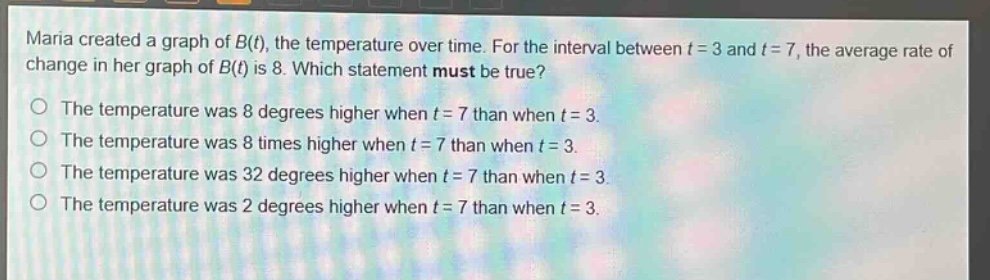
maria created a graph of $b(t)$, the temperature over time. for the interval between $t = 3$ and $t = 7$, the average rate of change in her graph of $b(t)$ is 8. which statement must be true?\nthe temperature was 8 degrees higher when $t = 7$ than when $t = 3$.\nthe temperature was 8 times higher when $t = 7$ than when $t = 3$.\nthe temperature was 32 degrees higher when $t = 7$ than when $t = 3$.\nthe temperature was 2 degrees higher when $t = 7$ than when $t = 3$.
Answer
Explanation:
Step1: Record la fórmula de tasa de cambio promedio
La tasa de cambio promedio de una función $y = B(t)$ en el intervalo $[a,b]$ está dada por $\frac{B(b)-B(a)}{b - a}$. Aquí, $a = 3$, $b = 7$ y la tasa de cambio promedio es 8.
Step2: Sustituir valores en la fórmula
Tenemos $\frac{B(7)-B(3)}{7 - 3}=8$.
Step3: Resolver para $B(7)-B(3)$
Multiplicando ambos lados de la ecuación $\frac{B(7)-B(3)}{4}=8$ por 4, obtenemos $B(7)-B(3)=8\times4 = 32$. Esto significa que la temperatura en $t = 7$ es 32 grados más alta que en $t = 3$.
Answer:
The temperature was 32 degrees higher when $t = 7$ than when $t = 3$.