6 mark for review consider the graph of the polar function r = f(θ), where f(θ) = (3θ² + 50)/(2θ²+5), in the…
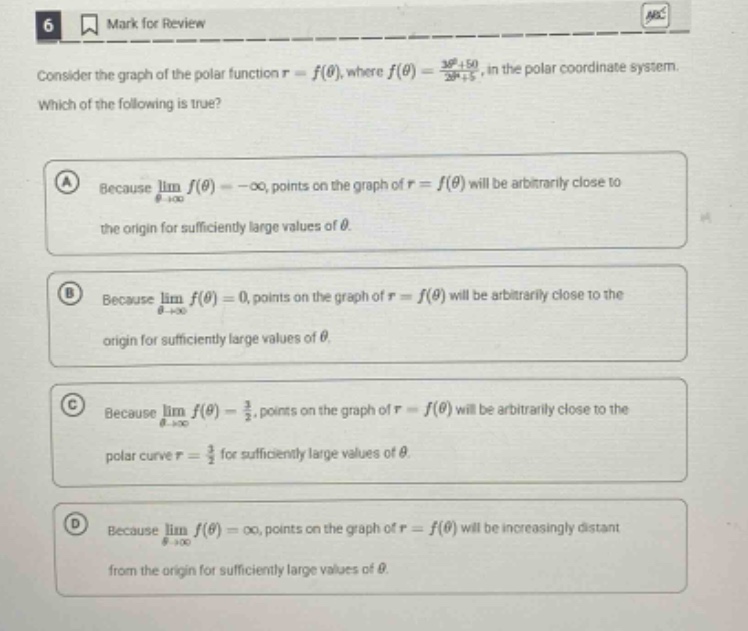
6 mark for review consider the graph of the polar function r = f(θ), where f(θ) = (3θ² + 50)/(2θ²+5), in the polar coordinate system. which of the following is true? a because lim f(θ) = -∞, points on the graph of r = f(θ) will be arbitrarily close to the origin for sufficiently large values of θ. b because lim f(θ) = 0, points on the graph of r = f(θ) will be arbitrarily close to the origin for sufficiently large values of θ. c because lim f(θ) = 3/2, points on the graph of r = f(θ) will be arbitrarily close to the polar curve r = 3/2 for sufficiently large values of θ. d because lim f(θ) = ∞, points on the graph of r = f(θ) will be increasingly distant from the origin for sufficiently large values of θ.
Answer
Explanation:
Step1: Find the limit of (f(\theta)) as (\theta\to+\infty)
We have (f(\theta)=\frac{3\theta^{2}+50}{2\theta^{2}+5}). Divide both the numerator and denominator by (\theta^{2}): (\lim_{\theta\to+\infty}f(\theta)=\lim_{\theta\to+\infty}\frac{3 + \frac{50}{\theta^{2}}}{2+\frac{5}{\theta^{2}}}).
Step2: Evaluate the limit
As (\theta\to+\infty), (\frac{50}{\theta^{2}}\to0) and (\frac{5}{\theta^{2}}\to0). So (\lim_{\theta\to+\infty}\frac{3 + \frac{50}{\theta^{2}}}{2+\frac{5}{\theta^{2}}}=\frac{3 + 0}{2+0}=\frac{3}{2}). In polar - coordinates, when (\lim_{\theta\to+\infty}r = \lim_{\theta\to+\infty}f(\theta)=C) (a non - zero constant), the points on the graph of (r = f(\theta)) will be arbitrarily close to the polar curve (r = C) for sufficiently large values of (\theta).
Answer:
C. Because (\lim_{\theta\to+\infty}f(\theta)=\frac{3}{2}), points on the graph of (r = f(\theta)) will be arbitrarily close to the polar curve (r=\frac{3}{2}) for sufficiently large values of (\theta).