8 mark for review which of the following could describe a single logarithmic function f? a lim f(x)= -∞ and…
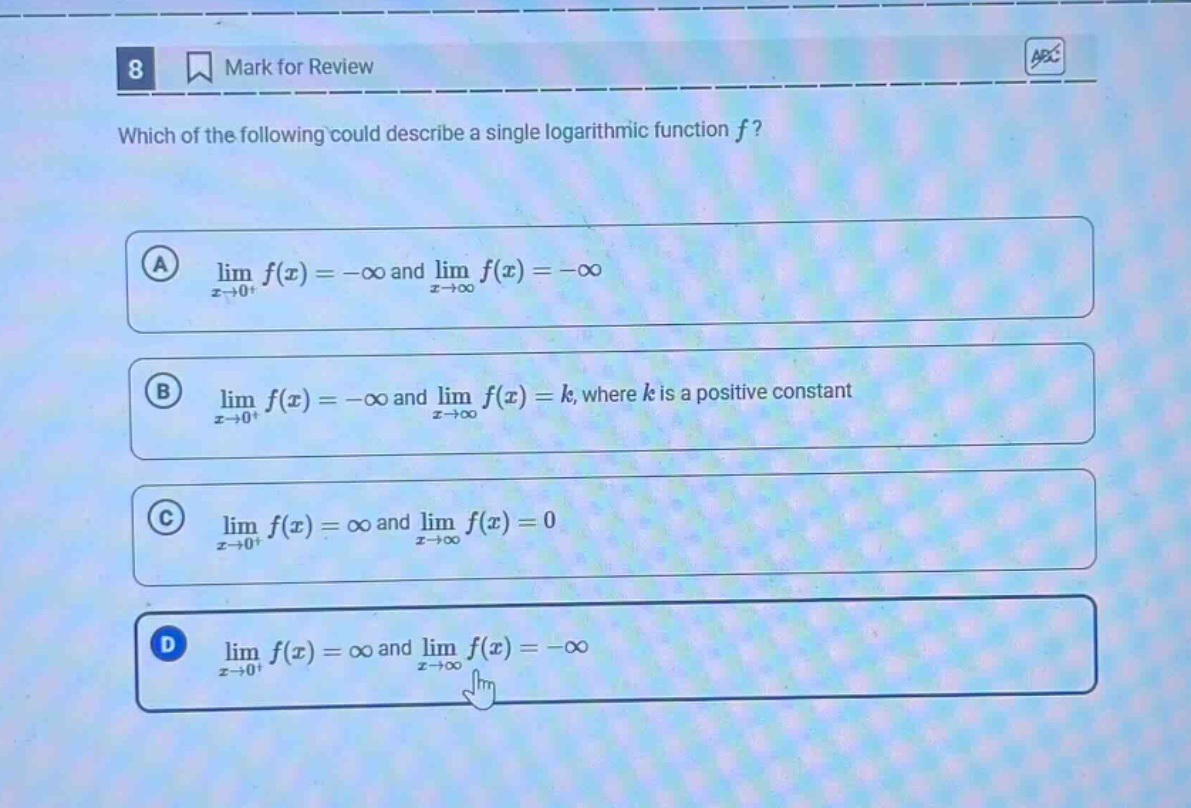
8 mark for review which of the following could describe a single logarithmic function f? a lim f(x)= -∞ and lim f(x)= -∞ x→0+ x→∞ b lim f(x)= -∞ and lim f(x)=k, where k is a positive constant x→0+ x→∞ c lim f(x)=∞ and lim f(x)=0 x→0+ x→∞ d lim f(x)=∞ and lim f(x)= -∞ x→0+ x→∞
Answer
Explanation:
Step1: Recall logarithmic - function properties
The general form of a logarithmic function is (y = \log_a(x)) ((a>0,a\neq1)) or (y=\ln(x)) (natural - log with base (e\approx2.718)). The domain of (y = \log_a(x)) is (x>0). As (x\rightarrow0^{+}), (\log_a(x)\rightarrow-\infty) for (a > 1) and (\log_a(x)\rightarrow\infty) for (0 < a<1). As (x\rightarrow\infty), (\log_a(x)\rightarrow\infty) for (a > 1) and (\log_a(x)\rightarrow-\infty) for (0 < a<1).
Step2: Analyze each option
- Option A: For a single - logarithmic function, it is not possible to have (\lim_{x\rightarrow0^{+}}f(x)=-\infty) and (\lim_{x\rightarrow\infty}f(x)=-\infty).
- Option B: A single - logarithmic function does not have (\lim_{x\rightarrow0^{+}}f(x)=-\infty) and (\lim_{x\rightarrow\infty}f(x)=k) (a positive constant) as its end - behaviors.
- Option C: A single - logarithmic function does not have (\lim_{x\rightarrow0^{+}}f(x)=\infty) and (\lim_{x\rightarrow\infty}f(x)=0) as its end - behaviors.
- Option D: Consider the function (y =-\log_a(x)) with (a>1). As (x\rightarrow0^{+}), (-\log_a(x)\rightarrow\infty), and as (x\rightarrow\infty), (-\log_a(x)\rightarrow-\infty).
Answer:
D. (\lim_{x\rightarrow0^{+}}f(x)=\infty) and (\lim_{x\rightarrow\infty}f(x)=-\infty)