mark for review \n3 \nwhich of the following is a left riemann sum approximation of (int_{2}^{6}cos(x^{2})dx)…
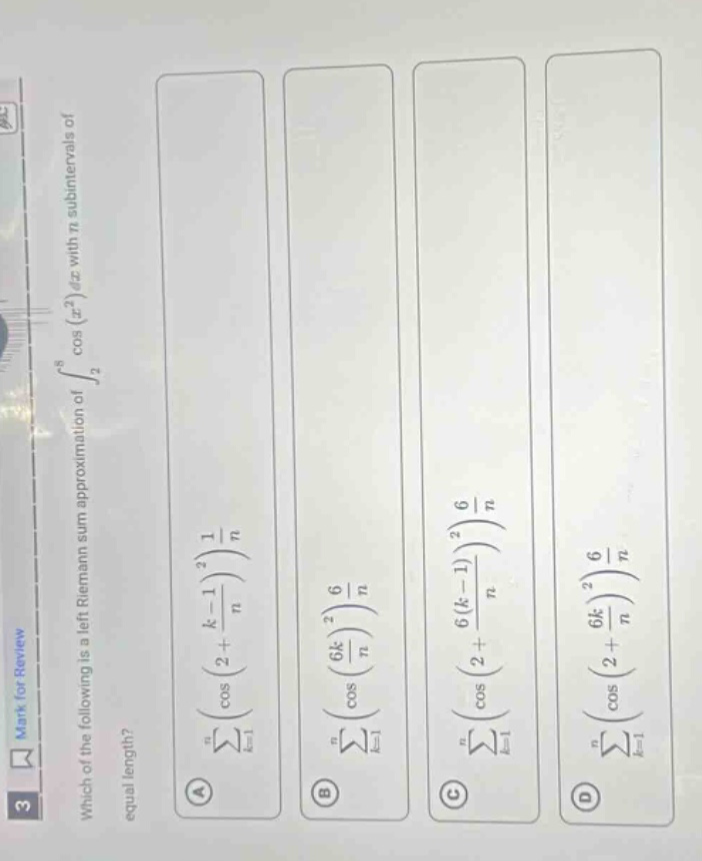
mark for review \n3 \nwhich of the following is a left riemann sum approximation of (int_{2}^{6}cos(x^{2})dx) with (n) equal - length subintervals? \na (sum_{k = 1}^{n}cos((2+\frac{k - 1}{n})^{2})\frac{1}{n}) \nb (sum_{k = 1}^{n}cos((\frac{6k}{n})^{2})\frac{6}{n}) \nc (sum_{k = 1}^{n}cos((2+\frac{6(k - 1)}{n})^{2})\frac{6}{n}) \nd (sum_{k = 1}^{n}cos((2+\frac{6k}{n})^{2})\frac{6}{n})
Answer
Explanation:
Step1: Recall left - Riemann sum formula
The left - Riemann sum for $\int_{a}^{b}f(x)dx$ with $n$ sub - intervals of equal length $\Delta x=\frac{b - a}{n}$ is given by $L_n=\sum_{k = 0}^{n-1}f(x_k)\Delta x$, where $x_k=a + k\Delta x$.
For the integral $\int_{2}^{6}\cos(x^{2})dx$, we have $a = 2$, $b = 6$, and $\Delta x=\frac{6 - 2}{n}=\frac{4}{n}$. And $x_k=2 + k\Delta x=2+\frac{4k}{n}$ for $k = 0,1,\cdots,n - 1$.
Step2: Analyze the given options
We know that the left - Riemann sum is $\sum_{k = 0}^{n-1}\cos((2+\frac{4k}{n})^{2})\frac{4}{n}$. But if we start the index from $k = 1$ instead of $k = 0$, we can rewrite it in terms of the general form.
The left - Riemann sum for $\int_{2}^{6}\cos(x^{2})dx$ with $n$ sub - intervals of equal length $\Delta x=\frac{6 - 2}{n}=\frac{4}{n}$ and $x_k=2+(k - 1)\frac{4}{n}$ (starting index $k = 1$) is $\sum_{k = 1}^{n}\cos((2+(k - 1)\frac{4}{n})^{2})\frac{4}{n}$.
Let's check each option:
- Option A: The form of the sum and the function inside the cosine and the multiplier do not match the left - Riemann sum formula for our integral.
- Option B: The form of the sum and the function inside the cosine and the multiplier do not match the left - Riemann sum formula for our integral.
- Option C: The form of the sum and the function inside the cosine and the multiplier do not match the left - Riemann sum formula for our integral.
- Option D: We have $\Delta x=\frac{6 - 2}{n}=\frac{4}{n}$, and $x_k=2+\frac{4k}{n}$. The left - Riemann sum $\sum_{k = 1}^{n}\cos((2+\frac{4k}{n})^{2})\frac{4}{n}$ is equivalent to the form in Option D when we consider the general structure of the left - Riemann sum for the given integral.
Answer:
D