match the conditions f (x)>0 and f (x)>0 on (a,b) with one of the graphs (a) - (d). (a) (b) (c) (d) graph c…
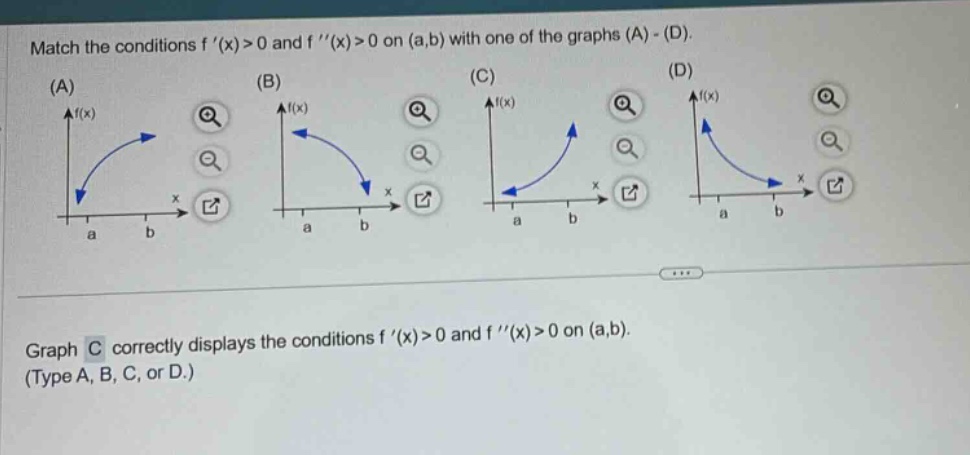
match the conditions f (x)>0 and f (x)>0 on (a,b) with one of the graphs (a) - (d). (a) (b) (c) (d) graph c correctly displays the conditions f (x)>0 and f (x)>0 on (a,b). (type a, b, c, or d.)
Answer
Explanation:
Step1: Analyze $f'(x)>0$
A positive first - derivative means the function is increasing. Graphs (A) and (C) are increasing on the interval $(a,b)$ since as $x$ increases from $a$ to $b$, the $y$ - values of the function are getting larger.
Step2: Analyze $f''(x)>0$
A positive second - derivative means the function is concave up. A concave - up function has a graph that curves upward like a cup. Among the increasing graphs (A) and (C), graph (C) is concave up while graph (A) is concave down.
Answer:
C