match each exponential function to its graph.\n$h(x) = 1.5^x$\n$q(x) = 2.5^x$\n$m(x) = 3.5^x$\n$j(x) = 4.5^x$
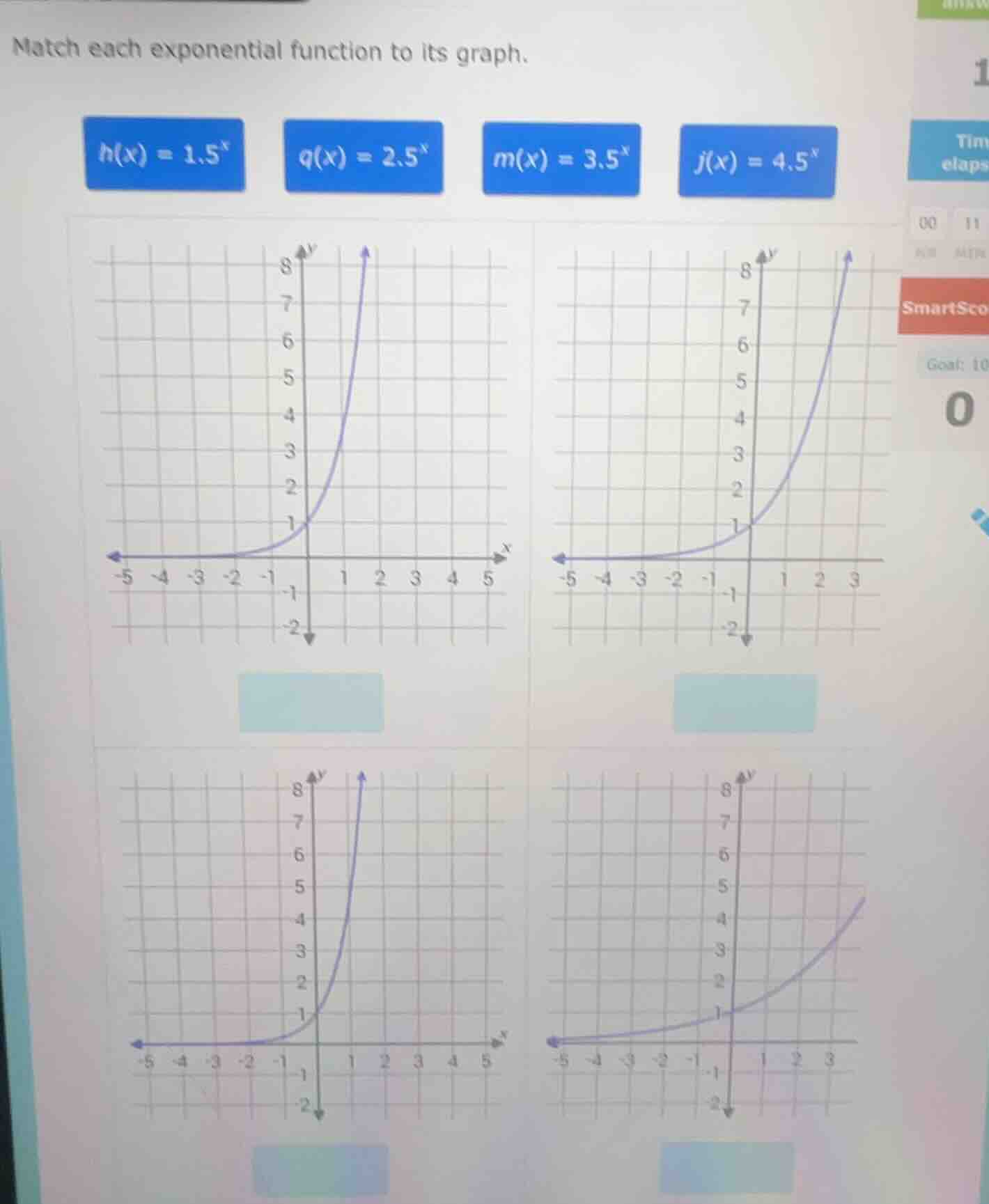
match each exponential function to its graph.\n$h(x) = 1.5^x$\n$q(x) = 2.5^x$\n$m(x) = 3.5^x$\n$j(x) = 4.5^x$
Answer
Explanation:
Step1: Analyze the base of exponential functions
All functions are of the form ( y = a^x ) where ( a>1 ), so they are increasing exponential functions. The larger the base ( a ), the steeper the graph (faster growth).
Step2: Compare the bases
The bases are ( 1.5, 2.5, 3.5, 4.5 ). So the order of steepness from least to most is ( h(x)=1.5^x ) (least steep), ( q(x)=2.5^x ), ( m(x)=3.5^x ), ( j(x)=4.5^x ) (most steep).
Step3: Match to graphs
- The least steep graph (slowest growth) corresponds to ( h(x) = 1.5^x ) (bottom - right graph, since it rises the slowest).
- The next is ( q(x)=2.5^x ) (top - right graph, steeper than ( h(x) ) but less than the others).
- Then ( m(x)=3.5^x ) (bottom - left graph, steeper than ( q(x) )).
- The most steep graph (fastest growth) corresponds to ( j(x)=4.5^x ) (top - left graph, rises the fastest).
Answer:
- Top - left graph: ( j(x)=4.5^x )
- Top - right graph: ( q(x)=2.5^x )
- Bottom - left graph: ( m(x)=3.5^x )
- Bottom - right graph: ( h(x)=1.5^x )