match the functions and their derivatives: 1. y = cos(tan(x)) 2. y = cos³(x) 3. y = sin(x)tan(x) 4. y =…
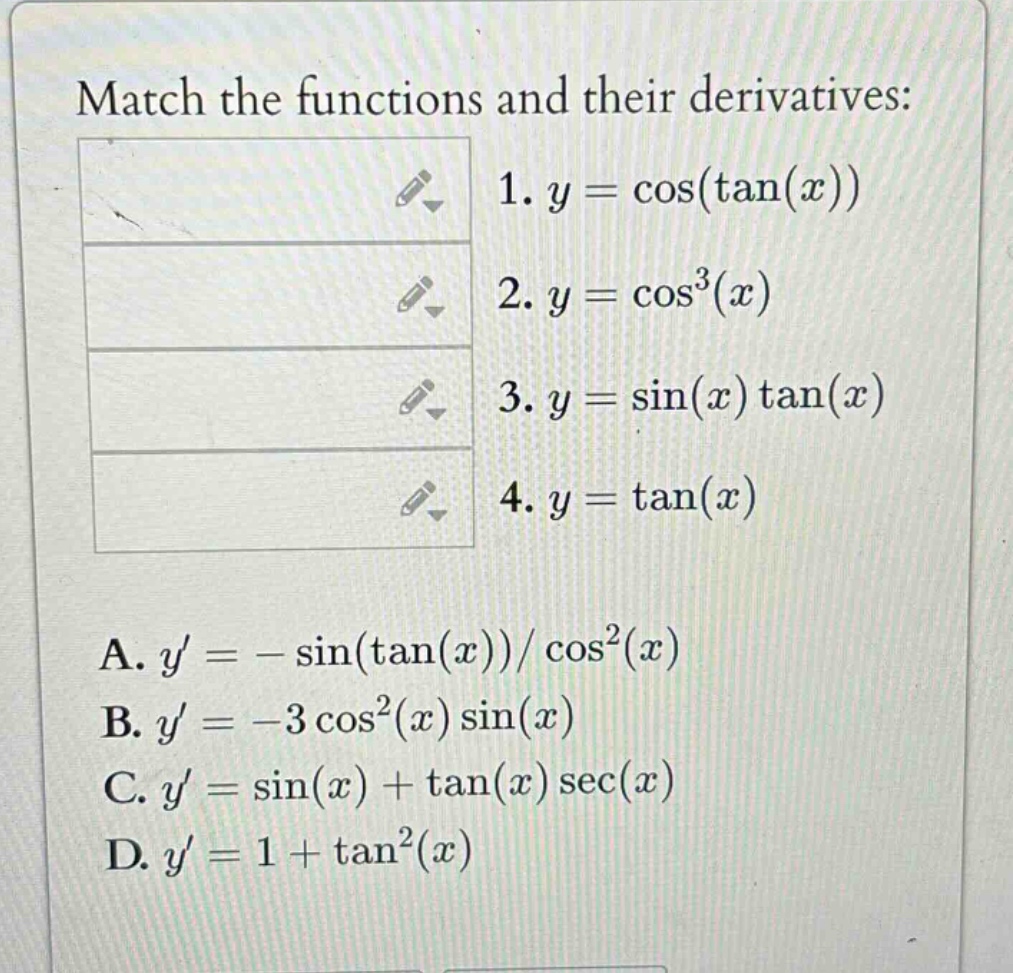
match the functions and their derivatives: 1. y = cos(tan(x)) 2. y = cos³(x) 3. y = sin(x)tan(x) 4. y = tan(x) a. y = -sin(tan(x))/cos²(x) b. y = -3cos²(x)sin(x) c. y = sin(x) + tan(x)sec(x) d. y = 1 + tan²(x)
Answer
Explanation:
Step1: Differentiate $y = \cos(\tan(x))$
Use the chain - rule. Let $u=\tan(x)$, then $y = \cos(u)$. The derivative of $y$ with respect to $u$ is $y'_u=-\sin(u)$ and the derivative of $u$ with respect to $x$ is $u'_x=\sec^{2}(x)=\frac{1}{\cos^{2}(x)}$. By the chain - rule $\frac{dy}{dx}=\frac{dy}{du}\cdot\frac{du}{dx}=-\sin(\tan(x))\cdot\frac{1}{\cos^{2}(x)}$, so $y = \cos(\tan(x))$ matches with A.
Step2: Differentiate $y=\cos^{3}(x)$
Let $u = \cos(x)$, then $y = u^{3}$. The derivative of $y$ with respect to $u$ is $y'_u = 3u^{2}$ and the derivative of $u$ with respect to $x$ is $u'_x=-\sin(x)$. By the chain - rule $\frac{dy}{dx}=\frac{dy}{du}\cdot\frac{du}{dx}=3\cos^{2}(x)\cdot(-\sin(x))=- 3\cos^{2}(x)\sin(x)$, so $y=\cos^{3}(x)$ matches with B.
Step3: Differentiate $y=\sin(x)\tan(x)$
Use the product - rule $(uv)'=u'v + uv'$, where $u=\sin(x)$ and $v = \tan(x)$. The derivative of $u$ is $u'=\cos(x)$ and the derivative of $v$ is $v'=\sec^{2}(x)$. Then $y'=\cos(x)\tan(x)+\sin(x)\sec^{2}(x)=\sin(x)+\tan(x)\sec(x)$ (since $\cos(x)\tan(x)=\sin(x)$), so $y=\sin(x)\tan(x)$ matches with C.
Step4: Differentiate $y = \tan(x)$
The derivative of $\tan(x)$ is $\sec^{2}(x)=1 + \tan^{2}(x)$, so $y=\tan(x)$ matches with D.
Answer:
- A. $y'=-\sin(\tan(x))/\cos^{2}(x)$
- B. $y'=-3\cos^{2}(x)\sin(x)$
- C. $y'=\sin(x)+\tan(x)\sec(x)$
- D. $y'=1+\tan^{2}(x)$