match each graph with its equation. use the mouse to rotate each graph.\nθ = tan(0.1)\nθ = tan(3.5)\nρ =…
match each graph with its equation. use the mouse to rotate each graph.\nθ = tan(0.1)\nθ = tan(3.5)\nρ = 2·2.75 sin(ϕ) cos(θ)\nϕ = arctan(1.3)\n a.\n b.\n c.\n d.
Answer
Explanation:
Step1: Analyze spherical - coordinate equations
In spherical coordinates, $\rho$ represents the distance from the origin, $\theta$ is the azimuthal angle in the $xy$ - plane, and $\phi$ is the polar angle from the positive $z$ - axis.
Step2: Analyze $\rho = 2\cdot2.75\sin(\phi)\cos(\theta)$
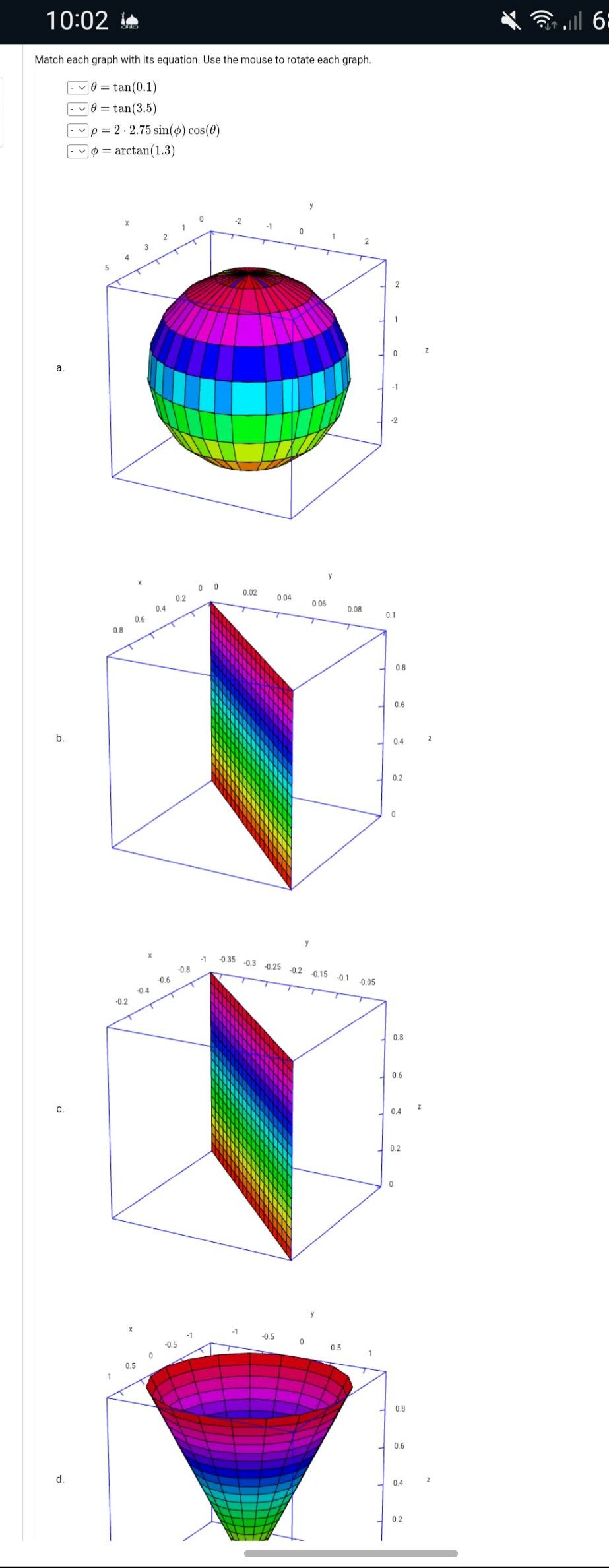
We know that in spherical - to - Cartesian conversion, $x = \rho\sin(\phi)\cos(\theta)$, $y=\rho\sin(\phi)\sin(\theta)$, $z = \rho\cos(\phi)$. If $\rho = 2\cdot2.75\sin(\phi)\cos(\theta)$, then $x=\rho\sin(\phi)\cos(\theta)$ and $\rho = 2\cdot2.75\frac{x}{\rho}$, or $\rho^{2}=5.5x$. In Cartesian coordinates, $x^{2}+y^{2}+z^{2}=5.5x$, which represents a sphere. So, $\rho = 2\cdot2.75\sin(\phi)\cos(\theta)$ matches graph a.
Step3: Analyze $\theta=\tan(0.1)$
The equation $\theta = c$ (where $c$ is a constant) represents a half - plane passing through the $z$ - axis. Since $\theta$ is the azimuthal angle in the $xy$ - plane, $\theta=\tan(0.1)$ is a half - plane. It matches graph b.
Step4: Analyze $\theta=\tan(3.5)$
Similarly, $\theta=\tan(3.5)$ is also a half - plane equation in spherical coordinates. It matches graph c.
Step5: Analyze $\phi=\arctan(1.3)$
The equation $\phi = c$ (where $c$ is a constant) represents a cone. Since $\phi$ is the polar angle from the positive $z$ - axis, $\phi=\arctan(1.3)$ represents a cone. It matches graph d.
Answer:
a. $\rho = 2\cdot2.75\sin(\phi)\cos(\theta)$ b. $\theta=\tan(0.1)$ c. $\theta=\tan(3.5)$ d. $\phi=\arctan(1.3)$