math 121 exam 3 name show all steps to receive full credit. circle your final answers and use correct…
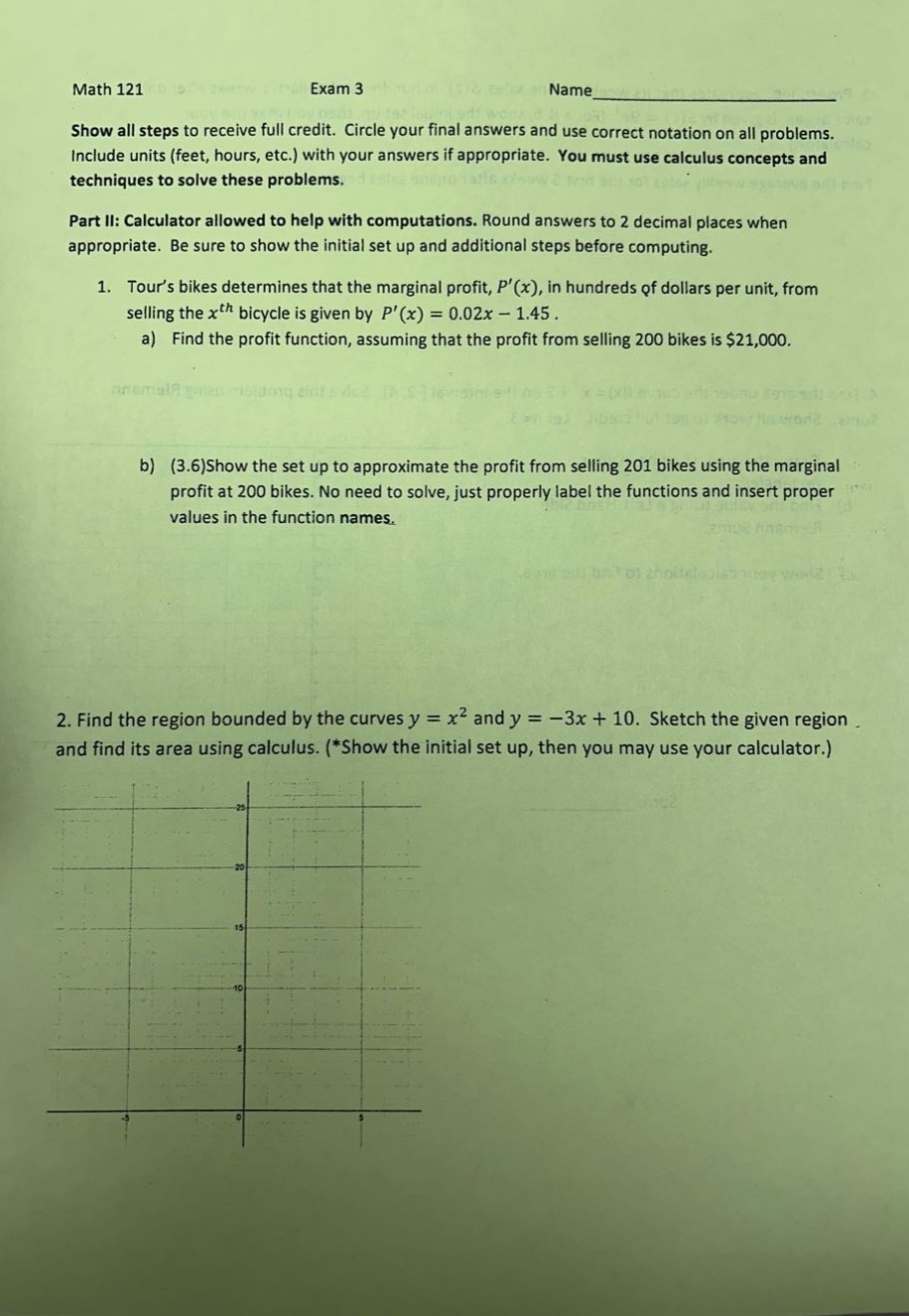
math 121 exam 3 name show all steps to receive full credit. circle your final answers and use correct notation on all problems. include units (feet, hours, etc.) with your answers if appropriate. you must use calculus concepts and techniques to solve these problems. part ii: calculator allowed to help with computations. round answers to 2 decimal places when appropriate. be sure to show the initial set up and additional steps before computing. 1. tours bikes determines that the marginal profit, p(x), in hundreds of dollars per unit, from selling the x^th bicycle is given by p(x)=0.02x - 1.45. a) find the profit function, assuming that the profit from selling 200 bikes is $21,000. b) (3.6)show the set up to approximate the profit from selling 201 bikes using the marginal profit at 200 bikes. no need to solve, just properly label the functions and insert proper values in the function names. 2. find the region bounded by the curves y = x^2 and y=-3x + 10. sketch the given region and find its area using calculus. (*show the initial set up, then you may use your calculator.)
Answer
1. a)
Explanation:
Step1: Integrate marginal - profit function
The marginal - profit function is $P^{\prime}(x)=0.02x - 1.45$. Integrating with respect to $x$ using the power - rule $\int x^n dx=\frac{x^{n + 1}}{n+1}+C$ ($n\neq - 1$), we get $P(x)=\int(0.02x - 1.45)dx=0.02\times\frac{x^{2}}{2}-1.45x + C=0.01x^{2}-1.45x + C$.
Step2: Find the value of $C$
We know that when $x = 200$, $P(200)=210$ (since $P(x)$ is in hundreds of dollars and $21000\div100 = 210$). Substitute $x = 200$ into $P(x)$: [ \begin{align*} P(200)&=0.01\times(200)^{2}-1.45\times200 + C\ 210&=0.01\times40000-290 + C\ 210&=400-290 + C\ 210&=110 + C\ C&=100 \end{align*} ] So the profit function is $P(x)=0.01x^{2}-1.45x + 100$.
Answer:
$P(x)=0.01x^{2}-1.45x + 100$
1. b)
Explanation:
The approximation of the change in profit $\Delta P$ using the marginal - profit function is given by $\Delta P\approx P^{\prime}(a)\Delta x$. Here, $a = 200$ and $\Delta x=201 - 200 = 1$. The profit from selling 201 bikes, $P(201)$ can be approximated as $P(201)\approx P(200)+P^{\prime}(200)\times(201 - 200)$. We know $P(200) = 210$ (in hundreds of dollars), and $P^{\prime}(x)=0.02x - 1.45$, so $P^{\prime}(200)=0.02\times200-1.45=4 - 1.45 = 2.55$. The setup is $P(201)\approx210+2.55\times1$.
Answer:
$P(201)\approx210 + 2.55\times1$
2.
Explanation:
Step1: Find the intersection points of the curves
Set $x^{2}=-3x + 10$. Rearrange to get $x^{2}+3x - 10=0$. Factor the quadratic equation: $(x + 5)(x - 2)=0$. So $x=-5$ or $x = 2$.
Step2: Determine which function is on top
For $-5\lt x\lt2$, we can test a value, say $x = 0$. When $x = 0$, $y=x^{2}=0$ and $y=-3x + 10 = 10$. So $y=-3x + 10$ is above $y=x^{2}$ on the interval $[-5,2]$.
Step3: Set up the integral for the area
The area $A$ between two curves $y = f(x)$ and $y = g(x)$ where $f(x)\geq g(x)$ on $[a,b]$ is given by $A=\int_{a}^{b}(f(x)-g(x))dx$. Here, $a=-5$, $b = 2$, $f(x)=-3x + 10$, and $g(x)=x^{2}$. So $A=\int_{-5}^{2}((-3x + 10)-x^{2})dx=\int_{-5}^{2}(-x^{2}-3x + 10)dx$. Using the power - rule for integration $\int x^n dx=\frac{x^{n+1}}{n + 1}+C$ ($n\neq - 1$), we have: [ \begin{align*} \int_{-5}^{2}(-x^{2}-3x + 10)dx&=-\frac{x^{3}}{3}-\frac{3x^{2}}{2}+10x\big|_{-5}^{2}\ &=\left(-\frac{2^{3}}{3}-\frac{3\times2^{2}}{2}+10\times2\right)-\left(-\frac{(-5)^{3}}{3}-\frac{3\times(-5)^{2}}{2}+10\times(-5)\right) \end{align*} ]
Answer:
$A=\int_{-5}^{2}(-x^{2}-3x + 10)dx$