math 1a\nmidterm 1 (practice 1), page 6 of 6\n5. (a) (15 points) using the direct definition of the…
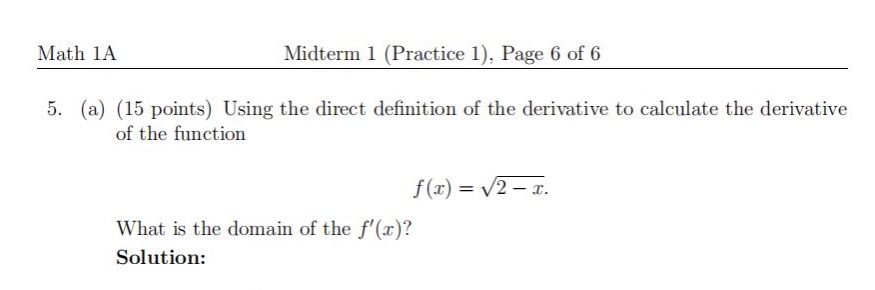
math 1a\nmidterm 1 (practice 1), page 6 of 6\n5. (a) (15 points) using the direct definition of the derivative to calculate the derivative of the function\n$f(x)=\\sqrt{2 - x}$.\nwhat is the domain of the $f(x)$?\nsolution:
Answer
Explanation:
Step1: Recall the direct - definition of the derivative
The direct - definition of the derivative is $f^{\prime}(x)=\lim_{h\rightarrow0}\frac{f(x + h)-f(x)}{h}$. Given $f(x)=\sqrt{2 - x}$, then $f(x + h)=\sqrt{2-(x + h)}$. So, $f^{\prime}(x)=\lim_{h\rightarrow0}\frac{\sqrt{2-(x + h)}-\sqrt{2 - x}}{h}$.
Step2: Rationalize the numerator
Multiply the numerator and denominator by the conjugate of the numerator $\sqrt{2-(x + h)}+\sqrt{2 - x}$. We get $f^{\prime}(x)=\lim_{h\rightarrow0}\frac{(\sqrt{2-(x + h)}-\sqrt{2 - x})(\sqrt{2-(x + h)}+\sqrt{2 - x})}{h(\sqrt{2-(x + h)}+\sqrt{2 - x})}$. Using the difference - of - squares formula $(a - b)(a + b)=a^{2}-b^{2}$, the numerator becomes $(2-(x + h))-(2 - x)=2 - x - h-2 + x=-h$. So, $f^{\prime}(x)=\lim_{h\rightarrow0}\frac{-h}{h(\sqrt{2-(x + h)}+\sqrt{2 - x})}=\lim_{h\rightarrow0}\frac{-1}{\sqrt{2-(x + h)}+\sqrt{2 - x}}$.
Step3: Evaluate the limit
As $h\rightarrow0$, we have $f^{\prime}(x)=\frac{-1}{2\sqrt{2 - x}}$.
Step4: Find the domain of $f^{\prime}(x)$
For the function $y = f^{\prime}(x)=\frac{-1}{2\sqrt{2 - x}}$, the expression under the square - root must be positive (since we have a non - zero denominator in a fraction with a square - root in the denominator). So, $2 - x>0$, which gives $x<2$.
Answer:
The derivative $f^{\prime}(x)=\frac{-1}{2\sqrt{2 - x}}$ and the domain of $f^{\prime}(x)$ is $(-\infty,2)$.